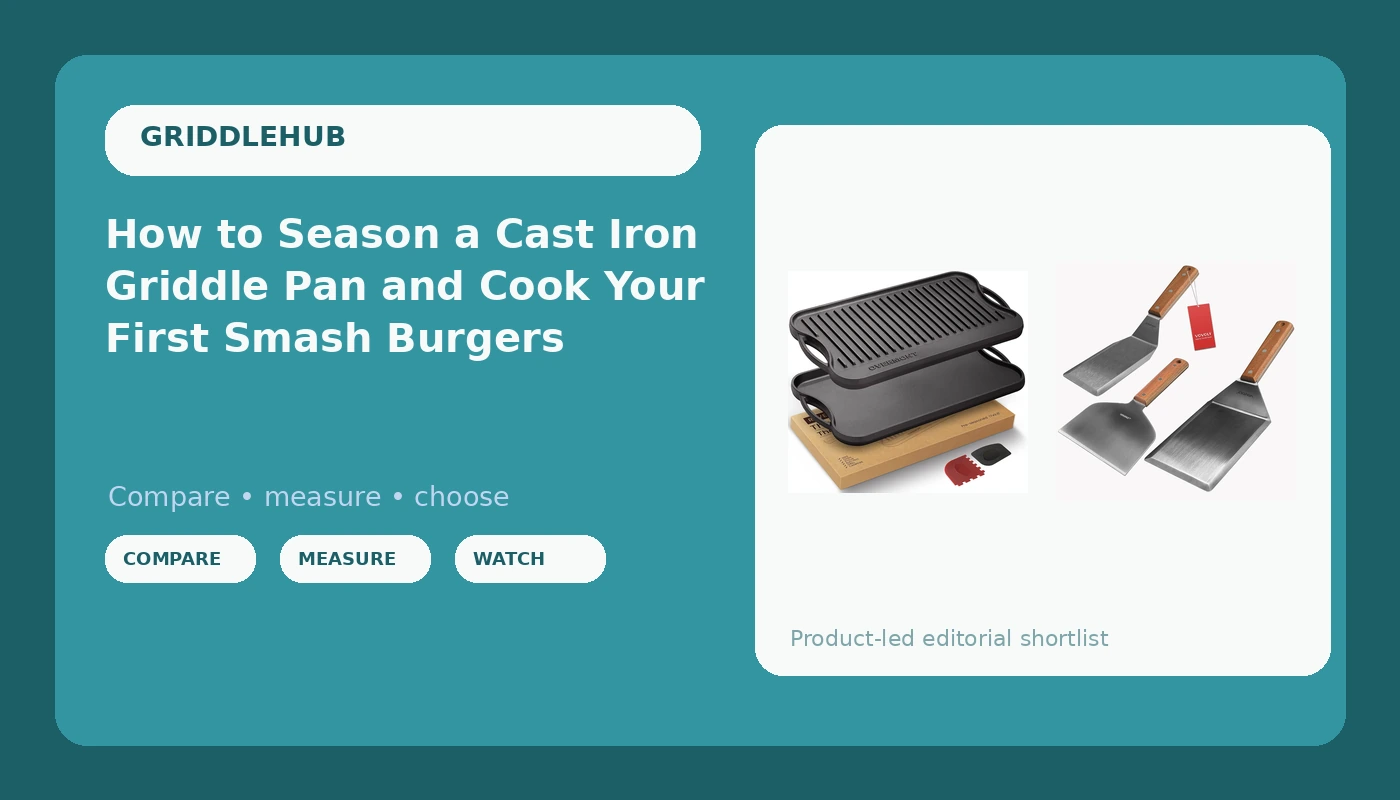
A cast iron griddle pan is the cheapest honest way to find out whether you actually want a flat top in your life. I spent 13 years as a line cook, eight of them on a four-foot commercial griddle at a diner that pushed 400 breakfasts before 11 a.m., and the advice I give anyone who asks about getting into griddle cooking is always the same: don't buy a 36-inch rig to find out. Buy a cast iron griddle pan, season it properly, and cook on it for a month.
The technique transfers. The wrist motion transfers. The scraper habit transfers. What doesn't transfer is the grease trap, the independent burner zones, and the acreage, and none of that matters on a Tuesday night when you're cooking two burgers and four eggs.
This is the walkthrough I wish somebody had handed me: how to season a cast iron griddle pan from bare metal to a working surface, what to cook first, and the two tools that make the whole thing feel like a station instead of a camping trip.
Why you should trust me
I'm Chef Dom. I run a food trailer in Phoenix, and I keep a 22-inch flat top in the backyard that gets used three or more times a week. I have cooked everything on a flat top from smash burgers for a crowd of thirty to hibachi for a birthday party, and I test surfaces the way a short-order cook does: a hundred smash burgers, a full breakfast service, and a seasoning test that runs 60 days to see how long a surface holds before it starts giving up.
Two things I won't do. I won't tell you any surface won't rust, because everything rusts if you neglect it. And I won't quote you a temperature off the top of my head, because a surface temp without a thermometer is a guess, and guesses are how you get grey burgers.
What I will tell you is that the two pieces below are the cheapest way I know to build real flat top skills at home.
How I picked and how I tested
For a beginner setup, only two things matter: the surface and the tool you move food with. Everything else is accessories.
I looked for a surface that holds heat instead of dumping it the second cold food lands on it, one that gives you both a flat side and a ribbed side, because the flat side teaches actual flat top technique and the ribbed side keeps the thing useful when you want marks on a chicken thigh. I looked for a tool with a full tang, a blade stiff enough to press and lift a smash burger without folding, and a beveled edge that slides under a set crust instead of tearing it.
Then I ran both through the routine I run on any new surface: pancakes first to build the seasoning, then eggs, then a hundred smash burgers, then the neglect test. That last one is the part nobody wants to hear about. Leave a piece of iron damp overnight and you find out exactly how honest the seasoning layer is.
The rule I cook by: thin coats, real heat, patience. A griddle that rusts is a griddle that was neglected, not a griddle that was bad.
The two pieces you actually need
Skip the kits. A griddle kit is a bag of plastic scrapers and a squeeze bottle you'll replace inside a month. You need a surface and a tool. That's the list.
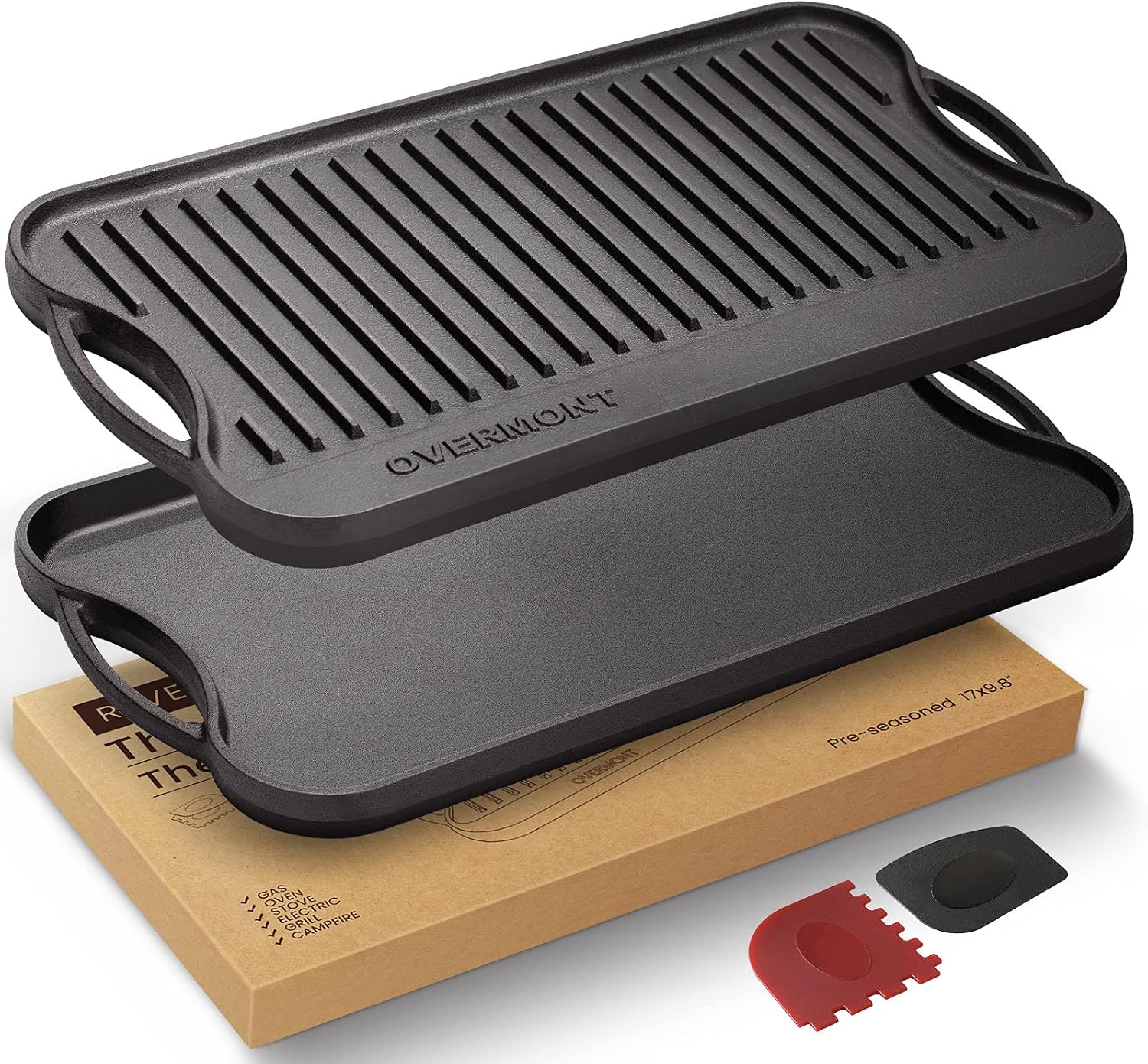
The surface: Overmont Reversible Cast Iron Grill - 17" x 9.8" Dual-Sided Griddle Pan
 Visit on Amazon →
This is a slab of cast iron with a flat side and a ribbed side, and it is the closest thing you can put on a home range to a real flat top. Cast iron holds heat the way the steel on a commercial griddle does: slowly, and then it holds. The flip side is that it gives heat back slowly too, so you manage the cook by preheating longer and moving food around the surface, not by twisting a knob.
Use the flat side for smash burgers, eggs, pancakes, fried rice, cheesesteaks. Use the ribbed side for chicken thighs, sausage, and anything you want marked. It works on a gas range, over a campfire grate, on a grill's side burner, or on the flat top itself when you want a second surface.
Two things to know before you buy. It's heavy, and the handle gets hot, so keep a towel or a glove within reach. And it is not nonstick out of the box. Cast iron is only as nonstick as the layer you build on it, which is the next section of this article.
Flaws but not dealbreakers: You get one heat zone, not four. Cast iron is slow to respond, so if you're used to sliding a burger from a hot zone to a cooler one, you'll be moving the pan instead, or sliding food toward the edge. That's a technique adjustment, not a defect.
Anyone cooking for one to four people on a home range, a grill, or a camp setup will get more flat top practice out of this than out of anything else in its class. Check current Amazon price.
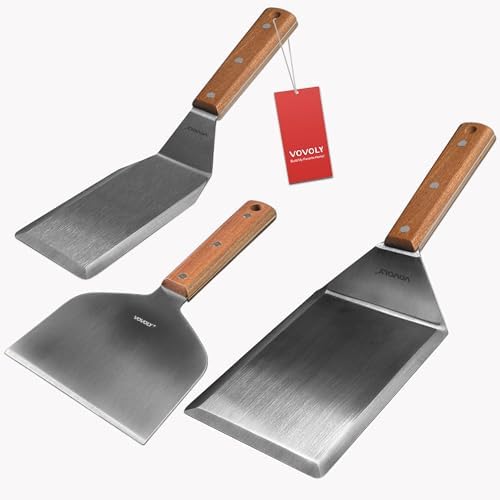
The tool: Stainless Steel Metal Spatula Set For Griddle, Grill Spatula Scraper for BBQ/Flat Top Grill- Full Tang Handle -Thicked Blade- Beveled Edges, Great Griddle Accessories for Pancake/Smash Burgers
 Visit on Amazon →
The spatula is not an accessory. On a flat top it is the tool, the way a chef's knife is the tool on a cutting board. Two things matter: stiffness and edge geometry. A stiff blade on a full tang lets you press a ball of beef flat and hold it there without the blade flexing up at the corners. A beveled edge slides under a crust that has already set, which is exactly what you need when a smash burger has welded itself to the surface in the first thirty seconds.
A set also gets you a scraper, and the scraper is the most important piece of griddle maintenance you own. You clean a hot surface while it's still hot, not later with a sponge and dish soap. Water, scraper, wipe, thin oil. That's the whole routine, and it takes ninety seconds.
Flaws but not dealbreakers: Stainless steel water spots if you leave it wet, so dry it. And the edge is sharp enough that you shouldn't scrape hard on a brand new seasoning layer, because you can take the layer right back off. Light pressure, hot surface, let the scraper do the work.
Anyone who has ever torn a burger in half trying to flip it with a thin flexible spatula needs this set. Check current Amazon price.
How to season a cast iron griddle pan, step by step
Seasoning is polymerized oil, thin coats of fat bonded to iron with heat. That's the whole science. Here's the order I do it in.
Step one: Scrub it clean. Hot water, stiff brush, no soap needed on bare iron. If the pan arrives with a waxy protective coat, hot water and a scrub pad takes it off. Dry it completely with a towel, then give it a minute on a warm burner, because water hiding in the corners is what starts rust.
Step two: Heat it dry, all the way through. Medium heat, five to ten minutes, until the whole pan is uniformly hot. Cast iron is slow. A pan that's hot in the middle and cool at the edges gives you a splotchy first layer.
Step three: Apply a coat so thin it looks like a mistake. A high smoke point oil: canola, grapeseed, vegetable. Put some on a rag, wipe it across the whole surface, then take a clean rag and wipe it off like you're trying to remove it. What's left is the coat. Thick oil turns into sticky brown patches, and sticky brown patches flake.
Step four: Heat until it smokes, hold it there, then let it cool. You'll watch the surface go from wet and shiny to matte. That's the polymerization happening in front of you.
Step five: Repeat three to five times. The first session builds the base layer. It doesn't have to be perfect, because cooking builds it faster than oil does.
Step six: Cook something fatty. Bacon, sausage, pancakes. Fat plus heat plus food is the fastest seasoning there is.
Step seven: Clean it hot. Scraper while the surface is still warm, a splash of water to lift the residue, wipe it dry, then a whisper of oil across the face. Ninety seconds, every time.
Step eight: Make it a habit. Seasoning is a habit, not a one-time event. The pan that looks great after two years looks that way because somebody oiled it after almost every cook, and the pan that rusts looks that way because somebody didn't.
The first cook: smash burgers on a fresh surface
Once the base layer is on, cook the thing you bought the pan for.
Get the surface hot. Not warm, hot, and give it a full preheat so the whole slab is at temperature. A thin layer of oil across the face, just enough to shimmer.
Roll your beef into loose balls, about two ounces each for a griddle burger, and set them down with space between them. Wait thirty seconds. Then put the spatula flat on top of a ball, press straight down, hard, and hold for a count of ten. You're not just flattening it, you're pressing the meat into the hot iron so the crust forms in one piece. Slide the spatula under, flip, and season the cooked side. Give it another thirty to forty-five seconds.
Do not press it again after the flip. Every press after the flip squeezes juice onto the surface instead of into the crust, and you get a grey patty with a steam burn.
When you're done, scrape the surface while it's hot. That crusted fat and beef residue is exactly what the next cook wants to sit on top of, so don't scrub it off with soap and water. Scrape, wipe, thin oil, done.
Then do it again next week. Same pan, same scraper, same ninety-second cleanup. That repetition is the whole point of starting here instead of on a big rig.
Care, and the honest caveats
Three things will kill a cast iron griddle faster than anything else.
Water. Leave it damp overnight and you'll find rust in the morning. That doesn't mean the pan is ruined, it means you scrub the rust off and start the seasoning again. I'm not going to tell you cast iron won't rust. Nothing won't rust if you neglect it.
Sudden heat. Cast iron hates a cold pan slammed onto a high burner. Preheat on medium and let it come up.
Soap and heavy scrubbing. A little dish soap won't destroy a well-established layer, but soap and a scouring pad on a fresh layer will set you back a week. Scrape it hot instead.
Two more practical notes. Fat: there is no grease trap on a pan, so pour the fat off into a can, never down the sink. Smoke: cast iron on a home range will smoke, especially during the seasoning cycles, so open a window and run the vent before you start, not after the alarm goes off.
Finally, a word about expectations. A reversible pan is not a four-foot flat top. You get one heat zone, a smaller surface, and no independent burner control. What you get in exchange is a surface that teaches heat management, a scraper habit, and smash burger technique for the cost of a couple of takeout dinners. That's the trade, and it's a good one.
What this all costs
Two pieces, and that's the whole shopping list. Check current Amazon price on the pan, check current Amazon price on the spatula set, and you're done. Compare that to a full-size flat top plus the accessory bundle that comes with it, and the math isn't close.
Here's the part people miss: neither piece becomes useless when you eventually buy the big griddle. The spatula set moves to the flat top permanently, because a full tang scraper and a stiff blade are exactly what a wide surface needs. The reversible pan becomes your side surface for when the main griddle is full of pancakes and you still need somewhere to cook sausage.
So the question isn't whether you should spend on a full-size rig. It's whether you want to learn the surface first. Season the pan, cook a hundred burgers, and you'll walk up to a big griddle already knowing what your hands are supposed to do. That's the job. Start small, cook often, scrape while it's hot.