Most people buy a cast iron griddle, cook on it twice, and then wonder why everything sticks by week three. It is almost never the griddle. A cast iron griddle is a slab of iron with no coating and no nonstick layer, so the cooking surface is the surface you build yourself. Season a cast iron griddle correctly and you get a flat top that outperforms anything coated, at a fraction of the cost. Skip that step and you get a rusty plate that lives in the garage.
I spent 13 years as a line cook, eight of those parked in front of a four-foot commercial flat top that ran from 5 a.m. to close. That surface never saw a bottle of nonstick spray. It saw oil, heat, a scraper, and somebody wiping it down at the end of every shift. That is the entire method, and it scales down to a 20-inch griddle on your stove or a 23-inch insert dropped into a gas grill without changing a thing.
This guide covers how to season cast iron properly, how to cook on it so the layer gets stronger instead of weaker, and what to do when you slack off for two weeks and find rust. I also cover the two shapes of griddle that make the most sense for a home setup, because the seasoning routine is different for an insert that lives outdoors and a reversible plate that lives on your range.
Why you should trust me
I have cooked roughly 400 breakfasts a morning on a flat top, which means I have seasoned, scraped, and re-seasoned more steel than most people will touch in a lifetime. I run a food trailer in Phoenix and a backyard griddle that gets used three times a week minimum. I have cooked everything on a flat top from smash burgers to hibachi for 30 people.
My bias is simple: seasoning is a habit, not a one-time event. A griddle that rusts is a griddle that was neglected, not a griddle that is bad. I do not believe in "won't rust" claims. Everything rusts if you ignore it, and I will say so in every guide I write. I also do not believe a griddle needs 36 inches of cooking surface. You need enough space for what you actually cook on a Tuesday night.
How I picked and how I tested
This is a how-to guide, not a shootout, so the two griddles below are here because they represent the two ways most people add a flat top at home: a drop-in insert for a gas grill, and a reversible plate that sits on a stovetop.
The test that matters for seasoning is not a spec sheet. It is surface behavior. When I evaluate a cast iron griddle I check four things. First, flatness. I lay a straightedge across the cooking surface and look for daylight underneath. Warped steel out of the box is a lifetime of uneven burgers, and no amount of seasoning fixes it. Second, thickness and mass. Thin iron heats fast and dumps heat the second food hits it, which is exactly when you need heat the most. Third, how the surface reads across zones with an infrared thermometer after a slow preheat, because cast iron conducts poorly and you want to see how wide the hot band actually is. Fourth, the seasoning test: how the factory coat takes a fresh layer of oil, how many cooks it survives before it goes patchy, and how long the surface holds up before rust shows if you get lazy about drying it.
I do not print temperature claims without a surface thermometer in hand, and I do not call anything "nonstick" until it has released eggs clean without a puddle of fat. Cast iron is not nonstick when it is new. It becomes nonstick, and only if you do the work.
The two griddles worth seasoning first
Both of these are bare cast iron, which is the point. A coated griddle cannot be seasoned, only replaced. Iron can be rebuilt forever with oil and heat.
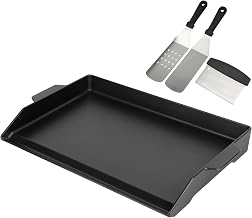
Pick for a gas grill: BBQ Future Universal Cast Iron Griddle for Gas Grill with Spatula Set, 23" x 16" Pre-Seasoned Nonstick Griddle Insert Large BBQ Flat Top Plate for All Gas/Electric Grill, Stove Top and more
 Visit on Amazon →
This is the shape I would hand a backyard cook who wants a flat top without buying a whole new grill. It is a 23 by 16 inch cast iron plate that drops over your existing grates, and the listing covers gas and electric grills plus stovetop use, so it travels. It ships pre-seasoned, which I treat as a starter coat, not a finished surface, and it comes with a spatula set, which matters because a thin metal spatula is the one tool you actually need on a flat top.
Before you order, measure the inside of your grill with the lid closed and confirm the plate clears the firebox and the lid. Cast iron does not flex, so a plate that is half an inch too wide is a return, not a trim job. Plan on a slow preheat too. Cast iron is a poor conductor, and a plate this size wants a good 10 to 15 minutes on low to medium before you drop food on it. Crank it and you get a hot center and cool corners.
Flaws but not dealbreakers: It is heavy, and heavy means you will not want to pull it in and out of the grill every night. Treat it as a semi-permanent install, season it in place, and leave it. Also check that your grill's grease path still works with the plate sitting on the grates. Fat has to go somewhere, and on a flat plate it runs to the edges.
Anyone with a standard three or four burner gas grill who wants a breakfast surface without a second appliance should start here.
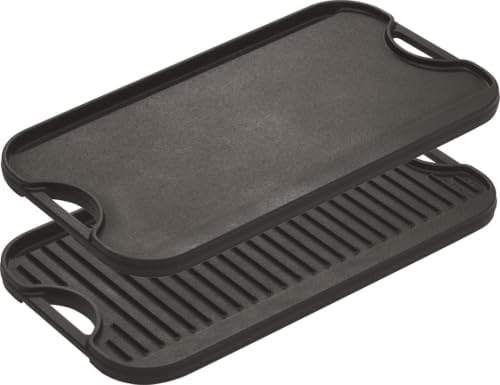
Pick for the stovetop: Lodge Pro-Grid Reversible Grill/Griddle, PFAS-Free, 20 x 10.5 Inches
 Visit on Amazon →
The Lodge Pro-Grid is the apartment and small-kitchen answer. It is reversible, so one side is a griddle for eggs, pancakes, and smash burgers and the other side is a grill surface for steaks and vegetables, and it is PFAS-free, which means there is no chemical coating to flake off into your food in year two. The 20 by 10.5 inch footprint is sized for a range rather than a full backyard setup.
Two things to know before you buy. First, check your burner spacing. A plate this long spans more than one burner on most stoves, which is a feature once you learn it: you get a hot zone and a holding zone, and you move food between them the way I move tickets across a flat top. Second, the whole plate gets hot, handle included. Keep a dry towel folded next to the stove.
Flaws but not dealbreakers: A reversible plate means you have to flip it to change functions, and flipping hot cast iron is a two-hand job with gloves. If you only ever want a griddle, a single-sided plate is simpler. Also, the grill side holds grease less gracefully than the griddle side, so keep a tray under the edge.
Anyone cooking for one or two people, or anyone in a rental with a residential range and no outdoor space, will get years out of this.
The actual seasoning workflow
Now the part you came for. This works on a brand new griddle, a pre-seasoned one, or a rusty one you rescued from the garage.
Step one: Strip the shipping gunk. New cast iron often ships with a wax or oil film to stop rust in the warehouse. Wash it in hot water with a stiff brush and a little dish soap, then dry it immediately and put it on a burner on low. Do not let it air dry. Air drying is how rust starts.
Step two: Preheat low and slow. Cast iron is a poor heat conductor. Ten minutes on low to medium gets the whole plate up to temperature. This is the step everyone skips, and it is the reason people complain about hot spots.
Step three: Apply oil thin, then thinner. Grapeseed, canola, or vegetable oil all work. Flaxseed is trendy and it flakes. Pour a teaspoon on the warm surface, spread it with a folded paper towel, then wipe it off like you made a mistake. The goal is a surface that looks dry with a faint sheen, not a surface that looks wet. Thick oil turns into sticky gum, and sticky gum is the number one reason a first seasoning fails.
Step four: Heat until it smokes, then hold. Bring the griddle up until the thin oil film starts to smoke, then keep it there for 20 to 30 minutes. That heat is what polymerizes the oil into a hard, slick layer. Below the smoke point you just have oil sitting on iron.
Step five: Repeat three to five times. One coat is not seasoning, it is a start. Let the griddle cool between coats, apply another whisper-thin layer, and heat it again. A pre-seasoned griddle needs two or three of these. A bare one needs four or five.
Step six: Cook something fatty first. Bacon, smash burgers, sausage, onions, or fried rice. Fat plus heat plus a metal spatula scraping across the surface is the best seasoning tool there is. Do not start with eggs. Eggs on a fresh griddle stick, and then you blame the griddle.
Step seven: Clean it hot, with water and a scraper. While the griddle is still warm, pour on a little water and push the scraper across the surface. Steam lifts the fond, the scraper takes it away. Modern dish soap will not destroy seasoning, but you do not need it. What destroys seasoning is soaking the griddle in the sink overnight. Never do that.
Step eight: Dry on heat, oil while warm. Back on the burner for two minutes to drive off every trace of water, then a thin wipe of oil while it is still warm. That wipe is the habit that keeps rust away.
Do those eight steps and you will not need to think about seasoning again for months, only maintain it.
When the seasoning goes wrong
Patchy gray spots mean the layer wore thin in the middle, which is normal on a griddle you actually cook on. Scrub it, dry it, and add two thin coats. You do not need to strip the whole plate.
Sticky, tacky patches mean you applied oil too thick. Heat it hard until it stops smoking and turns matte, or scrape it back and start over on that spot.
Rust means water sat on iron. It is not a death sentence. Scrub the rust off with steel wool or a green pad, wash, dry on the burner, and run the full seasoning cycle again. I have brought back griddles that looked like they were pulled out of a lake. Iron forgives, as long as you give it heat and oil.
The competition and why it lost
Coated nonstick griddle inserts lose this fight over a season, not a weekend. The coating is the cooking surface, and once it scratches or wears thin, the plate is done. You cannot season a coating back to life. That is the whole argument for bare iron.
Thin carbon steel is a legitimate alternative and it heats faster than cast iron, but it warps more easily at high heat, and a warped griddle is a lifetime of uneven burgers. Aluminum plates heat fast and dump heat fast, which sounds fine until you load them with cold food.
The other thing that loses is a cheap portable griddle with a surface that is already dished or crowned out of the box. Put a straightedge on it before you cook on it. If you see daylight under the middle, send it back. No amount of oil fixes geometry.
What this all costs
The math on cast iron is the easiest math in cooking. Check current Amazon price on the insert and on the reversible plate, add a metal scraper and a squeeze bottle for oil, and you have the whole setup. There is no coating to replace, no proprietary surface to rebuy, and no accessory ecosystem you have to buy into.
Compare that to a coated griddle that needs replacing when the nonstick fails, or a full flat top grill that costs more than both of these plates combined and takes up a patio. The per-year cost of a cast iron griddle you maintain is close to nothing, because the only thing you are spending is a few minutes of oil and heat every few weeks.
The real cost is the habit. Five minutes after dinner, every dinner, for the first month. After that the surface is black and glassy and eggs slide, and you will stop thinking about it entirely.
That is the job. Season it once, feed it oil, and it will outlast the grill you set it on.