I spent eight of my thirteen years as a line cook on a four-foot commercial flat top, cooking roughly 400 breakfasts a morning, and I still run a food trailer and a backyard griddle that gets fired up three times a week. In Phoenix that means cooking outside in 110 degrees in July and on a cool patio in January, and the surface has to survive both. So when people ask me which gas grill griddle tops are actually worth buying, I don't answer with a spec sheet. I answer with what happens on a Tuesday night when you're cooking for four and the steel is finally hot.
The best gas grill griddle top for most people is the cast iron 17 x 13 flat top, because it seasons quickly, holds heat like a diner griddle, and it will outlast the grill you set it on. If you already own a Camp Chef 4-burner, the Stanbroil stainless top is the smarter fit.
That's the short answer. The long answer is about burner zones, grease paths, and why a nonstick stove-top griddle and a cast iron slab are two different tools that happen to share a name.
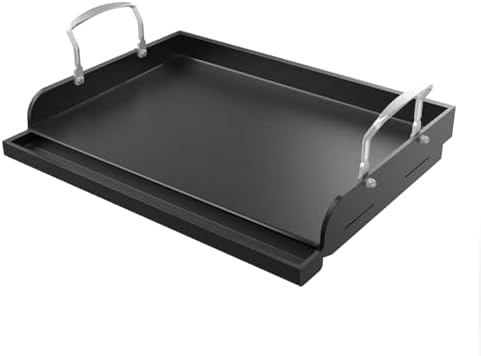
Cast Iron Griddle for Gas Grill Griddle 17 x 13 Inch Flat Top
Best heat retention of the group, seasons fast, nearly impossible to destroy, works on any gas grill
Heavy, small footprint, needs a full preheat, rusts if you slack off
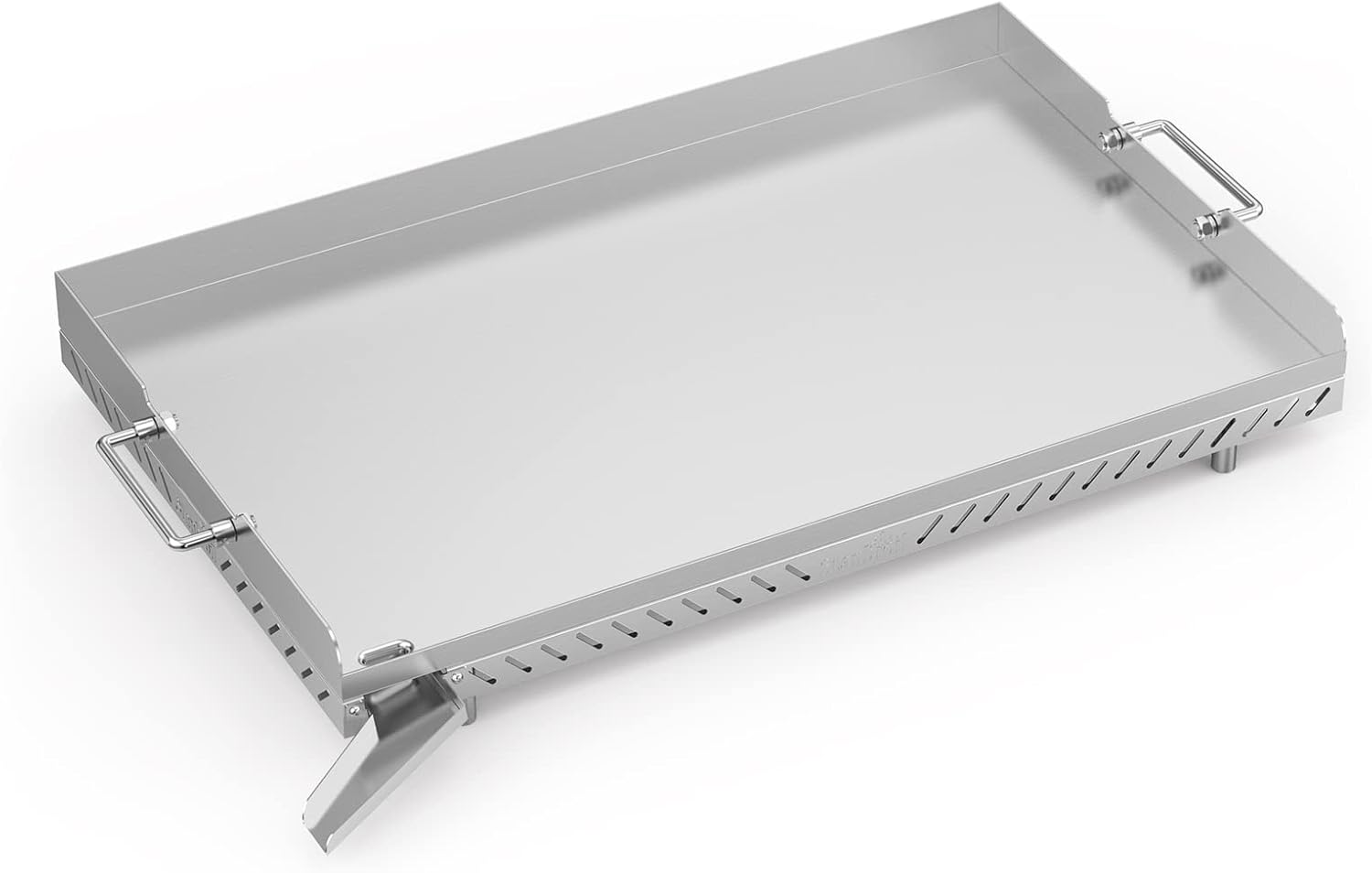
Stanbroil Stainless Steel Griddle for Camp Chef 4 Burner Grills
Drop-in fit for Camp Chef 4-burner frames, four real burner zones, stainless forgives neglect better than carbon steel
Only useful if you own the Camp Chef frame, seasons more slowly, not a standalone cooker
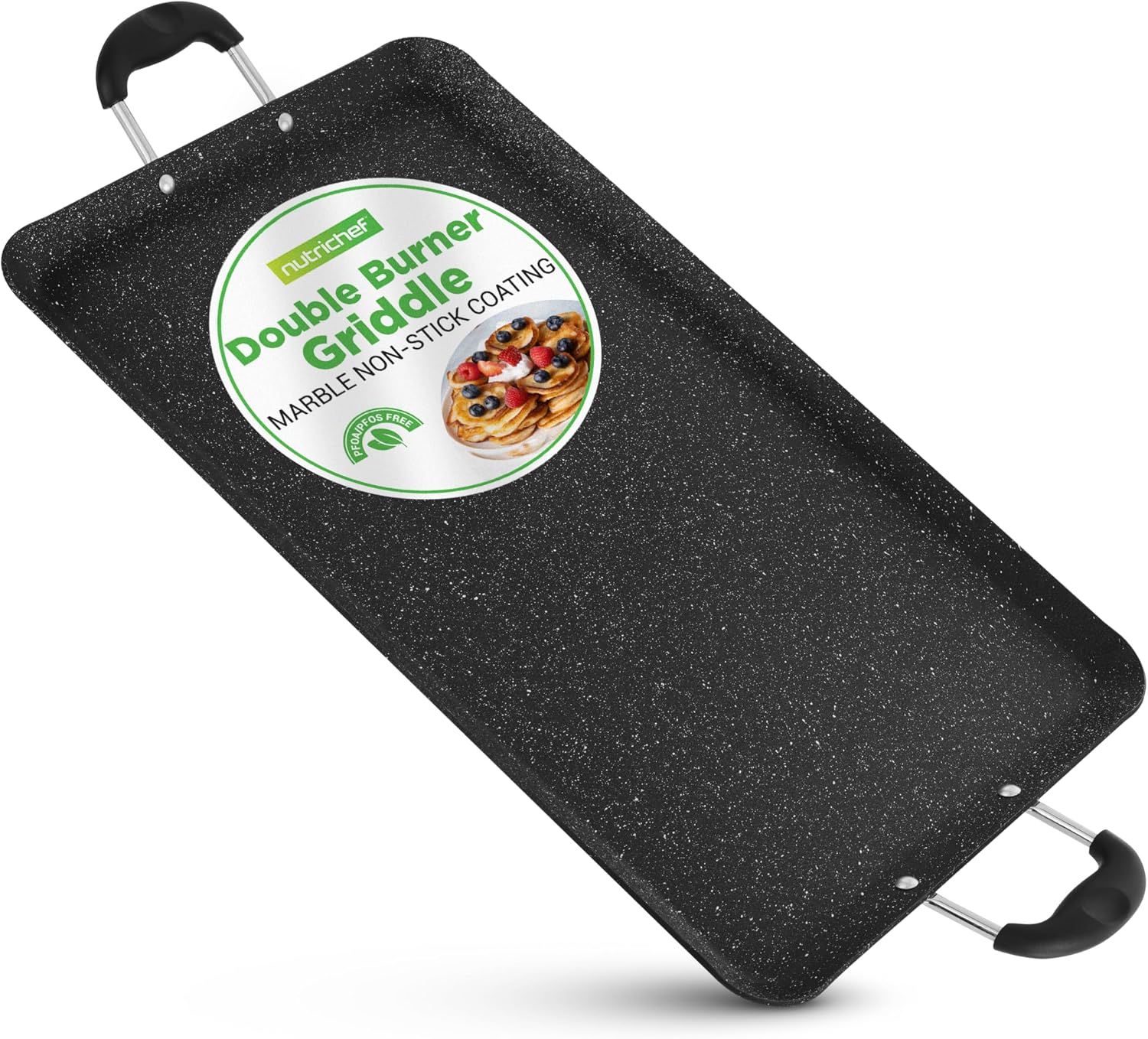
Nutrichef Double Burner Griddle, Non-Stick Stove Top Griddle for Gas Stove, Dishwasher Safe, Heatproof Bakelite Handles, Even Heat Distribution, PFOA & PFOS Free, 20” x 12” x 0.8” Inch (Black)
Cheapest way onto a flat top, dishwasher safe, light enough to store in a cabinet, fits over two stove burners
Coating has a lifespan, thin compared to steel, no sear like cast iron, no grease management of its own
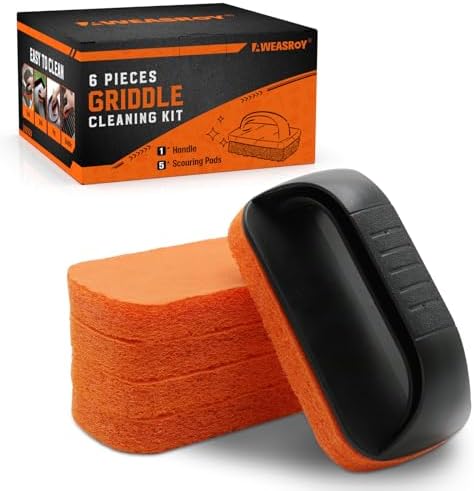
Griddle Cleaning Kit for , Non-Scratch Scouring Pads for Kitchen
Non-scratch pads protect coated surfaces, the scraper-and-pad routine is what keeps a griddle alive
It's an accessory, not a cooking surface, and kits always include two tools you'll never touch
Prices and availability were captured from Amazon Creators API and may change.
How I judge a griddle top
BTU count is a lie without burner layout, and the same is true of a griddle top. A surface can sit over four burners and still cook like one, because the steel between the flame and the food decides everything. I run four questions on anything that claims to be a flat top:
- Does heat spread across the whole surface, or is there a hot stripe down the middle and cold corners?
- Where does the grease go, and can I clean that path without a screwdriver and a bad attitude?
- Will the surface hold seasoning through 60 days of real use, or does it flash rust the first week I forget it?
- Could I run a full breakfast service on it, meaning a dozen eggs, a pound of hash browns, and a stack of pancakes, without the cook turning into a traffic jam?
Notice that none of those questions are about brand names. They're about material, thickness, and geometry. Those three things predict how a griddle cooks far better than any marketing claim on the box, and they're why this comparison splits the way it does.
Cast iron: the 17 x 13 flat top
Cast iron is the material that made the diner flat top famous, and this 17 x 13 inch slab is the closest thing to that experience you can drop on a backyard gas grill. Iron holds heat in a way thin steel cannot. When you lay a cold patty on a properly preheated cast iron surface, the temperature doesn't crater, which is the whole secret to a smash burger with a lacy, browned crust instead of a gray steamed puck.
The catch is preheat time. Cast iron wants a full ten minutes over medium heat before you cook anything, and it wants that heat spread gradually rather than slammed on high. Skip the preheat and you get the classic complaint: uneven browning, with one edge of the surface cooking twice as fast as the other. That's not the griddle failing, that's the cook rushing.
The other honest note is rust. Iron rusts. Everything rusts if you neglect it, and I say that to every person who emails me asking for a surface that "won't rust." What cast iron does better than any other material here is reward a habit. Thin coats of oil, heat until it smokes, repeat. Do that and the seasoning builds into a black, glossy surface that releases eggs and slides a scraper clean. Slack off for two weeks in a humid climate and you'll be scrubbing orange spots with steel wool, which is annoying but not fatal.
Where it loses: weight and footprint. Seventeen by thirteen inches is a real cooking area for two to four people, and it's the size I'd recommend if you cook on a Tuesday night rather than for a block party.
Stainless steel: the Stanbroil drop-in for Camp Chef
If you own a Camp Chef 4-burner, this is a replacement griddle top rather than a standalone cooker, and it's the one I'd point you toward for temperature control. Camp Chef's flat top is the best in the business at holding distinct heat zones, and that's a function of the frame and the burner layout, not the steel alone. Four independent burners under one surface means you can run a hot zone for searing on the left, a medium zone for pancakes in the middle, and a low zone for keeping bacon warm on the right. That's the difference between cooking and traffic management.
Stainless brings one real advantage over carbon steel: it tolerates neglect better. It won't flash rust the way a bare steel top will, which matters if your grill lives outside under a cover and you're not the kind of person who oils a surface every single time. The trade is seasoning speed. Stainless takes longer to build a polymerized layer, and the first few cooks will stick more than you expect. Thin coats, patience, and a hot surface will get you there, but it's a two-week project, not a two-cook project.
The other thing to know: this only makes sense if the frame is already on your patio. Buying a Camp Chef just to run this top is a bigger decision than a griddle purchase, and you should make it on the strength of the burner layout, which is genuinely the best part of that system.
Nonstick stove-top: the Nutrichef double burner
Not everyone has a patio, and I'm not going to pretend the answer for an apartment cook is a 36-inch outdoor unit. The Nutrichef double burner griddle is 20 by 12 by 0.8 inches, it sits across two burners on a gas stove, and it's dishwasher safe with heatproof Bakelite handles and a PFOA and PFOS free coating. For a small kitchen, that's a legitimate flat top, and it's the one piece here that doesn't require you to own a grill at all.
Now the honest part, because I have a pet peeve about this category: a nonstick griddle is not a seasoned griddle, and the coating is a consumable. It will lose its release over a season or two of hard use, especially if you treat it like carbon steel and attack it with a metal spatula. Use silicone, wood, or plastic tools. Wash it gently, and take the dishwasher option only when you actually need it. The handles and the light aluminum body are genuinely convenient, and the low mass means it heats up fast, which is great for a quick breakfast and less great for searing, because fast heat is also heat that leaves fast when cold food hits the surface.
Buy it as an indoor tool with a lifespan, not as a lifetime surface, and it will serve you well.
The cleaning kit is the least glamorous pick, and the one most people need
Every griddle conversation eventually becomes a cleaning conversation, because the surface you cook on is only as good as the routine that maintains it. This kit's value is the non-scratch scouring pads. On a coated stove-top griddle, a green Scotch-Brite pad is a slow-motion destruction of the coating, and non-scratch pads are the difference between a surface that lasts two seasons and one that lasts one.
On cast iron and stainless, the routine is different: scrape while the surface is hot, wipe with a thin film of oil, and let the seasoning do the rest. The pads in a kit like this still earn their place for the cool-down wipe and for the frame, the side shelves, and the drip tray, which is where the real grime lives. Kits always include one or two tools you'll never use, and I'll say that plainly, but the pads and a decent scraper cover 90 percent of what a griddle actually needs.
The trade-offs nobody puts on the box
Grease management is the thing that decides whether you cook or fight. None of these tops ships with a real grease trap of its own. On the Camp Chef frame you get a channel and a cup, and that system is one of the reasons I rate that platform so highly. Drop a cast iron slab on a standard gas grill and the fat runs wherever gravity and your grill's slope decide, which means a foil drip pan underneath is not optional unless you enjoy scraping rendered beef fat off a firebox.
The second trade-off is tool compatibility. Cast iron and stainless want metal: a stiff scraper, a heavy spatula, a press for smash burgers. Nonstick wants the opposite, and using the wrong tool on the wrong surface is how people end up replacing a griddle after a year.
The third is heat zones. One surface over two burners gives you two zones at best. One surface over four burners gives you real control. That's why I keep coming back to burner layout as the spec that matters most, and why a cheap griddle on a good frame beats an expensive griddle on a bad one.
Which one should you buy?
- Buy the cast iron 17 x 13 flat top if you cook for two to four people on a gas grill and you want the best sear and the best heat retention for the money. It's the most forgiving surface here and the one I'd hand a first-timer.
- Buy the Stanbroil stainless top if you already own a Camp Chef 4-burner and want the four-zone control that frame is famous for, with a surface that shrugs off a little neglect.
- Buy the Nutrichef double burner if you're cooking indoors, on a gas stove, in a kitchen without patio space, and you want a dishwasher-safe surface that heats fast and stores in a cabinet.
- Buy the cleaning kit with the non-scratch pads regardless of which surface you pick, because the maintenance routine is what keeps any of them alive past year one.
What I'm testing next
I'm in the middle of a 60-day seasoning consistency test across a handful of surfaces, and the pattern so far matches what I've believed for years: the cheap steel is getting better, and the grease traps are still an afterthought. Almost every complaint I hear about griddles traces back to one of two things, a surface that was never properly seasoned or a grease path that was never properly cleaned. Fix those two habits and even a modest griddle cooks like a short-order line. Neglect them and no price tag will save you.