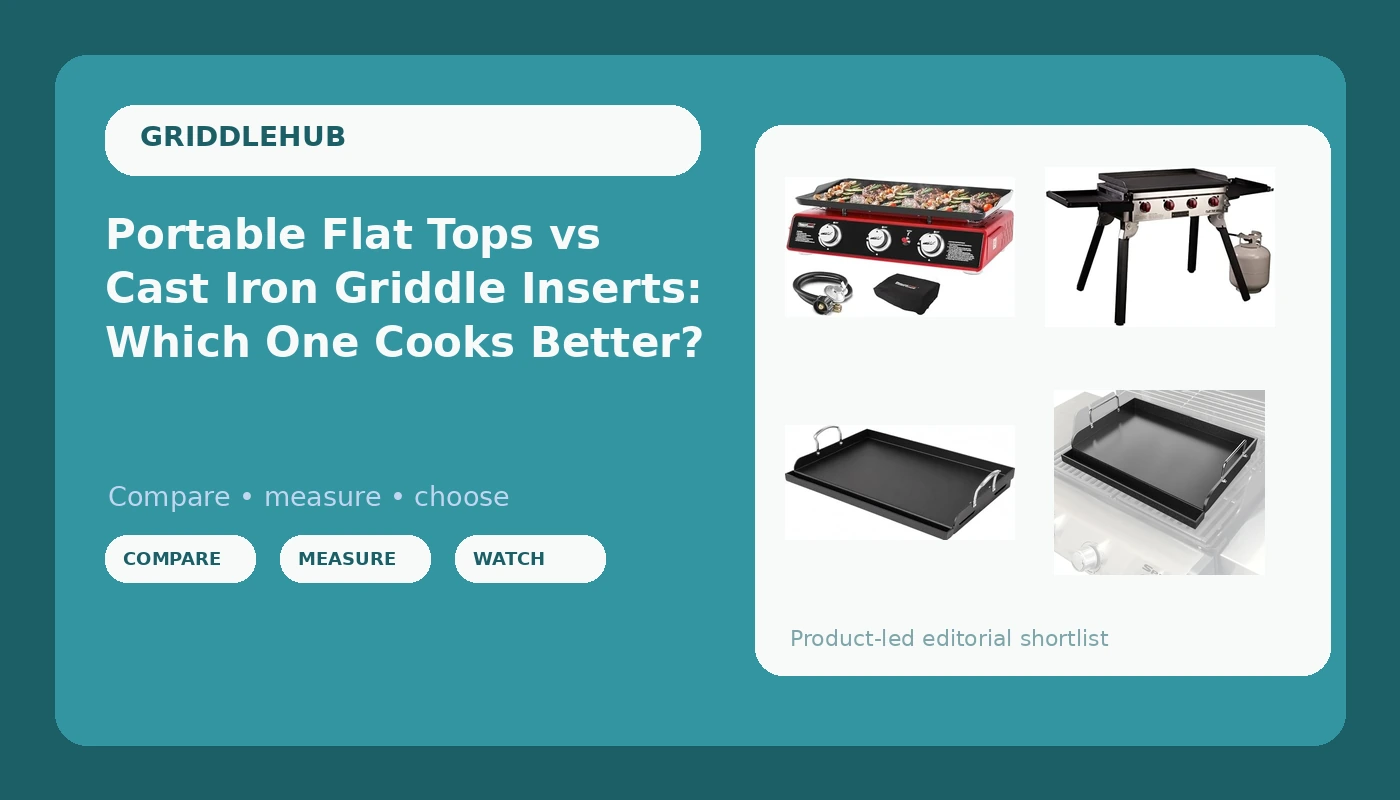
I spent eight of my thirteen years as a line cook parked behind a four-foot commercial flat top, working a breakfast service that pushed four hundred covers before nine in the morning. These days I run a griddle on a food trailer and a smaller one in the backyard that gets fired up three or four nights a week. I still think the flat top is the most versatile cooking surface ever put in front of a person. So when friends ask whether they should buy a standalone propane griddle or drop a cast iron plate onto the grill they already own, I give them the same flat top griddle comparison I give my own crew. There are two families of product here, and choosing the wrong one costs you either money or patio space. The four units below cover both: two self-contained propane flat tops and two cast iron inserts that turn an existing gas or charcoal grill into a griddle.
Short answer: if you cook for a crowd and want genuine heat zones, the Camp Chef Portable Flat Top Grill is the one to beat. If you already own a gas grill and want to spend as little as possible, a cast iron insert gets you most of the way there for a fraction of the money.
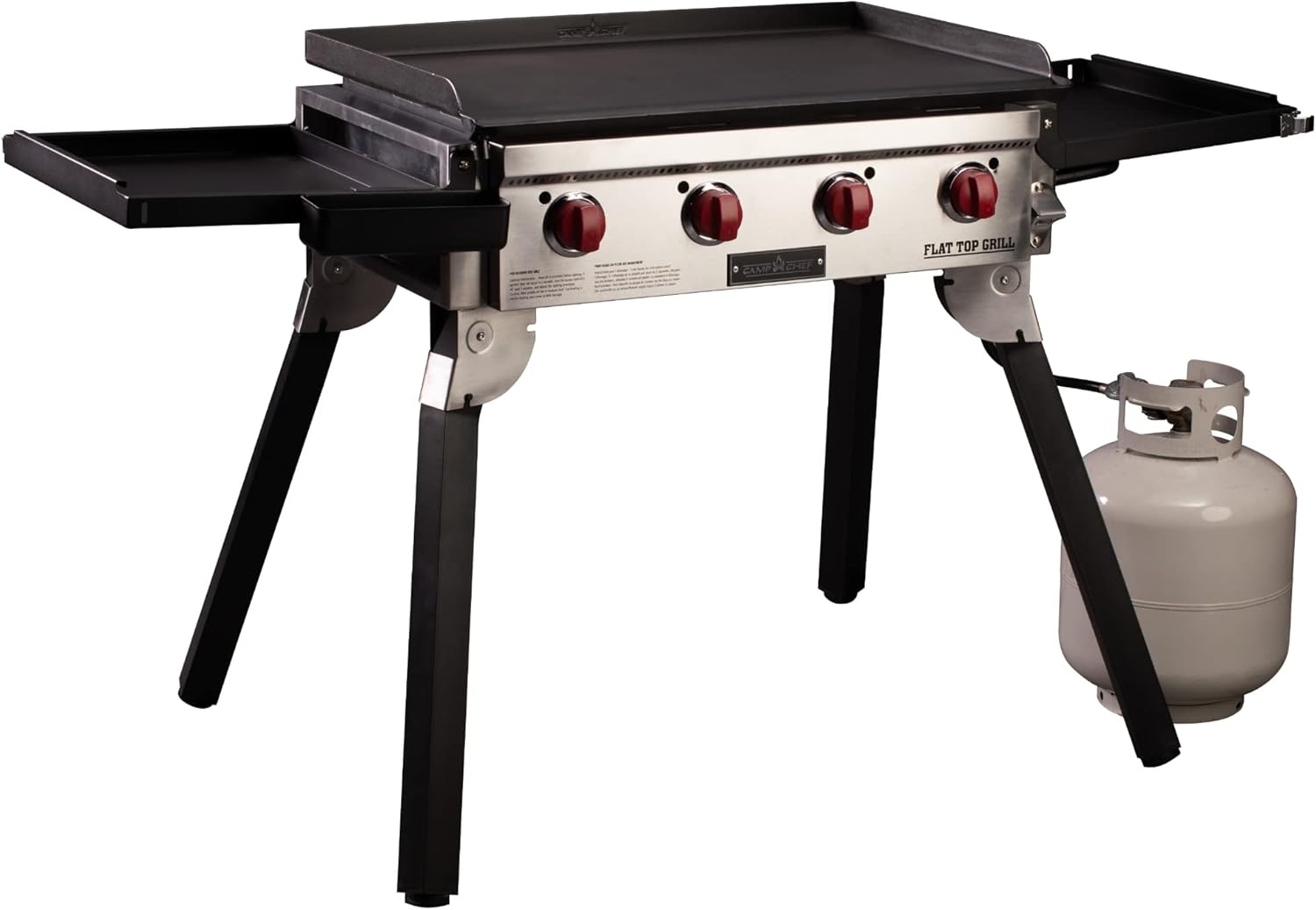
Camp Chef Portable Flat Top Grill, True Seasoned Griddle Surface, Four 12,000 BTU/hr. stainless steel burners
Four independent 12,000 BTU/hr stainless burners give you real heat zones, and the true seasoned surface is ready to cook on day one
The heaviest and most expensive of the four, and it wants a table or tailgate you actually trust
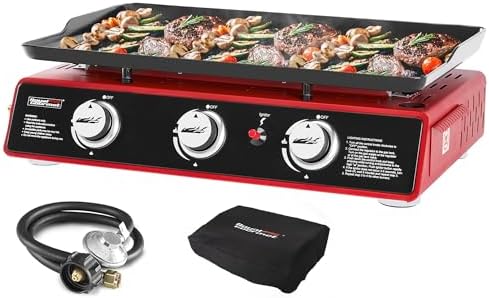
Royal Gourmet PD1301R 3-Burner Tabletop Propane Gas Griddle with Cover
The budget entry into a real propane flat top, and the included cover protects it between cooks
Three burners means fewer usable zones, and the steel is thinner than the premium units
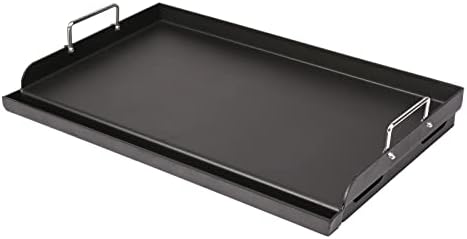
Utheer 25" x 16" Pre-Seasoned Nonstick Cast Iron Griddle for Gas & Charcoal
A big, heavy cooking surface that holds heat and works over charcoal or gas
No grease channel and no hood, so it is your grill's grease system or nothing
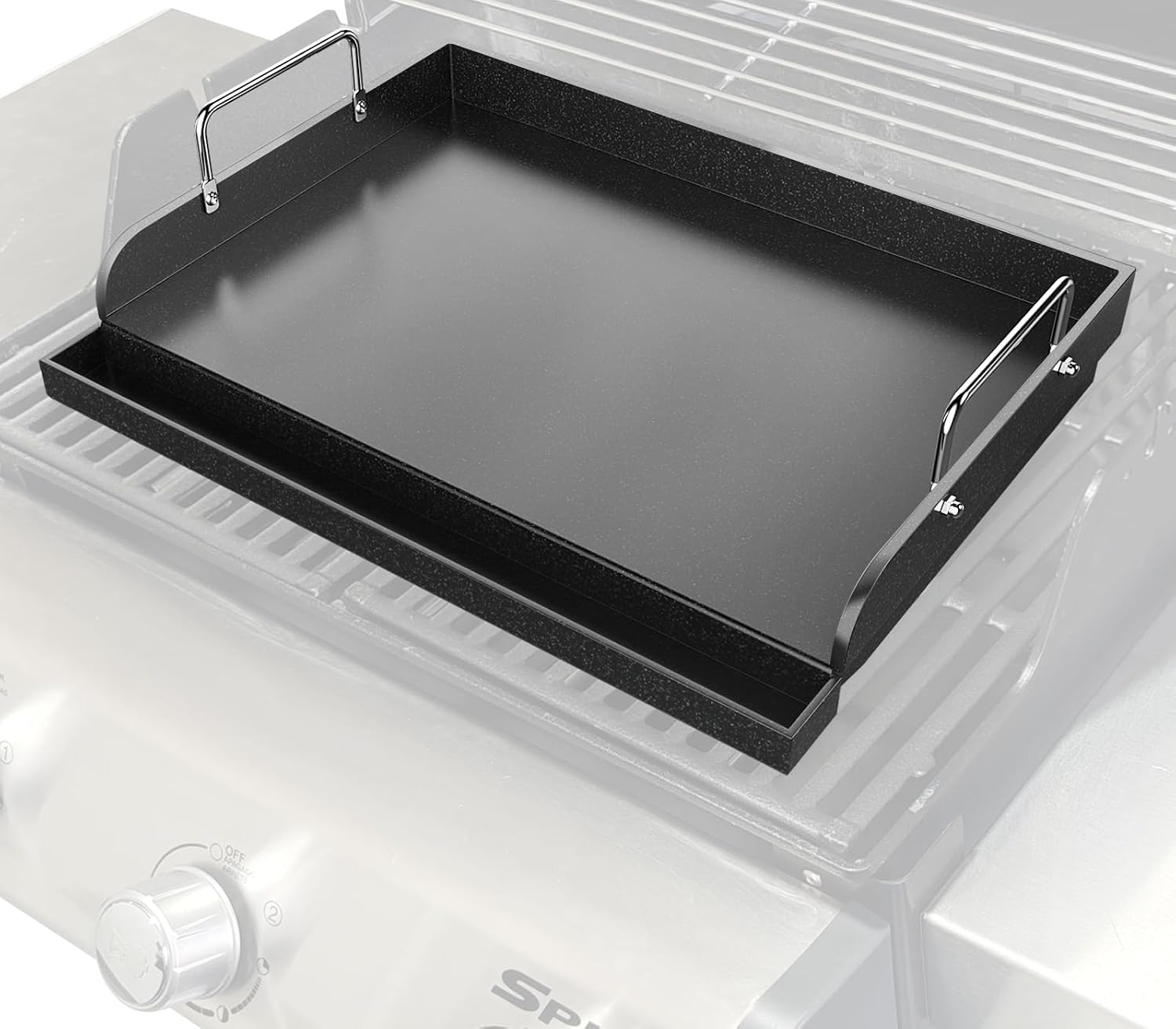
Pre-seasoned Cast Iron Griddle for Gas Grill, Nanoceramic Nonstick Flat Top Griddle Insert, 17" x 13"
The cheapest way to find out whether you like cooking on a flat top, and it drops into a two-burner grill footprint
Small surface, and any coated nonstick layer is a wear item, not a forever feature
Prices and availability were captured from Amazon Creators API and may change.
The two families, and why the difference matters
A standalone propane flat top is a complete cooking appliance. It has its own burner tubes under the steel, its own grease management, its own legs and usually a hood. You buy propane, you set it on a table, you cook.
A griddle insert is a slab of cast iron or a coated plate that sits on the grates of the grill you already own. Heat comes from below, through whatever burners you have. There is no hood unless your grill has one, and grease runs wherever your grill's own system sends it.
That single design difference explains almost every trade-off in this comparison. Standalone units buy you control. Inserts buy you economy and floor space. Everything else is detail.
Camp Chef Portable Flat Top Grill: the control pick
Four 12,000 BTU/hr stainless steel burners under a true seasoned griddle surface. Read that spec again, because the number that matters is not the BTU figure, it is the word four.
Four independent burners means four zones, which means you can hold a pile of finished smash burgers on one end, run a hot sear zone in the middle, and keep a low zone for eggs and onions at the other end. That is how a diner actually works. You are not cooking everything at one temperature and shuffling food around to dodge hot spots. You are assigning real estate.
The true seasoned surface is also worth calling out. Seasoning is a habit, not a one-time event, and a factory-seasoned top gives you a head start rather than a lifetime guarantee. But it means your first cook is a cook, not a science project.
Where it loses: it is the heaviest and priciest of these four, and portability has limits. A unit with four burners and a real cooking surface is not something you casually carry one-handed from the truck to the picnic table. If you want a griddle that lives in a bag in the trunk, this is not that.
Royal Gourmet PD1301R: the budget propane route
Three burners, tabletop propane, and a cover in the box. The cover is not a throwaway accessory in a place like Phoenix, where dust finds every exposed surface within a day.
The honest framing on a three-burner tabletop is this: you get a hot zone and a warm zone, and the middle burner mostly blends the two. That is still a real step up from cooking everything on one heat setting, but it is not the four-zone control of the Camp Chef. Fewer zones means more moving food around and more attention on the surface instead of on the plate.
Thinner steel is the other trade. Thin steel reacts faster to burner changes and holds less heat, which is a wash on a Tuesday night and a disadvantage when you are loading a cold batch of burgers onto a hot surface. It will cook fine if you season it properly and give it a few minutes to recover between batches.
Utheer 25" x 16" cast iron: the big insert
Cast iron is the original flat top, and a 25 by 16 inch plate is a serious amount of surface. It works over gas and charcoal, it comes pre-seasoned, and it holds heat like nothing else in this comparison. Set it on a hot grill, give it time, and it will sear a steak the way a flat top should.
The problems are the same problems cast iron has always had. It takes time to come up to temperature, and it does not heat evenly across the whole plate, so the middle runs hotter than the corners. There is no grease channel, which means fat and burger juice either pool on the surface or run into your grill's own system, and that system was designed for a steak, not for a pound of bacon.
And cast iron rusts. Not because it is bad, because it was neglected. If you are the kind of cook who wipes the surface down and oils it while it is still warm, this will outlast your grill. If you are not, you will be scrubbing orange spots off it by August.
The 17" x 13" nanoceramic insert: the cheap experiment
This is the smallest and least expensive way into flat top cooking. It is pre-seasoned cast iron with a nanoceramic nonstick finish, sized to drop onto the grates of a Weber, Nexgrill, or Charbroil, and it is built to convert a two-burner grill into a griddle for a weeknight.
For a household of two, that footprint is genuinely enough: two smash burgers, a pile of onions, a couple of eggs, done. It heats faster than the big Utheer plate because there is less mass to bring up, and the nonstick layer means your first few cooks are forgiving.
The catch is the coating. Any nonstick griddle surface is a wear item, and a coated plate that gets scraped hot every weekend is going to show it eventually. That does not make it a bad buy at this size. It makes it a consumable, and you should price it that way. If you want a surface that gets better with age instead of thinner, buy bare cast iron and season it yourself.
Burner zones beat BTU numbers
I will say the unpopular thing: BTU count is a lie without burner layout. A single 20,000 BTU burner and four 12,000 BTU burners are not the same appliance, even though the second one has more total output. One is a hot plate. The other is a cooking surface you can actually manage.
The practical test I run on any new griddle is the cold morning start. Light every burner, walk away for five minutes, come back, and check whether each zone is doing what you asked. Burners that struggle to light or that die in the wind are a daily annoyance, and on a tabletop propane unit in an open yard, wind is not a hypothetical.
That is the whole reason the Camp Chef sits at the top of this comparison and the Royal Gourmet sits in the middle. It is not brand loyalty. It is four zones versus three.
The grease question
Every flat top eventually becomes a grease management problem, because fat has to go somewhere. A good system is removable and you can clean it in a sink. A bad one is a cup you cannot reach, a channel that clogs, or a tray that hides under the burners.
The standalone units handle this by design, because they were built as griddles first. The inserts hand the job to your grill, and your grill's grease management was sized for drippings off a grate, not for a full breakfast service. If you plan to cook bacon and smash burgers on an insert, watch the tray and empty it before it turns into a science experiment.
Seasoning is a habit, not a feature
No griddle in this comparison is immune to rust, and any product page that tells you otherwise is selling you something. Seasoning is a polymerized oil layer you build with thin coats, heat, and patience, and it is maintained the same way you maintain a cast iron skillet: scrape it hot, wipe it clean, oil it thin, and do it again next time.
Pre-seasoned surfaces shorten the runway. They do not remove the destination. If you are honest with yourself about whether you will oil a cooking surface after a long Sunday cook, that answer should drive which of these four you buy more than any spec.
Sizing: buy the surface you will actually fill
You do not need thirty-six inches. You need enough space for what you cook on a Tuesday night, plus a little room to work.
If you cook for a family of four or more, or you tailgate, the Camp Chef surface is the one that will not make you cook in shifts. If you cook for two with occasional guests, the Royal Gourmet will keep up and the 17 inch insert will surprise you. If you already own a good gas grill with solid burner coverage and you just want to try flat top cooking, the Utheer plate is the lowest-risk way to find out whether the griddle life is for you.
Who should buy which
- Buy the Camp Chef Portable Flat Top Grill if you cook for crowds, you want real independent zones, and you would rather buy once.
- Buy the Royal Gourmet PD1301R if you want a real propane flat top on a budget and you accept three burners and thinner steel as the price of entry.
- Buy the Utheer 25" x 16" cast iron plate if you already have a grill with good heat and you want maximum surface for minimum money.
- Buy the 17" x 13" nanoceramic insert if you are cooking for one or two, you want a cheap test run, and you understand the coating will wear.
The trade-offs, said plainly
Standalone propane units cost more and weigh more, and in exchange you get burner zones, a hood, and a grease system that was designed for the job. Cast iron inserts cost less and take up no extra space, and in exchange you give up zone control, grease management, and the assumption that the surface will still be perfect in three years.
Neither answer is wrong. The wrong answer is buying a four-burner tabletop when you live alone and grill twice a month, or buying a 17 inch insert when you promised smash burgers for twelve people on Saturday.
Pick the one that matches your actual Tuesday, season it like you mean it, and keep a scraper and a squeeze bottle within arm's reach. That is the whole game.