Related: Griddle Seasoning: The 60-Day Habit That Keeps Steel Black
I learned to cook on a four-foot commercial flat top at a diner that served 400 breakfasts before ten in the morning. Eight of my thirteen years on the line were spent in front of that surface, and it taught me two things I still believe: the griddle is the most versatile cooking surface there is, and most people buy the wrong one.
So this is a flat top griddle comparison built around jobs instead of hype. Four units, four different jobs: a 36-inch four-burner steel station, a smaller four-burner flat top with folding side tables, an extra-large electric griddle for indoor cooking, and a reversible cast iron piece that lives on the stove. Buy the one that matches the cooking you actually do on a Tuesday night, not the video you watched on Saturday.
Three things decide whether you will love a griddle or resent it. BTU count is a lie without burner layout, so ignore the big number on the box until you know how many independent zones the burners create. Grease management decides whether you cook or fight, because a bad trap turns every cook into a cleanup project. And seasoning is a habit, not a one-time event, which means the surface you choose has to be one you are willing to oil and heat on a regular schedule.
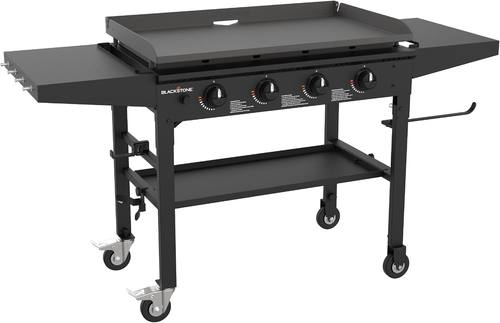
Best Overall: 36 Inch 4 Burner 60,000 BTU Portable Steel Griddle Cooking Station with Foldable Legs
If I were building a backyard setup from scratch, this is where the money would go. Thirty-six inches of steel over four burners gives you four independent zones, and four zones is what turns a griddle into a short-order line. Bacon on the far left, eggs in the middle, smash burgers on the right, and nothing waits on anything else.
Sixty thousand BTU spread across four burners is a real number because the layout supports it. Each burner owns its own strip of steel, so when you turn one down, the surface above it actually cools. That is the difference between a griddle and a hot plate, and it is the reason this is the unit in this comparison I would trust with a full breakfast service.
The grease pan is the part I would inspect first. A pan that slides out and goes straight into the sink is the difference between a Sunday cook and a Sunday scrub, and the storage rack underneath means your scraper and squeeze bottle have a home instead of living on the ground.
Foldable legs are the other practical win. This is a station you can break down and stand in the corner of the garage, which matters if your patio has to do double duty. It is heavy, it takes up real space when it is set up, and it will rust if you slack off on the seasoning. Those are the trade-offs, and they are worth it when you cook for a crowd.
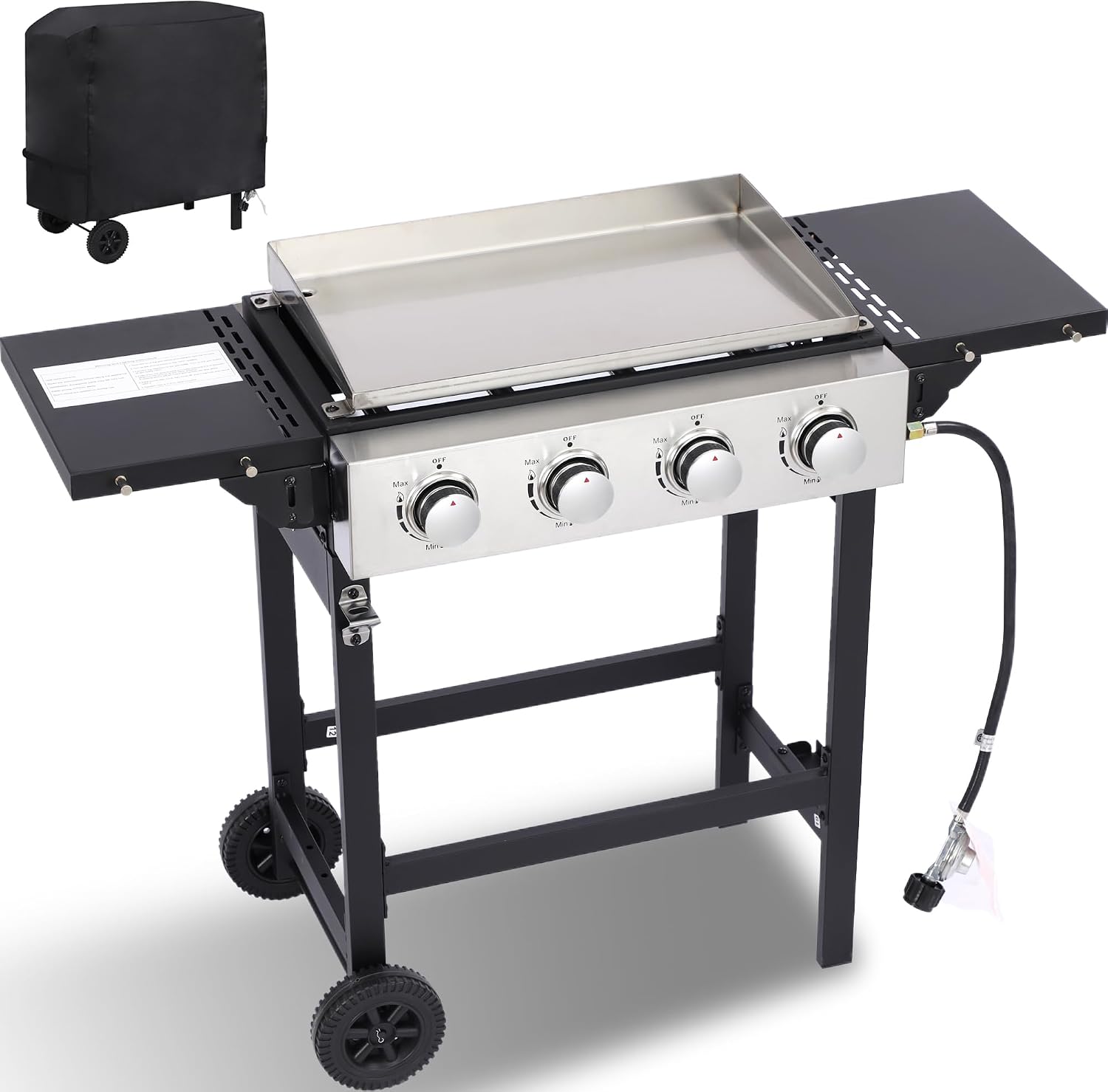
Best Value: 4-Burner Flat Top Grill with Folding Side Tables, 40,000 BTU
This is the griddle I would hand to someone who is not sure they need a griddle. Four burners and folding side tables give you real heat zones and a place to land a spatula, without demanding a permanent spot on the patio.
Forty thousand BTU across four burners works out to less heat per zone than the 36-inch station, and that changes how you cook. You are not going to run three sear zones at once. What you get instead is a surface that behaves well for pancakes, eggs, bacon, quesadillas, and fried rice, plus a footprint that folds down when the cook is over. For smash burgers, keep the patties thin, work two at a time, and give the steel a minute to recover between batches.
The folding side tables are the feature I would pay for. A griddle without landing space turns your patio table into a grease trap, and that is how people end up resenting a setup that cooks perfectly well.
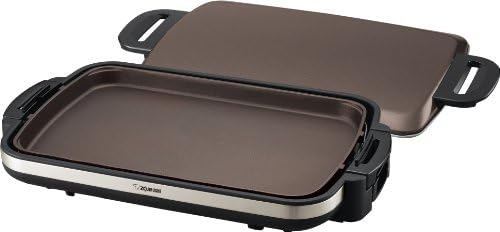
Best Electric: Zojirushi EA-DCC10 Gourmet Sizzler Electric Griddle, Stainless Brown Extra Large
Not everyone can run propane. Apartment cooks, balcony cooks, and anyone in Phoenix in July who does not want to stand next to a lit four-burner in the afternoon sun has a real use for an extra-large electric griddle.
The Gourmet Sizzler is the indoor answer in this lineup. You plug it in, you get a big flat surface, and you cook pancakes for six or a hibachi-style dinner without a single flame. It is the easiest of the four to live with in a small kitchen because there is no fuel, no tank, and no wind to fight.
What you give up is crust. Electric heat does not hit like a gas burner under steel, so you are not getting the smash burger sear that makes a flat top worth owning. This is also not a surface you build a seasoning on the way you do bare steel, so the maintenance habit is different: wipe it down, keep the drip tray clean, and treat it like the appliance it is. It needs counter space and an outlet, and the extra-large surface takes up plenty of both.
Best Small Space: Lodge Pro-Grid Reversible Grill/Griddle, PFAS-Free, 20 x 10.5 Inches
The Pro-Grid is the piece I recommend to people who want to learn a flat top before they buy one. It is reversible, with a griddle side and a grill side, it is PFAS-free, and at 20 by 10.5 inches it bridges two burners on a typical range, goes in the oven, and works over coals.
Because it is bare cast iron, it seasons the same way a full-size flat top seasons. Thin coats of oil, heat, patience, repeat. If you can keep this piece black and slick, you can keep a 36-inch steel station black and slick, and you will have learned that lesson on a surface that asks for a fraction of the commitment.
The limits are honest ones. Twenty by ten and a half inches is a two-to-four-person surface, so a family of six is cooking in batches. It is heavy enough that you will think about it before you pull it out. And it holds heat so well that turning the burner down does not change the surface temperature as fast as you might want. For smash burgers, breakfast for two, and a steak finished in the oven, it is the most versatile small piece you can own.
How I test a griddle
Every griddle that earns a recommendation from me has to survive three things, and I would run the same three before spending money on any brand.
The first is 100 smash burgers. Not because I need 100 burgers, but because repetition is the only way to find the hot spots. By burger 40 you know which corner runs hot, where the steel recovers slowly, and whether your spatula catches on the surface. A griddle that fights you on burger ten will fight you forever.
The second is a full breakfast service: a pound of bacon, 20 eggs, and a pile of hash browns, all in one session, all at once. This is the grease management test. A trap that fills up, clogs, or is impossible to clean turns a 20-minute cook into a 40-minute cleanup, and that is the number one reason backyard griddles end up under a cover.
The third is the seasoning check, and it takes 60 days. Thin coats, regular use, and then a deliberate stretch of neglect to see how the surface reacts. I do not believe anyone who says a griddle will not rust. Everything rusts if you neglect it. What matters is how quickly a little rust comes off with a scraper and a fresh coat of oil.
Analysis: what the numbers actually mean
Total BTU is the number on the box, and it is the least useful one. Divide it by the number of burners and ask what that means per zone. The 36-inch station spreads 60,000 BTU over four burners, and the smaller flat top spreads 40,000 over four. Both have four zones, but the bigger unit has more heat per zone and more steel to hold it, which is why it handles a full service and the smaller one handles a family breakfast.
Steel thickness is the spec nobody prints and everybody feels. Thick steel holds temperature when you drop a pound of cold ground beef on it. Thin steel drops fast, recovers fast, and warps if it is cheap enough. A warped griddle is a lifetime of uneven burgers, so that is the one defect I will not work around.
Burner layout beats burner count. Four burners in a straight line under a wide surface give you four usable zones. Two burners under the same surface give you two, plus a hot spot in the middle where they overlap. More zones means more control, and control is what makes a griddle feel professional.
Grease management decides your Sundays. Look at the pan or the channel before you look at anything else. Can you get it out? Can you get a sponge into the corners? Does it sit under the cooking surface or beside it? A griddle with a bad trap is a griddle you will stop using.
The flat top griddle reference table
| Product | Fuel | Setup | Best for | Price |
|---|---|---|---|---|
 Visit on Amazon → Visit on Amazon →36 inch four burner steel station |
Propane | Foldable legs, grease pan, storage rack | Full breakfast service, parties, four-zone cooking | $399.00 |
 Visit on Amazon → Visit on Amazon →4-burner flat top with folding side tables |
Propane | Folding side tables | Family breakfasts, smaller patios, first griddle | $149.99 |
 Visit on Amazon → Visit on Amazon →Zojirushi Gourmet Sizzler electric griddle |
Electric | Countertop, plug in | Apartments, balconies, indoor hibachi nights | $184.95 |
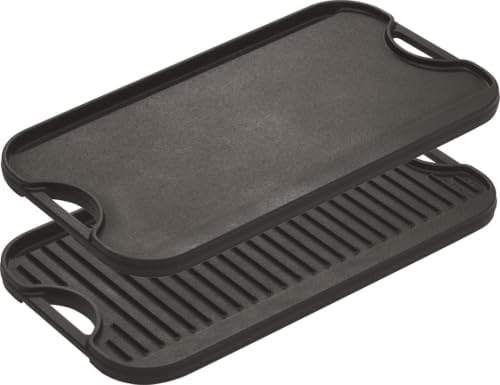 Visit on Amazon → Visit on Amazon →Lodge Pro-Grid reversible grill and griddle |
Stovetop, oven, or coals | Reversible, two-sided | Small spaces, learning to season, two to four people | $49.90 |
The pattern in that table is simple. If you cook outside for a crowd, buy burners. If you cook inside or on a balcony, buy the electric surface. If you are not sure yet, buy the cast iron and learn the habit first.
The accessory that decides the cook
A griddle is not a grill, and the tools are different. You need a metal scraper, and you need a squeeze bottle of oil. That is it. The scraper cleans the surface while it is hot, which is the only time it cleans easily, and it also gets under a smash burger without tearing it apart. The squeeze bottle gives you thin, controlled coats of oil instead of a pour that turns into a puddle.
I keep both in my truck, and I keep both next to the backyard griddle. Every gadget beyond those two is optional, and most of them are drawer filler.
Should you buy the 36 inch four burner steel griddle station?
Yes, if you cook for groups and you have the patio space. Four burners across 36 inches is the layout that lets you run a real service, and the foldable legs mean it does not have to live outside. It is heavy, it needs a cover, and it needs oil on a regular schedule. If you are willing to do that, this is the closest thing to a diner flat top you can put in a backyard.
Should you buy the 4-burner flat top with folding side tables?
Yes, if you want a real four-zone griddle without a permanent footprint. It will not sear like the 36-inch station, and you should not expect it to. What it does well is breakfast, quesadillas, fried rice, and burgers in small batches, with side tables that keep your tools off the ground and legs that fold when the cook is over.
Should you buy the Zojirushi Gourmet Sizzler?
Yes, if indoors is your only option or your preference. It is the only unit here that needs nothing but an outlet, which makes it the practical pick for apartments and for anyone who does not want to deal with propane. Accept that you are trading sear for convenience, and it will earn its counter space.
Should you buy the Lodge Pro-Grid?
Yes, if you want to learn a flat top on a small surface, or if you cook for two. It is PFAS-free, reversible, and it seasons exactly like the big steel surfaces do. It is also small and heavy, so it is a tool for a specific job rather than a replacement for a full-size griddle. Start here, learn the habit, and upgrade when the guest list grows.