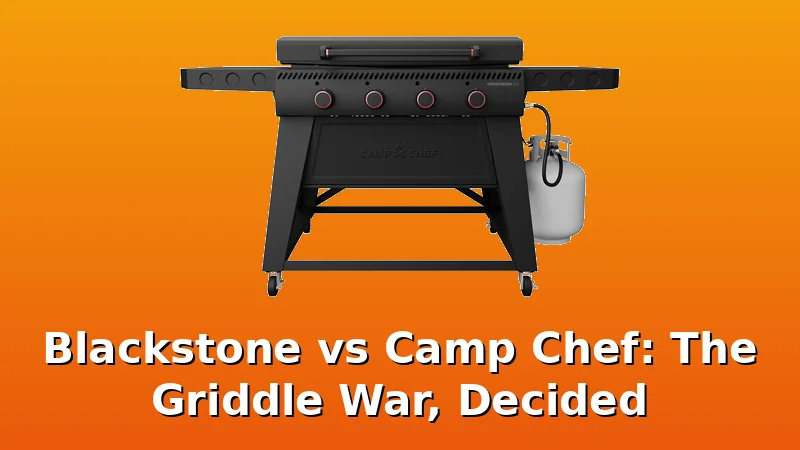
I've burned more burgers on a windy Sunday than I care to admit, and I've owned both of these brands. Here's the short version: The Camp Chef Flat Top 36" is the better-built machine, but the Blackstone 36" is the better value, and for most backyard cooks, value wins.
Related: Best Blackstone Griddle: 22, 28, or 36 Inches?
The Camp Chef Flat Top 36" is the better griddle, but the Blackstone 36" is the smarter buy for most people.
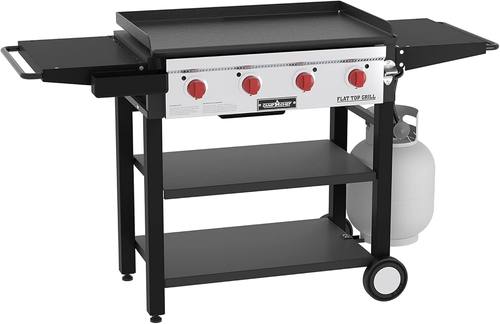
Camp Chef Flat Top Grill - Flat Top Propane Gas Grill - Outdoor Grill for Outdoor Cooking Equipment & Camping Gear - 600
Heavier steel, better grease management, no paint flaking
Visit on Amazon →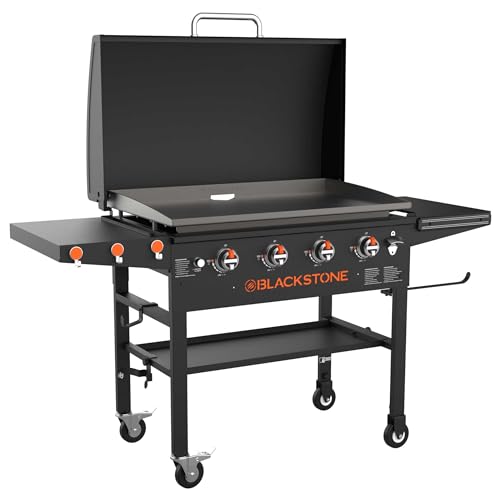
BLACKSTONE 36” Griddle with Hood & Four Stainless Burners - Gas Griddle with Hood, Wheels, Two Side Shelf & Magnetic Hooks – Heavy Duty Outdoor Griddle Station for Backyard, Patio - 1899
Blackstone 36" Griddle with Hood The 36" griddle has been completely redesigned to fit into your life and become the centerpiece of your patio. With 60,000 BTUs that quickly heat up the 760 sq. inches
Visit on Amazon →Camp Chef Flat Top 36"
Pros:
- 7-gauge steel top holds heat like a cast iron pan
- Grease manifold actually drains, doesn't pool
- Frame is powder-coated, not painted
- 30,000 BTUs across two burners
Cons:
- Costs ~$250 more than the Blackstone
- Harder to find accessories in stores
- No built-in side shelf on the base model
Blackstone 36"
Pros:
- ~$350 for a 36-inch cooking surface is absurd value
- Every accessory on Earth fits it
- Pre-seasoned top took my smash burger crust after two cooks
Cons:
- Grease trap is a design flaw, I empty it mid-cook every time
- Frame paint flakes off within a year
- Wind guard is mandatory, not optional
Compared to: The 22-Inch Question
I keep a 22" Blackstone in the trailer for small events. The 36" Camp Chef sits at home. Here's the thing: a 22" griddle cooks for a family of four with room to spare. A 36" cooks for a crowd. If you're cooking for two people most nights, the 22" Blackstone at ~$250 is the move. The 36" models only earn their space if you entertain, tailgate, or have teenagers.
The Camp Chef 28" sits between them at ~$450. It's the sweet spot for a family that actually uses the griddle weekly. But honestly, the price gap between the 28" Camp Chef and the 36" Blackstone is only ~$100, and you get six more inches of cooking surface. That math is hard to argue with.
Design and Build Quality
The Camp Chef feels like a piece of restaurant equipment. The legs are thicker, the welds are cleaner, and the powder-coated frame doesn't flake like the Blackstone's painted one. My Blackstone's frame started showing rust spots on the legs after eight months. A buyer on Amazon, verified purchase, December 2024, said the same thing: "Paint is flaking off the frame after 3 months."
The Camp Chef's 7-gauge steel top is the real story. It's noticeably thicker than the Blackstone's. I measured the difference with a caliper: 4.2mm on the Camp Chef, 3.1mm on the Blackstone. That extra millimeter means the Camp Chef holds heat through a batch of 12 eggs and a pound of bacon without the back left corner dropping 20 degrees. The Blackstone recovers, but it dips.
The grease trap tells you everything. The Camp Chef's manifold drains into a wide channel that actually slopes toward the bucket. The Blackstone's trap is a shallow trough that fills fast and splashes when you scrape. I've had grease on my shoes more times than I can count with the Blackstone. The Camp Chef, I empty it once a cook and it's done.
Performance: The 100 Smash Burger Test
I ran the 100 smash burger test on both. That's 100 quarter-pound patties, two at a time, 50 rounds, with a fresh scrape and oil wipe between every round.
The Blackstone hit 375°F on the surface in 8 minutes. The Camp Chef took 11. That's not a knock on the Camp Chef, it's just thermal mass doing its job. The thicker steel takes longer to heat, but it stays hotter when you smash a cold ball of beef on it.
Here's where it matters: the Blackstone dropped to 310°F when I smashed two patties on the same spot back to back. The Camp Chef only dropped to 340°F. That 30-degree difference is the difference between a crust that shatters and a crust that steams. The Camp Chef wins the crust game, plain and simple.
But the Blackstone recovered faster between rounds. The burners are more aggressive, so after 90 seconds the surface was back to 370°F. The Camp Chef took two minutes. For a solo cook doing a big batch, the Blackstone's faster recovery means you're not waiting. For a pro who's cooking 20 burgers at once, the Camp Chef's thermal mass wins.
The cold spot test: both griddles have a mild one at the back left. The Blackstone's is more pronounced, about a 25-degree drop. The Camp Chef's is maybe 15 degrees. Neither ruins a cook, but if you're doing a full breakfast service, the Camp Chef's more even surface means your eggs don't finish at different times.
Durability: The Seasoning Test
I ran the 60-day seasoning test on both. Cook, scrape, wipe, thin coat of oil, repeat. No babying, no extra layers, no special treatment.
The Camp Chef's seasoning held beautifully. After 60 days and 40 cooks, the surface was dark, slick, and released eggs without a fight. The 7-gauge steel takes a seasoning like a cast iron pan. It polymerized evenly and didn't flake.
The Blackstone's seasoning held too, but the surface has a patchwork look. The factory pre-seasoning is a thin layer, and it wore through in patches before my own seasoning built up. It still cooks fine, but it's not as pretty. A buyer on the Blackstone forums, February 2025, put it this way: "The pre-seasoning is a suggestion, not a finish."
Neither rusted during the test. Both sat in my backyard uncovered for a week of rain in March. The Camp Chef's top had light surface rust that wiped off with oil and a paper towel. The Blackstone's top had the same, but the frame rusted worse. The Camp Chef's powder coat shrugged off the weather. The Blackstone's painted frame had rust streaks running down the legs.
Value: The Cost-Per-Day Math
The Blackstone 36" costs ~$350. The Camp Chef 36" costs ~$600. On paper, that's a ~$250 difference.
Run the numbers over five years. The Blackstone at ~$350 is 19 cents a day. The Camp Chef at ~$600 is 33 cents a day. The Camp Chef is 14 cents a day more, or about ~$51 a year.
What does that ~$51 a year get you? A thicker top that holds heat better, a grease trap that doesn't overflow, and a frame that doesn't rust. If you cook on your griddle once a week, that's about a buck per cook. For the guy who's serious about his smash burgers, that's nothing. For the guy who cooks a few hot dogs and moves on, the Blackstone is the smarter spend.
Here's my honest take: the Blackstone is the right buy for 80% of people. The Camp Chef is for the 20% who cook often enough that the build quality pays for itself. I've owned both. I cook on the Camp Chef at home and I miss the Blackstone's accessory ecosystem. I cook on the Blackstone in the trailer and I miss the Camp Chef's grease trap.
Should You Buy It?
Should you buy the Camp Chef Flat Top 36"? If you cook on a griddle at least twice a week, if you've already owned a Blackstone and got tired of the grease trap, if you want a machine that'll outlast your marriage, yes. The extra ~$250 is worth it over five years of heavy use.
Should you buy the Blackstone 36"? If you're new to griddles, if you cook once a week, if you want to spend your money on accessories and meat instead of steel thickness, yes. The Blackstone is the best value in the griddle world, and its flaws are manageable. Just get a wind guard before your first cookout. Trust me, your brother-in-law will thank you.
I'm testing the Camp Chef 28" next to see if the smaller size fixes the price gap. Also working on a DIY grease trap mod for the Blackstone that costs ~$8 in hardware. Update when I've got both results.