Related: Best Flat Top Griddle for a Small Patio
A tabletop griddle is the most versatile cooking surface you can put outside, and it is the one people buy wrong. They buy 36 inches of steel for a Tuesday night where they cook four burgers. Or they buy a cheap portable with a thin lid, and by August the surface looks like a topographical map. I cooked on a commercial flat top for 13 years, eight of them at a diner that pushed 400 breakfasts before ten in the morning. My home tabletop griddle is a 22-inch Blackstone, and it runs three times a week minimum. The gap between a four-foot commercial unit and a two-burner tabletop is where I learned what actually matters.
Four units here, all worth your money for a specific job, none of them right for everyone. Steel thickness, burner layout, grease management, and the size you will actually fire up on a weeknight. That is the whole conversation, and it decides more than the number on the box.
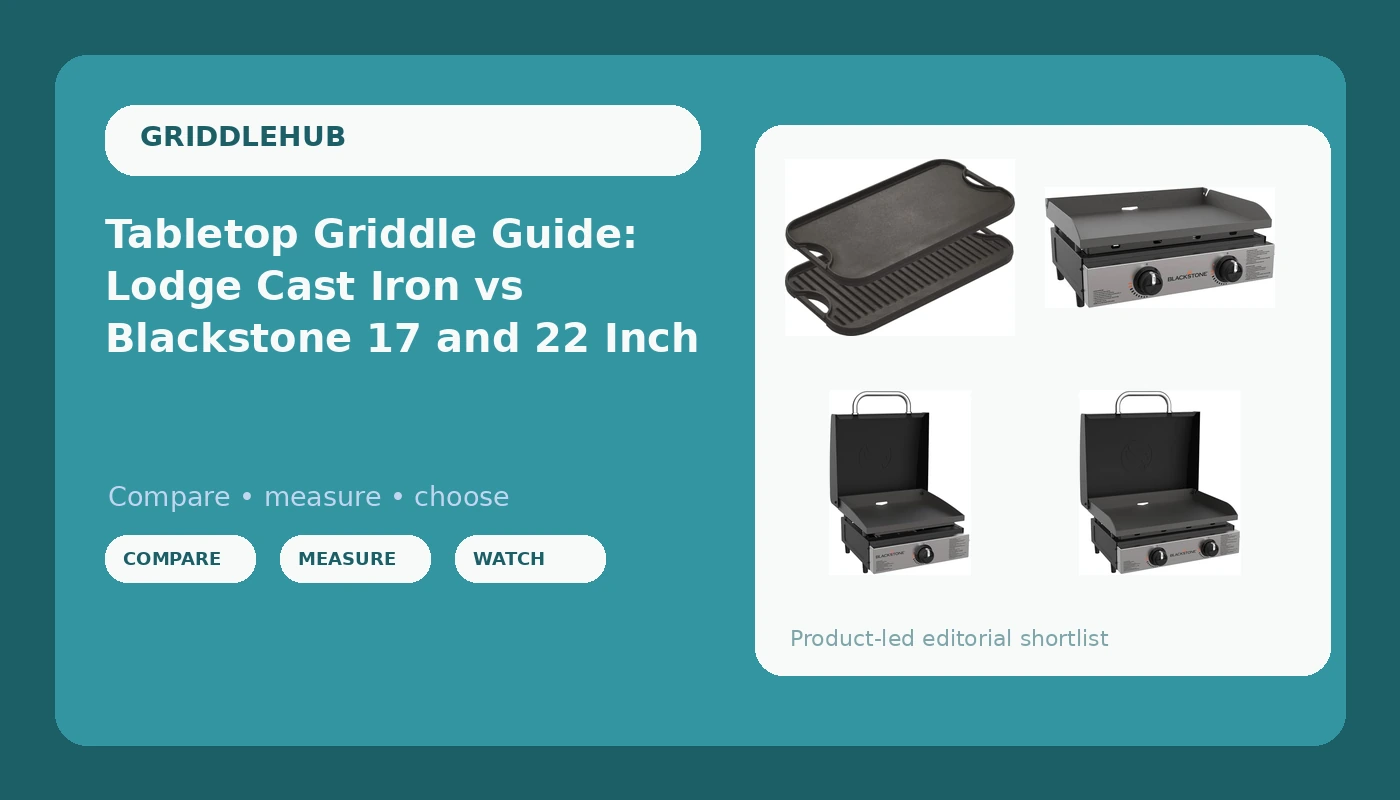
Lodge Pro-Grid Reversible Grill/Griddle: Best Cast Iron Pick
The Lodge Pro-Grid is 20 by 10.5 inches of cast iron, and it flips. One side is a grill surface, one side is flat, which means it does the job of two pans in one piece of iron. It is PFAS-free, so there is no coating to flake off in month three. If your version of a griddle cook is two steaks and a pile of onions, or you want to run it on a gas range in the kitchen and then carry it out to a fire, this is the one.
Cast iron does what cast iron does. It holds heat like a brick, it takes a while to get there, and once it is hot it does not care that you just dropped four cold patties on it. That heat retention is the reason I still keep a cast iron piece in rotation. The trade is weight and warm-up time, and both are real. This is not the griddle you pack for a tailgate unless you like carrying a small anvil.
Two things to know before you buy. The flat side is the side you will use 90 percent of the time, so think of the grill side as a bonus, not the headline. And cast iron is seasoning-dependent. Seasoning is a habit, not a one-time event: thin coats of oil, heat, repeat. Skip it and it rusts. Everything rusts if you neglect it, and I say that about every surface in this guide, including the expensive ones.
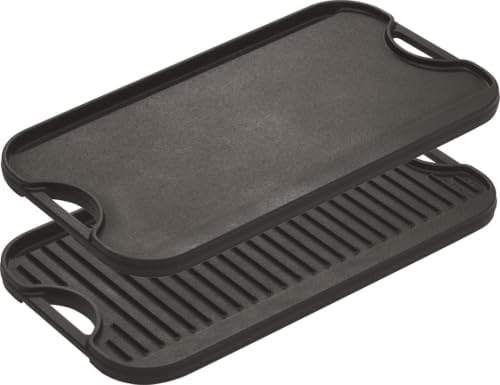
Blackstone 1666 22-Inch Tabletop Griddle: Best Step-Up Blackstone
The 1666 is the 22-inch Blackstone with a stainless steel faceplate and a powder coated steel body in black. The faceplate is the detail that matters to me, because that is where your hands live. It is the panel you grab, the surface that takes the grease splatter, and the part that looks like the unit you bought three years in. Stainless up front means it cleans up with a rag instead of a scrub.
The 22-inch footprint is the size I keep coming back to. It is big enough for a full breakfast for four, and small enough that you do not dread dragging it out of the garage on a Wednesday. You get one flat cooking surface, which is what you want. Nobody ever flipped a smash burger on a grill grate and thought, yes, this is better.
My rule on this class of griddle: the layout under the steel is the part I trust, and the accessory ecosystem around the 22-inch Blackstones is the deepest in griddling. Spatulas, scrapers, squeeze bottles, covers, and a griddle press are all easy to find and cheap. That matters more than it sounds, because a griddle without a scraper and a bottle of oil is just a heavy table.
Buy this one if you want the 22-inch cooking footprint and you care about how the unit wears. Buy the Original 22 with the hood if you want the lid and you are price-conscious. Both are the same size class, and neither will let you down if you season it and scrape it hot.
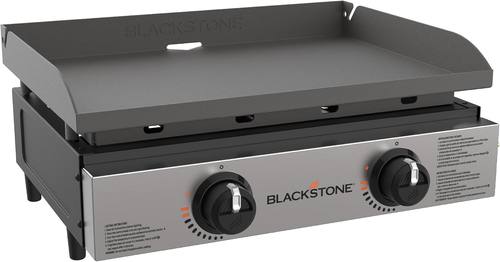
Blackstone 1814 17-Inch Propane Griddle: Best Small Patio Pick
The 1814 is a 17-inch propane griddle in black, and it is the answer to the question I get most: what do I buy for a balcony, a small patio, or a tailgate. You do not need 36 inches. You need enough space for what you actually cook on a Tuesday night, and for two people that is 17 inches of steel.
This is the unit I hand to people who are honest with themselves. If you cook for two, if your outdoor space is four feet wide, if you want a griddle that lives on a shelf and comes out when you want smash burgers and hash browns, this is the size. It heats up faster than the bigger steel because there is less of it to bring up to temperature, and it takes up less room in the truck.
The compromise is the crowd. Four people is fine on this if you plan the cook. Eight people is a negotiation. And the same rule applies here as everywhere: scrape it while it is hot, oil it thin, and it will hold its seasoning. Let it sit dirty overnight in the desert and it will punish you. That is not a knock on this unit. That is a knock on you.
Blackstone 1813 Original 22-Inch Tabletop Griddle with Hood: Best Overall
This is the one I would buy first. The 1813 is the Original 22-inch tabletop with a hood, and the hood is the part people underrate until they own one. Melt a slice of cheese over a burger, hold a pile of pancakes warm while the bacon finishes, keep the surface from taking every leaf in the yard. It also doubles as a windbreak on a cool morning, which matters more than anybody admits until the burners fight them at 6 a.m.
The 22-inch cooking surface is the sweet spot. It is enough for a full breakfast service for four people, meaning eggs, potatoes, bacon, and toast all coming off one surface in the same fifteen minutes. That is the test I actually run. Not a photo of a sear. A real breakfast, all of it hot at the same time.
My home unit is this size class, and it gets used three times a week. Smash burgers, hibachi for a crowd, a full breakfast on a Sunday, and the occasional batch of fried rice when I do not want to smell up the kitchen. A griddle turns you into the grill guy, and the guy with the 22 is the one everybody calls.
How I test a griddle
My rule is simple: nothing gets written up until it has cooked 100 smash burgers and a full breakfast service. Burgers find the hot spots. Breakfast finds the grease management, because eggs and bacon throw fat in a way a burger never does, and if the grease system is an afterthought you will spend the cook fighting it instead of cooking.
Then the seasoning test. I want to see how the surface holds up over 60 days of normal use, which includes the nights I do not want to clean it. I check the surface with a thermometer before I ever make a claim about heat, and I check it across the whole surface, not just the middle.
The last thing I check is the grease trap. Can you get it out with one hand? Can you clean it in a sink without a brush and a prayer? A bad grease trap ruins every cook, and it is the single most common corner cut on cheap units.
What actually decides a griddle
BTU count is a lie without burner layout. Four burners of nothing beats two burners of hype, and a big number on a box tells you nothing about whether the front of the surface runs hotter than the back. What you want is even heat you can steer, and a surface that recovers when cold food hits it. Steel thickness is what buys you that recovery. Thin steel spikes and drops, and you end up chasing the temperature all cook.
Temperature control is the other half. Independent zones mean you can run bacon on one end and hold finished burgers on the other, which is how a real short-order cook works. One zone means you cook in waves, and somebody eats cold.
Then it is grease and size. A removable trap you can dump and rinse makes the difference between a griddle that gets used and a griddle that becomes a chore. And size is about honesty. If you cook for two on a weeknight, a 17-inch unit will get used more than a 36 will. A griddle that stays in the garage is a griddle that was the wrong size.
One more thing: the scraper matters more than any gadget you will buy. Hot surface, thin layer of oil, scrape it down while it is still warm, and the surface will outlast the unit. Skip that and no amount of price will save it.
The tabletop griddle comparison table
| Model | Type | Surface | Best For | Price |
|---|---|---|---|---|
 Visit on Amazon → Visit on Amazon →Lodge Pro-Grid Reversible Grill/Griddle |
Cast iron, reversible, PFAS-free | 20 x 10.5 in | Range, fire pit, two to three people | Check current Amazon price |
 Visit on Amazon → Visit on Amazon →Blackstone 1666 22-Inch Tabletop Griddle |
Propane, stainless steel faceplate | 22 in | Buyers who care how the unit wears | $178.99 |
 Visit on Amazon → Visit on Amazon →Blackstone 1814 Propane Gas Griddle |
Propane, 17 inch | 17 in | Balconies, small patios, two people | $159.99 |
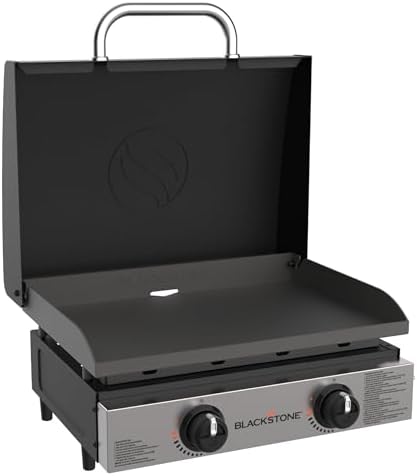 Visit on Amazon → Visit on Amazon →Blackstone 1813 Original 22-Inch Tabletop Griddle with Hood |
Propane, hood included | 22 in | Full breakfasts, four people, most kitchens | $219.99 |
Should you buy the Lodge Pro-Grid?
Yes, if you cook for two or three and you want one piece of iron that works on a gas range and then over a fire. It is PFAS-free, it flips, and cast iron gives you the heat retention that thin steel cannot fake.
Understand the trade. It is heavy, it takes time to heat, and it is not going to feed eight people at once. If you want a griddle for a crowd, this is not it. If you want the most durable cooking surface in the house and you will actually season it, this is the one I would hand you.
Should you buy the Blackstone 1666?
Yes, if you want the 22-inch footprint with a stainless steel faceplate where your hands live. It is the same size class as the Original 22, so you get the same cooking room, and you get a front panel that cleans up easily instead of holding onto grease and stains.
Buy it if you care how the unit looks and wears after a couple of seasons. If you mostly want the hood and the lowest entry into 22-inch cooking, the 1813 is the better call. Either way, same size, same accessory ecosystem, same rule: scrape it hot.
Should you buy the Blackstone 1814 17-Inch?
Yes, if you have a small patio, a balcony, or a truck bed and you cook for two. This is the size I recommend to anybody who admits they will not feed a crowd, and it heats up fast because there is less steel to bring to temperature.
The only reason to skip it is capacity. If your weekends mean eight people and a full breakfast spread, step up to a 22. If your weeknights mean two burgers and a pile of onions, this is the griddle that will actually get used.
Should you buy the Blackstone 1813 Original 22-Inch with Hood?
Yes. This is the one I would buy first. The 22-inch surface handles a full breakfast for four in one pass, the hood melts cheese and holds heat, and the accessory ecosystem around this size class is the deepest in griddling.
It is also the size that does not become a chore. It lives on a shelf or a cart, comes out in a minute, and gets used three times a week instead of twice a summer. That is the whole test for a griddle, and this one passes it.