A flat top griddle is the most versatile cooking surface you can own, and most people get three cooks out of one before it becomes a rusty slab in the corner of the garage. That is not a griddle problem. That is a habit problem.
I spent thirteen years as a line cook, eight of them working a four foot flat top at a diner that pushed out 400 breakfasts before ten in the morning. These days I run a food trailer and a backyard griddle that gets fired up at least three times a week, everything from smash burgers for the neighbors to hibachi for thirty people.
Learning how to run a flat top griddle comes down to three things: seasoning you build and keep, burner zones you actually use, and a grease management system that does not turn into a science experiment. Get those right and a cheap griddle will out cook an expensive one that got neglected.
Why you should trust me
Thirteen years on the line, eight of them on a flat top, and I still keep a scraper and a squeeze bottle of oil within arm's reach at all times. The diner owner who trained me used to say a flat top is a piano and you play it all day: one end for the hash browns, the middle for the eggs, the far side for the burgers, the whole thing moving at once.
That is the lens I bring to every griddle. Not how it looks under showroom lights, but whether the steel holds heat evenly across the surface, whether the grease trap can be cleaned without a chisel, and whether I would cook a full breakfast service on it on a Tuesday morning. A griddle that rusts is a griddle that got neglected, not a griddle that is bad, and I say that about every unit I write about, including the ones I like.
The two griddles below cover the two real situations: cooking outside on propane, and cooking on a countertop indoors. Same habits apply to both.
How I picked and how I tested
I did not run a lab here. I narrowed the field the way a short order cook does, with four questions that decide everything:
- Does heat spread across the steel, or is it hot in one lane and dead everywhere else?
- Does the grease trap actually work, or does it fill in one cook and overflow onto your shoes?
- Will the surface hold what you build on it if you slack off for a week?
- Would I cook a full breakfast service on it?
The BTU number on the box tells you almost nothing by itself. Four burners of nothing beats two burners of hype, and the layout of the burners under the steel matters more than the total count. That is why this guide leans on zones instead of spec sheet bragging.
I also split the field by where you cook. A propane flat top with a hard cover and side tables belongs in a yard or a driveway. A countertop electric griddle belongs in an apartment, a small kitchen, or a covered patio where an open flame is not an option. Those are two different jobs, and buying for the wrong one is the mistake I see most often.
What survived the cut was one outdoor propane griddle and one countertop electric. Everything else in this guide is technique, and technique is free.
The griddle you'll need before you start
You cannot learn seasoning on a warped cooking surface. A warped griddle is a lifetime of uneven burgers. Pick the surface first, then break it in properly.
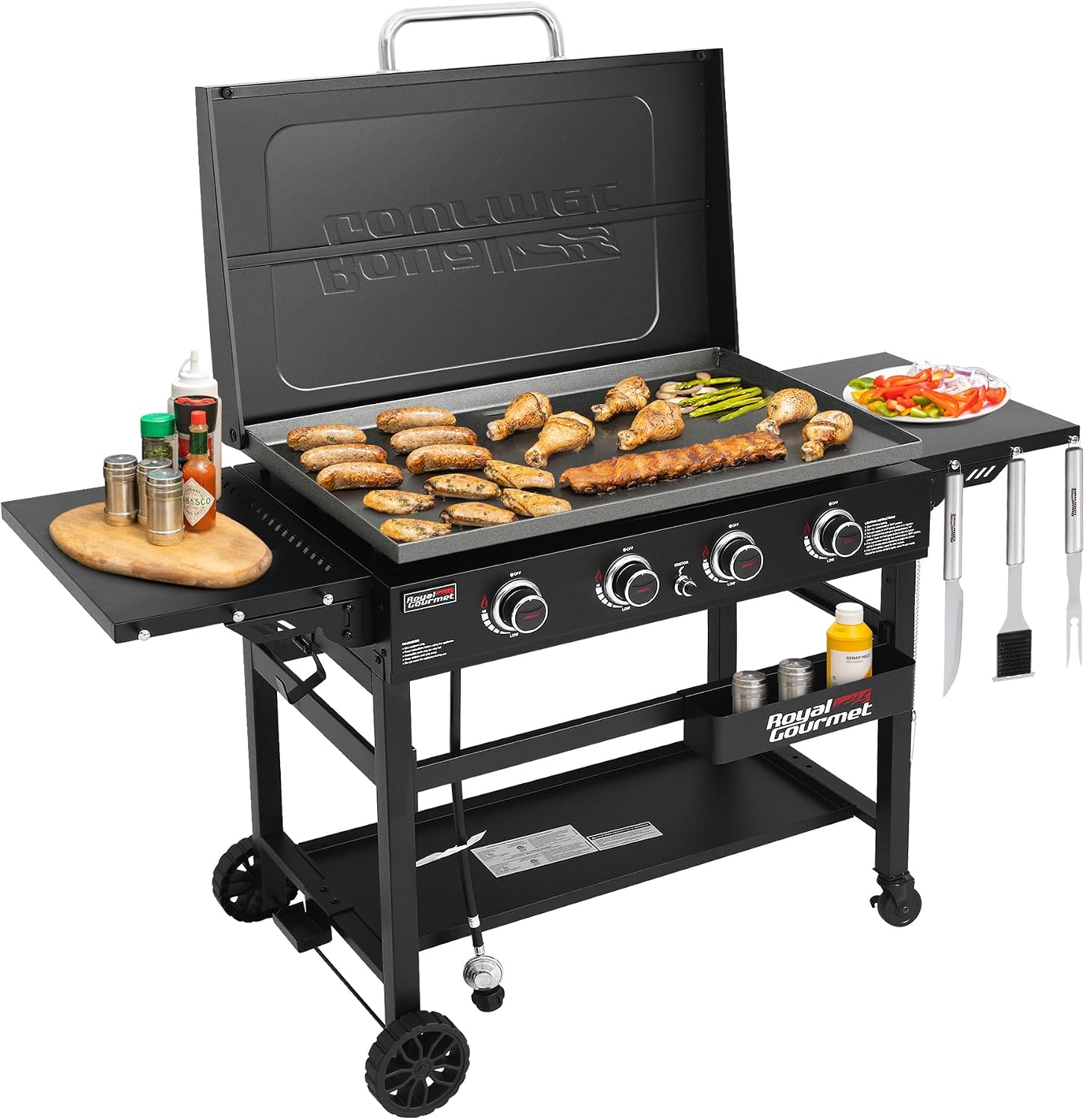
For the backyard: Royal Gourmet GB4000P 4 Burner Propane Gas Griddle, Hard Cover, Side Tables
 Visit on Amazon →
Four burners under one flat top, a hard cover, and side tables. The hard cover matters more than people think, because it is the difference between a surface you wipe down and a surface you scrape rust off of after a wet week. The side tables give you a landing zone for the scraper, the squeeze bottle, and the plate you are loading, which sounds minor until you have nowhere to set a spatula while both hands are full.
Four burners is the real selling point, because four burners means real zones. Potatoes on the far left, eggs in the middle, smash burgers on the right, and you can run all three at once without shuffling food around a single hot spot.
This is a propane unit, so it lives outside, needs a tank, and needs airflow around it. Royal Gourmet sits in the budget lane, and I will say that plainly: the steel is thinner than the premium names. Thinner steel heats up fast and gives heat back fast, which means you learn to cook with the burners rather than just on them. Season it properly and it cooks fine, and that is not a knock, it is a description. Check current Amazon price.
Anyone with a yard, a family to feed, and a Tuesday night burger habit will get their money out of this shape of griddle.
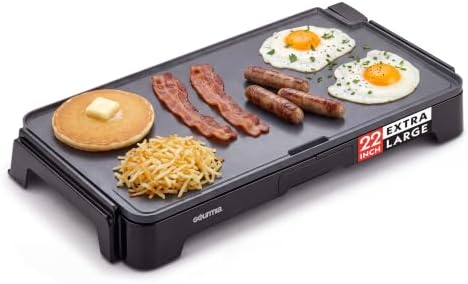
For the countertop: Gourmia 22 Inch XL Electric Griddle Pan - Nonstick Extra Large Flat Top Ceramic Surface, Countertop Cooker, Adjustable 200°F, 400°F, Pull-Out Drip Tray, Compact Handle-Free Design
 Visit on Amazon →
Twenty two inches of flat surface that plugs into a wall outlet. The dial runs from 200°F to 400°F, which covers pancakes and eggs at the low end and a proper sear at the top. The pull out drip tray handles the grease, and the handle free compact design means it stores on its side in a cabinet instead of owning your counter forever.
This is the griddle for anyone without a yard, and it is also the griddle for anyone in Phoenix in July who does not want to stand over a propane flame when it is 110 degrees outside. There is a real difference in how you treat the surface, though. A nonstick ceramic top is not carbon steel. You are not building a polymerized seasoning layer on it, you are protecting what the factory put there. Keep metal tools off it, use silicone or wood, wash it gently, and let the drip tray do the grease work.
The trade off is heat recovery. An electric element takes a moment to come back after you drop a pound of cold ground beef on it, so cook in batches rather than piling everything on at once. Check current Amazon price.
Small kitchens, apartments, dorms, and covered patios are where this one earns its place.
The actual workflow
Now the part you came for. This works on propane and electric, carbon steel and ceramic, cheap and expensive.
Step one: Pick the spot before you pick the griddle. A griddle needs airflow, a level surface, and enough clearance that you are not cooking with your forearms against a wall. For propane, that means outside and away from anything that can catch. For electric, that means a counter with an outlet you do not have to reach across a hot surface to unplug.
Step two: Season before the first cook. On carbon steel, heat the surface, wipe on a thin coat of a high smoke point oil, and let it smoke off. Thin coats, several of them, with the heat on. A thick coat turns into a sticky brown mess that you will be scraping for a week. Thin is the whole secret.
Step three: Learn your zones. Before you cook anything you care about, turn on one burner at a time and see where the heat lands. Every griddle has a hot lane. Knowing where yours is decides whether your pancakes come out even or half raw.
Step four: Preheat, then wait. Give the steel five to ten minutes after the burners light. A surface thermometer is the only honest way to know what you are cooking on, and I do not make temperature claims without one. Cold steel is why food sticks, and it is why people blame the griddle.
Step five: Oil the surface, not the food. A thin film of oil on the steel is what makes the sear happen. Pouring oil on the patty just steams it. Squeeze bottle, quick pass with a paper towel or a spatula, then the food goes down.
Step six: Cook in the diner's order. Potatoes first, because they take longest and they like the hottest zone. Then proteins. Then eggs, on the coolest zone, at the end, because eggs are the most sensitive thing on the surface. If you are running a breakfast service, this order is the difference between everything landing hot and everything landing at once, cold.
Step seven: Manage grease while you cook, not after. Push fat toward the trap as you go. A grease trap that fills mid cook is a grease trap that overflows onto your patio, and once it overflows you are cleaning instead of cooking. This is the single most common design failure on cheap griddles, so check yours before you buy, not after.
Step eight: Scrape hot, oil, cover. While the surface is still hot, scrape it down with a metal scraper, push the debris into the trap, wipe it with a thin coat of oil, and put the cover on. That is the whole maintenance routine. Two minutes, every time. Skip it for a month and you will meet rust, and everything rusts if you neglect it, including the expensive stuff.
The one caveat worth repeating: seasoning is a habit, not a one time event. It is also not permanent. A griddle you cook on three times a week keeps building. A griddle you ignore for two months starts over.
What did not make this guide
The 36 inch four burner class is a great surface and the wrong answer for most people. You do not need 36 inches. You need enough space for what you actually cook on a Tuesday night, and a bigger griddle means more steel to heat, more surface to season, and more grease to manage for the two burgers you are making after work.
The cheap portable griddles with warped surfaces got cut for a harder reason. A warped griddle is a lifetime of uneven burgers, and no amount of technique fixes a surface that does not sit flat.
Outdoor units sold as nonstick got cut too, because a coating that wears out in a season is a coating you cannot rebuild. Carbon steel you can always re season. A worn coating is a landfill decision.
And the countertop category in general got narrowed to one unit, because a bad drip tray on an indoor griddle is worse than no griddle at all. Indoors, the grease has nowhere to go.
What this all costs
Both griddles carry their current price on the product page, and the only honest way to quote a live price is to send you there. Check current Amazon price on the Royal Gourmet, and check current Amazon price on the Gourmia. What I can tell you is how to think about the number.
Divide the price by the cooks you will actually do in a year. Three cooks a week is roughly 150 cooks, and that math gets friendly fast. Twice a summer is not, and if that is your honest answer, buy a cast iron skillet instead and save the money.
Then budget for the accessories, because they are not optional. A metal scraper, a squeeze bottle for oil, a surface thermometer, and a cover. Those four things are the difference between a griddle that works and a griddle that frustrates you, and none of them are expensive.
Consumables are the cheapest part of the whole hobby. Oil, paper towels, and a scraper that lasts years. The griddle is the investment. The habits are free, and they are the reason a budget unit seasoned properly will beat a premium unit that gets left out in the rain.
That is the job. A flat top is a piano. Play it all day, scrape it down, oil it, cover it, and it will keep getting better every month you own it.