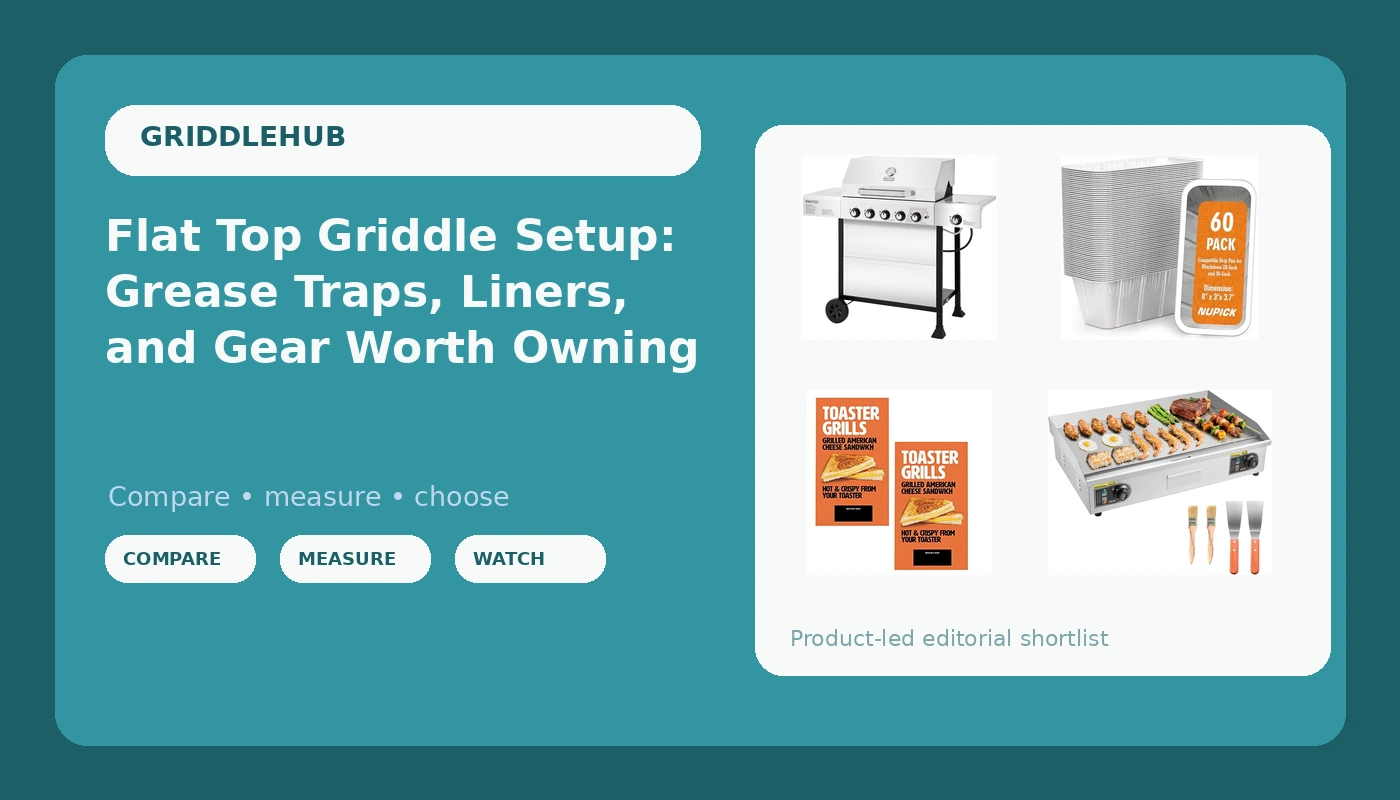
Related: How to Season a Flat Top Griddle So Nothing Sticks
I have spent 13 years on the line, eight of them standing at a four foot flat top in a diner that served 400 breakfasts before 10 a.m. Now I run a food trailer and a backyard griddle that gets fired up three times a week minimum. Every flat top griddle setup I have watched fail, failed in the same place: the grease. Not the steel. Not the burners. Not the BTU number printed across the front of the box.
So this is not a shopping list. It is the four pieces that decide whether you cook or whether you fight your equipment, in the order they matter. A cooking surface, a second cooker for volume, a grease system that does not turn into a science experiment, and a cheap test load that tells you in four minutes whether the surface is ready.
I test gear the way a short order cook does, because that is the only test that has ever mattered to me. 100 smash burgers, a full breakfast service, and a seasoning check at 60 days to see how long it takes the surface to start rusting if you slack off. Everything below earns its place against that standard. If a piece of gear cannot survive a Saturday, it does not belong in the setup.
The Countertop Flat Top: VEVOR Commercial Electric Griddle, 30"
This is the surface that starts the whole conversation. It is a 30 inch commercial style electric flat top built for countertop use, which puts it in a different category from the propane units most people picture when they hear the word griddle. Electric means no open flame under the steel, no wind fighting your flame on a patio, and a heat source that behaves the same in January as it does in July. In Phoenix that matters less than it does in Minnesota, but consistency is consistency.
The listing says no plug. Read that twice before you buy. You are planning the power side yourself rather than hoping a household cord reaches from the nearest outlet. For a food trailer or a garage setup, that is a feature, because you were going to deal with the electrical anyway. For a guy who wants to unbox it on a Saturday and cook by noon, it is a project, and you should know that going in.
Thirty inches is the number I would pick for a home setup, and I will defend it. You do not need 36 inches. You need enough space for what you actually cook on a Tuesday night: four smash burgers, a pile of onions, and a couple of buns toasting on the side. A 36 inch surface is more steel to heat, more steel to season, and more surface to scrape at midnight. Buy the size you will actually use, not the size that looks impressive in a photo.
Two things decide whether any flat top is worth keeping. First, does the heat spread evenly across the surface, or does it pool in the middle and leave the corners cool? Second, will the steel hold its seasoning for 60 days of real cooking? A griddle that rusts is a griddle that was neglected, not a griddle that is bad. I have said that for years and I will keep saying it. Seasoning is a habit, not a one time event.
The Backyard Anchor: Royal Gourmet GA5401T 5-Burner Gas Grill
Let me be straight about what this is. It is a liquid propane gas grill: five main burners, a side burner, stainless steel construction, and 61,000 BTU of rated output, built for patio, backyard, and picnic cooking. It is not a flat top. If you are looking for a griddle surface, this is not it, and I would rather tell you that than pretend otherwise.
What it is good for is the other half of a real backyard setup. A flat top handles the sear, the smash burgers, the breakfast service, the fried rice, the things that need contact with hot steel. A five burner grill with a side burner handles volume: a dozen burgers held warm, corn, skewers, a pot of beans on the side burner while the griddle is covered in onions. When you are feeding 20 people, one cooking surface is not enough, and the second cooker is what keeps you from standing there plating in shifts.
Now the BTU conversation, because it is where most people get fooled. BTU count is a lie without burner layout. Five burners of rated output tells you about total capacity, not about control. What you want to know is whether you can hold a low zone on one end and a screaming hot zone on the other. More zones equal more control equal better cooks. That principle holds on a griddle and it holds on a gas grill. Treat the number on the box as a starting point, not a verdict.
If you are building a setup for a crowd, this is the piece that makes the flat top usable, because it takes the pressure off the flat top.
The Grease Trap Fix: NUPICK Grease Cup Liners
This is the part nobody writes about and everybody fights. The grease management system decides whether you cook or whether you clean, and a bad grease trap ruins every cook that comes after it. You know the scene. You finish a batch of bacon, you go to dump the cup, and the fat has cooled into a layer that needs a chisel. Now you are scraping a cup at the sink instead of cooking the eggs.
Sixty disposable aluminum liners, sized for the grease cups and drip pans on griddles in the 17 to 36 inch range. You drop one in the cup before you cook, you pull it out when it is full, and the cup underneath stays clean. That is the entire pitch, and it is enough. This is the single cheapest upgrade to any flat top setup, and it is the one that pays you back on the second Saturday.
Match the liner to your cup. That is the only real decision here. Griddles come with different cup shapes and different drip pan widths, and a liner that does not sit flat in the cup is worse than no liner at all, because fat gets underneath it and you are back to the chisel. Measure your cup before you order, then buy the pack that matches it. Sixty of them is a season of heavy cooking for most backyard cooks, and a couple of months in a food trailer.
The Test Load: Lily's Toaster Grills Grilled Cheese
Two boxes, eight grilled American cheese sandwiches in each, sixteen total. I will tell you why this belongs in an article about flat tops, and it is not because it is dinner.
A grilled cheese is the most honest surface test there is. It tells you three things at once. Is the surface hot enough to brown bread without drying it out? Is the seasoning layer intact, or is the sandwich going to tear and stick? And is the heat even across the zone you are using, or is one half of the bread golden while the other half is pale and sad? Four minutes, one sandwich, and you know more about your griddle than any spec sheet will tell you.
If the bread sticks, your seasoning is not built yet, and you go back to thin coats of oil and heat. If the bread browns unevenly, you have found a hot spot, and you learn to work around it or you learn that the steel is not distributing heat the way it should. That is diagnostic information you can act on.
It is also just practical. Sixteen grilled cheese sandwiches in the freezer is a lunch you can put on the flat top between bigger cooks, and it is food that a kid will eat without negotiation. Keep a couple on hand for the days when you are testing a new surface and you want a cheap, low stakes way to find out if it is ready.
How I test a flat top griddle setup
The same way every time. 100 smash burgers. A full breakfast service: bacon, eggs, hash browns, pancakes, all on the same surface, in the order a short order cook would actually cook them. Then the seasoning check at 60 days, which is the one that separates the machines that last from the machines that rust.
Hot surface, thin layer of oil, smash it flat. Thirty seconds and flip. That is the rhythm, and a surface that cannot keep up with that rhythm is a surface that will frustrate you by week three. I am looking for even browning across the full width, no warped steel out of the box, and burners that light on a cold morning without a fight.
I also time the cleanup, because cleanup is where flat tops lose owners. If the grease cup takes ten minutes to deal with, you will cook less. That is not a small thing. It is the whole thing.
What the setup actually looks like on a Tuesday
The gear list above is built for the weekend crowd, so let me scale it back down to reality. On a normal Tuesday, one surface and one scraper is the whole operation. A 30 inch electric flat top, a squeeze bottle of oil, a metal scraper, and a liner in the grease cup. That is a setup that cooks burgers, breakfast, fried rice, and quesadillas without a single accessory you have to hunt for in a drawer.
The grill and the crowd sized cooks come out on Saturdays. The grease liners get used every single time. The grilled cheese is what I reach for when I want to know if the surface is behaving, or when I want lunch in four minutes.
If I had to rank these by how much they change your cooking, the liner is first, the surface is second, and everything else is optional. Seasoning is a habit. Grease management is a system. Get the system right and the cooking takes care of itself.
Flat top griddle setup reference table
| Piece | What it is | Where it fits | What to watch |
|---|---|---|---|
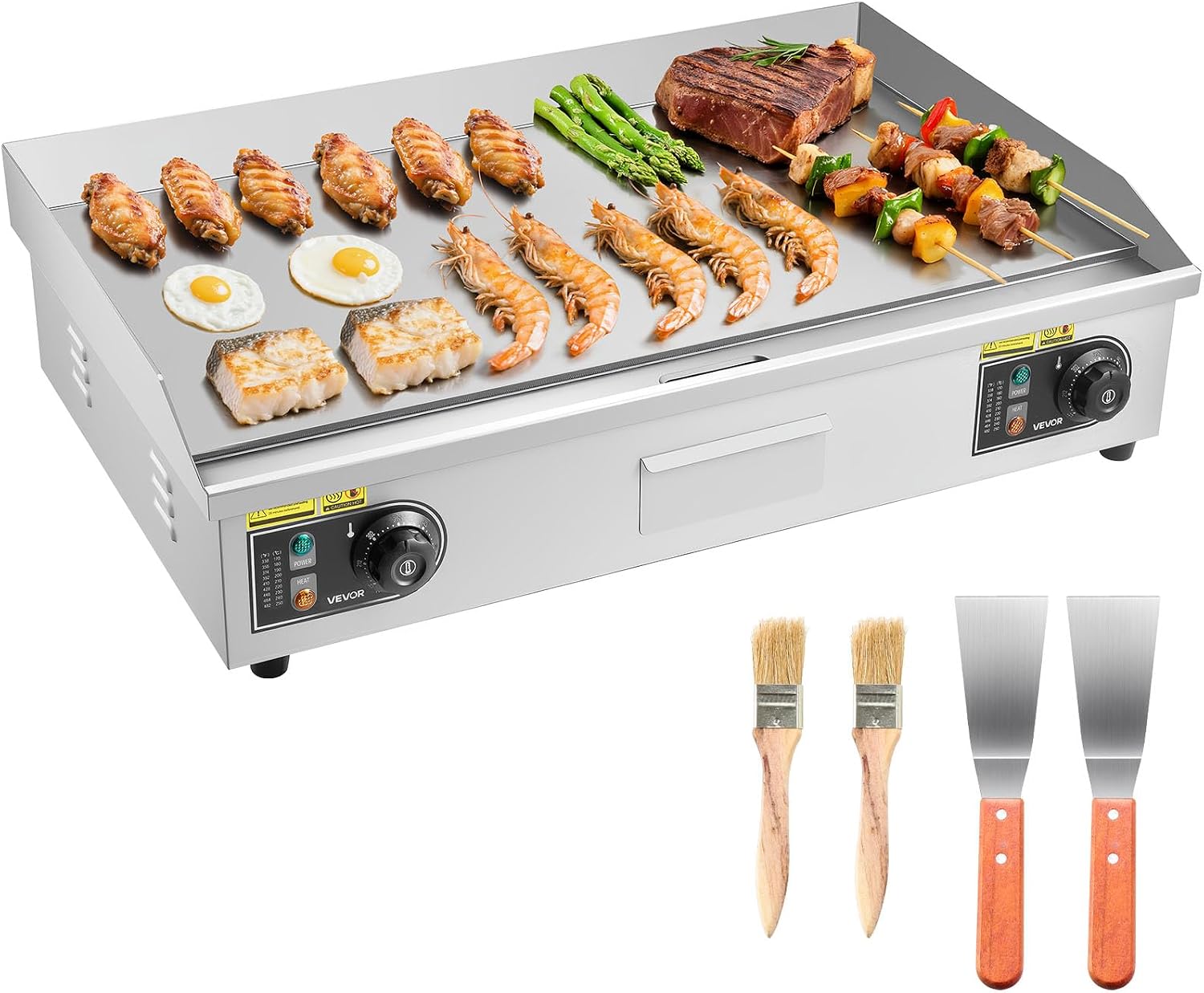 Visit on Amazon → VEVOR 30 inch commercial electric flat top |
The main cooking surface | Countertop, trailer, garage, covered patio | No plug included, so plan the power before you buy |
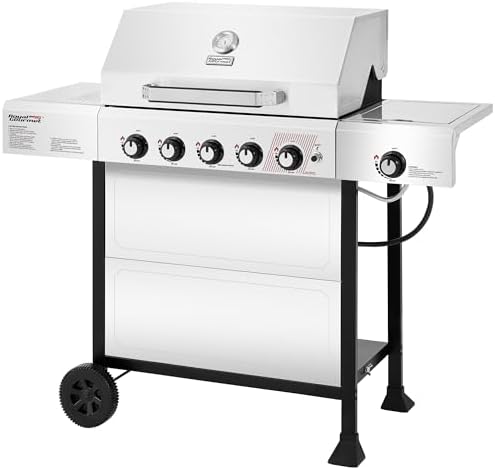 Visit on Amazon → Royal Gourmet 5 burner propane grill |
The second cooker for volume | Backyard, patio, feeding a crowd | It is a grill, not a flat top. BTU is capacity, not control |
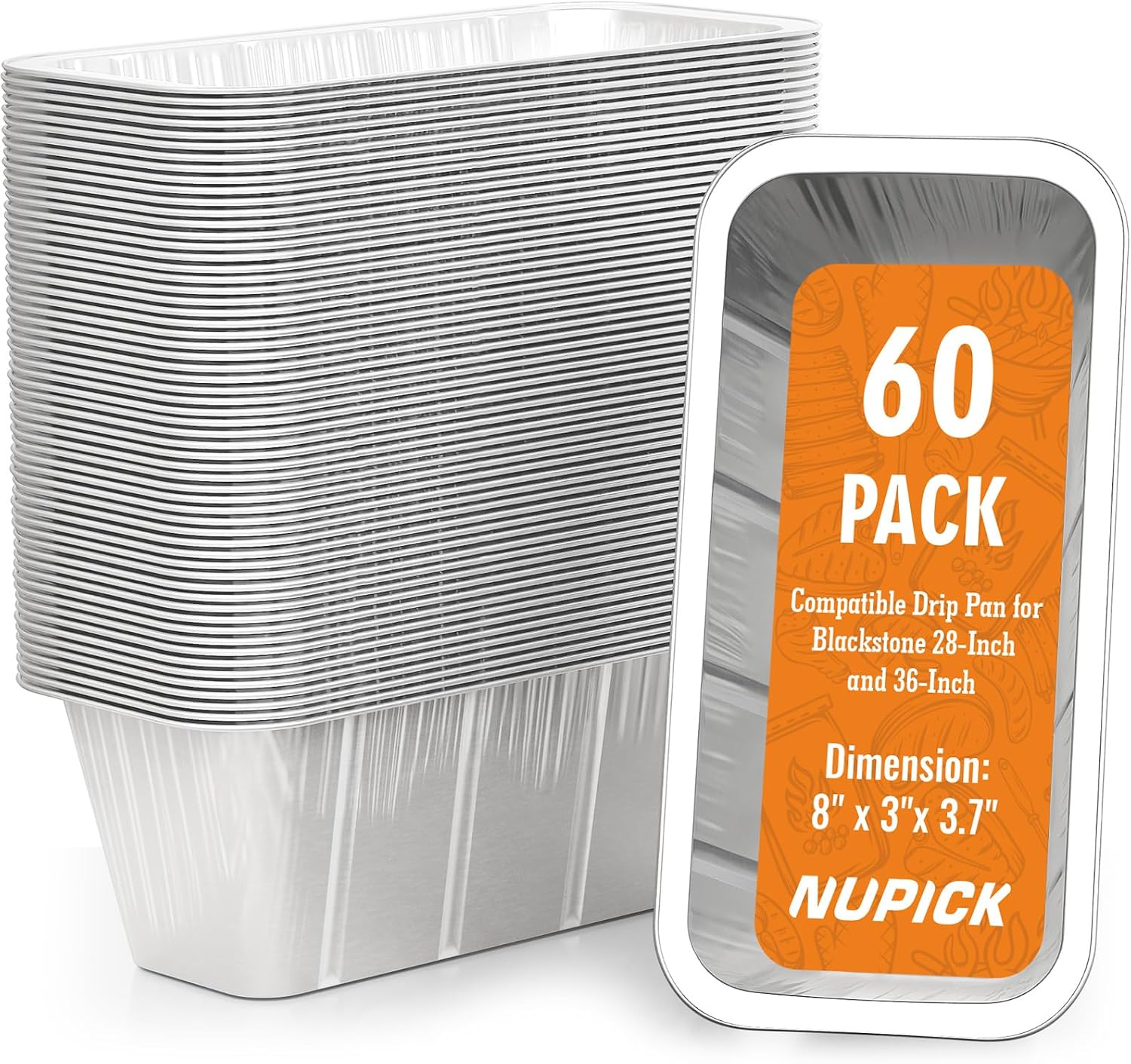 Visit on Amazon → NUPICK grease cup liners, 60 pack |
Keeps the grease trap from becoming a chore | Any griddle in the 17 to 36 inch range with a cup or drip pan | Match the liner to your actual cup size |
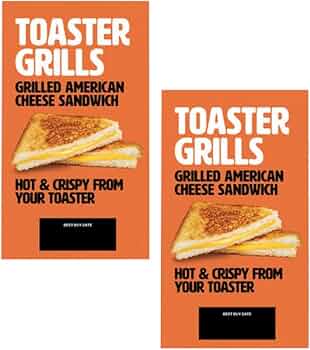 Visit on Amazon → Lily's Toaster Grills grilled cheese, 16 total |
Cheap surface test and a fast lunch | Freezer to flat top in minutes | Treat it as a diagnostic, not a meal plan |
Should you buy the VEVOR Commercial Electric Griddle?
Yes, if your cooking happens indoors, in a trailer, or under a covered patio, and you are willing to sort out the power. The listing says no plug, which means you own that decision instead of discovering it on delivery day. Thirty inches is the size I would recommend to almost anyone. You do not need 36 inches to cook well, and a smaller surface seasons faster, heats faster, and cleans faster.
The thing I would check first is heat distribution across the full width. If the middle runs hot and the corners lag, you learn to work the zones, the same way you would on any commercial surface. That is a technique problem, not a deal breaker. What would be a deal breaker is warped steel out of the box, and you find that in the first cook, not in month six.
Should you buy the Royal Gourmet GA5401T?
Yes, if you are feeding a crowd and you want a second cooker so the flat top is not doing everything alone. Five burners and a side burner give you room to hold food warm and finish sides while the griddle stays busy. 61,000 BTU tells you it can move volume.
Just keep your expectations straight. It is a propane grill. It is not a flat top, and it will not sear a smash burger the way hot steel does. Buy it for the volume, keep the flat top for the crust, and the two together will out cook any single machine in your backyard.
Should you buy the NUPICK grease cup liners?
Yes. This is the one I would buy before anything else on the list. Sixty disposable aluminum liners turn the worst part of owning a griddle into a five second job. Pull the liner, drop in a new one, get back to cooking. If your current routine involves a chisel and a sink full of cold fat, you already know why this matters.
Should you buy Lily's Toaster Grills grilled cheese?
Yes, as a test load and a fast lunch. Sixteen sandwiches is enough to run a surface test, feed the kids on a Saturday, and still have a couple left for the next time you season a new griddle. If the bread browns even and lifts clean, your surface is ready. If it sticks, you know exactly what to work on.