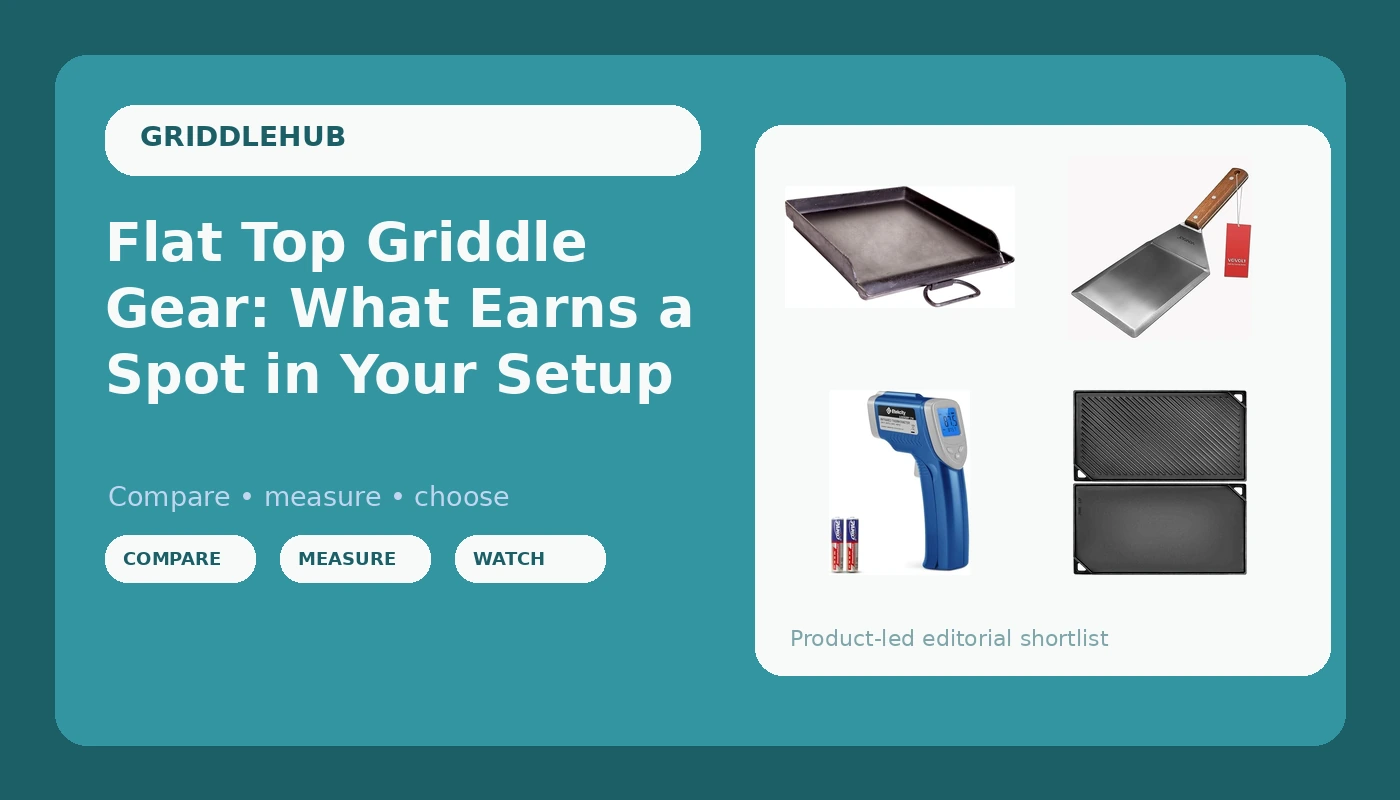
A flat top griddle essentials list is easy to get wrong, because the gear that matters on a Tuesday night is rarely the gear that looks impressive in a product photo. Most people buy a cooking surface first, then discover the surface is only part of the setup. You need something to move food with, something to tell you what the steel is actually doing under your hand, and a backup surface for the nights when the big unit stays in the garage or the weather turns. The four items below cover those jobs without padding out a drawer with gadgets you will touch twice a year.
Related: How to Season a Flat Top Griddle So It Stays Nonstick →
Quick answer
A compact outdoor setup needs four things: a cooking surface, a wide spatula, a surface thermometer, and a secondary griddle surface. The Camp Chef Single-Burner Griddle is the primary cooking surface at 224 square inches. The extra wide metal spatula is the tool you will pick up every single cook. The Etekcity infrared thermometer reads the surface instead of guessing at it. The GGC reversible cast iron griddle adds a second surface for indoor or campfire cooking. Buy the surface first, then the tools that support it.
Four useful options
| Model | Best fit | What stands out |
|---|---|---|
| Camp Chef Single-Burner Griddle, 14x16 in., 224 sq in | A small patio or tailgate setup where one strong burner zone is enough | A dedicated single-burner flat top with a 224 square inch surface and a 14 by 16 inch footprint |
| Extra Wide Spatula, Large Metal Spatula with Full Tang Wooden Handle & Beveled Edges | Anyone flipping smash burgers, pancakes, or hash browns on a flat surface | A 6 by 5 inch blade with beveled edges and a full tang wooden handle |
| Etekcity Infrared Thermometer Laser Temperature Gun 774, Blue | Cooks who want to know the surface temperature before the food goes down | Non-contact infrared surface reading with laser targeting |
| GGC Reversible Cast Iron Griddle, 16.5" x 9.5" Rectangular Griddle Pan | Indoor cooking, campfire cooking, or a second surface alongside an outdoor flat top | Reversible cast iron with a flat side and a ridged side in one 16.5 by 9.5 inch pan |
The cooking surface: Camp Chef Single-Burner Griddle, 14x16 in., 224 sq in
A single burner means a single heat zone, and that is the honest trade-off here. You are not getting the independent zones that let you run a cool corner for eggs and a screaming hot side for searing at the same time. What you get instead is simplicity and a footprint small enough to live on a balcony. You manage temperature by moving food around the surface and by adjusting the one dial, which is exactly how line cooks worked short-order stations for decades. If you cook for two to four people and you are not trying to run a full breakfast service, one well-managed zone is plenty. If your weekend plan involves a griddle full of smash burgers plus a pile of onions, you will feel the ceiling of a single zone quickly.
The everyday tool: Extra Wide Spatula, Large Metal Spatula with Full Tang Wooden Handle & Beveled Edges
A narrow kitchen turner is the wrong tool on a flat top. The blade is too small to support a patty, the edge is too thick to get under a smash burger that has crusted onto the steel, and the handle is usually short enough that your knuckles ride close to the surface. A wide blade with a beveled leading edge changes the whole cook. You press, you slide, you lift, and the food comes up in one piece. The full tang matters for a different reason: a spatula takes a lot of torque when you are scraping and pressing, and a handle that is only glued into a socket will eventually give. Wood stays cooler in the hand than bare metal, which matters when you are working over a hot surface for an hour.
The temperature check: Etekcity Infrared Thermometer Laser Temperature Gun 774, Blue
Hand test and visual cues only get you so far. An infrared thermometer lets you check the actual surface temperature at several points across the griddle, which is how you find out whether one corner runs hotter than the rest. That is genuinely useful information: it tells you where to put the eggs and where to put the sear. Two caveats are worth stating plainly. Infrared readings are surface readings, so a shiny or highly reflective surface can throw the number off, and the reading is only as good as the distance and angle you hold the unit at. Use it as a comparison tool, checking the same way every time, rather than as an absolute laboratory measurement.
The second surface: GGC Reversible Cast Iron Griddle, 16.5" x 9.5" Rectangular Griddle Pan
This is the piece that covers the nights when the outdoor flat top is not the right answer. Cast iron holds heat well, which means it recovers faster after you drop cold food on it, and it moves between a stovetop, an oven, and a campfire without complaint. The reversible design gives you a flat face for pancakes, eggs, and smash patties, and a ridged face for anything you want lifted off the surface. The trade-off is weight and warm-up time. Cast iron is heavy, it takes longer to come up to temperature than thin steel, and it demands the same seasoning discipline as any other iron surface. Neglect it and it rusts, same as everything else.
Prices and availability may change. Product images, names, and retailer links are matched to verified listings. No current price, rating, stock status, or measured result is stated here without current evidence.
Why burner zones and surface material matter more than headline numbers
A griddle is a heat delivery system, and the number that gets printed on the box is rarely the number that decides how it cooks. Total output tells you how much heat the burner can produce, not where that heat goes. What actually shapes a cook is the layout: how many independent zones the surface is divided into, and whether the steel is thick enough to spread heat sideways instead of leaving a hot ring directly over the flame. Two well-placed burners under a thick plate will out-cook four burners under a thin one for most home cooking, because the thick plate evens out the peaks.
Surface material matters just as much. Thin steel heats fast and responds quickly to dial changes, which is convenient, but it also develops hot and cold spots and can warp if it is heated hard and cooled fast. Cast iron and heavier steel plates take longer to come up to temperature, then hold that temperature and recover faster when cold food lands on them. Neither material is automatically better. The question is whether you want fast response or steady heat, and how much weight you are willing to move.
Then there is the part nobody puts on the box: grease management. A griddle produces a surprising volume of fat, and if the trap or channel is awkward to remove and clean, the fat pools, burns, and turns the surface into a mess. A removable, accessible trap is worth more day to day than a slightly larger cooking area. If you are comparing two units and everything else is close, pick the one you can clean without tools.
How to build seasoning that survives the week
Seasoning is polymerized oil bonded to the metal, and it is built in thin layers, not poured on. The process is the same whether you are working with a single-burner flat top or a cast iron pan.
- Clean the surface down to bare metal and dry it completely, because seasoning will not bond over moisture or leftover residue.
- Warm the surface to a moderate temperature, not a screaming one, so the oil can spread and polymerize evenly instead of scorching in patches.
- Apply a very thin coat of a high smoke point oil across the entire surface, then wipe most of it back off. A surface that looks wet is over-oiled and will go sticky.
- Let it sit at temperature until the sheen turns from glossy and tacky to dry and slightly matte, then repeat the thin coat two or three more times.
- Cook on it. Fat from real cooking continues building the layer, and scraping the hot surface after each cook keeps it level and clear.
Practical guidance for a small setup
- Match the surface to the number of people you actually cook for, not the number you imagine hosting.
- Buy the wide spatula before you buy anything else. It is the tool that makes the surface usable.
- Keep a thermometer in the kit and check the surface at several points, not just the center.
- Keep a dedicated scraper for the hot surface and clean while the griddle is still warm, when food releases easily.
- Store cast iron and carbon steel dry, with a thin oil film, because rust is a maintenance failure, not a product defect.
- Season in thin layers and accept that the first few cooks will look patchy. Even color comes with repetition.
Which option should you choose?
Choose the Camp Chef Single-Burner Griddle, 14x16 in., 224 sq in when you want a real flat top surface on a small patio, tailgate, or camp setup and you can manage one heat zone well. Choose the Extra Wide Spatula, Large Metal Spatula with Full Tang Wooden Handle & Beveled Edges for Skillets, Griddles & Grills, Pancake Flipper Turner, Smash Burgers Turner, 6 x 5-inches when you are cooking on any flat surface and want a blade that can lift a whole patty without tearing it. Choose the Etekcity Infrared Thermometer Laser Temperature Gun 774, Blue when you are tired of guessing and want to compare surface temperatures across the griddle. Choose the GGC Reversible Cast Iron Griddle, 16.5" x 9.5" Rectangular Griddle Pan when you need a second surface that works indoors, in an oven, or over a fire and you are willing to handle the weight.
The caveat is that none of these are universal answers. A single burner is a real constraint if you routinely cook for a crowd, an infrared reading is a comparison tool rather than a precision instrument, and cast iron demands upkeep. Buy for the cooking you do most weeks, not the cooking you do twice a year.
The bottom line
A flat top griddle essentials kit does not need to be large. One cooking surface sized to your actual Tuesday night, one wide spatula with a beveled edge, one thermometer so you know what the steel is doing, and one reversible cast iron pan for everything the outdoor unit cannot reach will cover the overwhelming majority of what you cook. The gear matters less than the habits around it: thin layers of seasoning, a clean grease path, and a hot surface scraped down after every cook. Get those right and almost any surface will serve you for years.