A flat top griddle is the most forgiving cooking surface in your backyard and the most neglected. Learning how to season a flat top griddle takes about an hour, one bottle of oil, and the willingness to let steel smoke for a while. The bad news is that most people skip the break-in entirely, cook a batch of bacon on bare metal, and then wonder why their eggs stick by October.
I ran the flat top at a diner that served 400 breakfasts a morning for eight years. Every one of those mornings started the same way: burners on, thin film of oil, scraper in hand. A griddle does not care what you paid for it. It cares whether you fed it oil in thin layers and kept water off it.
This is the routine I use on a brand new griddle, and the same routine I use to bring a rusted one back from the dead.
Why you should trust me
Thirteen years on a line, eight of them on a four foot commercial flat top. I have cooked more eggs than most people have eaten. Now I run a food trailer and a backyard griddle that gets fired up three times a week minimum, everything from smash burgers to hibachi for thirty people.
The test I run on any flat top is the test the diner ran on me. One hundred smash burgers. A full breakfast service. Then the part nobody wants to do, which is sixty days of paying attention to whether the seasoning holds or the steel starts showing rust the first time I get lazy and leave it wet overnight.
I keep a scraper and a squeeze bottle in my truck at all times. That is not a personality. That is the toolkit.
How I picked and how I tested
Every griddle I look at gets judged on four things: does the heat spread across the surface or pool in the middle, does the grease management work when you are cooking a pound of bacon, does the steel hold its seasoning for two months, and would I cook a full breakfast service on it without cursing.
That is why there are only two shapes in this guide. A freestanding flat top for people who will cook outside every weekend, and a cast iron drop-in for people who already own a gas grill and want to find out whether they actually like cooking on steel before they buy a cart. Both surfaces season the same way. The routine does not change.
When a griddle is new to me, I check surface temperature with an infrared thermometer across the corners and the middle, because a plate that runs hot in the center and cool at the edges will lie to you on the first cook. I do not trust "it gets hot" as a review, and I do not trust a BTU number on a box without knowing the burner layout underneath it.
The two surfaces worth your money
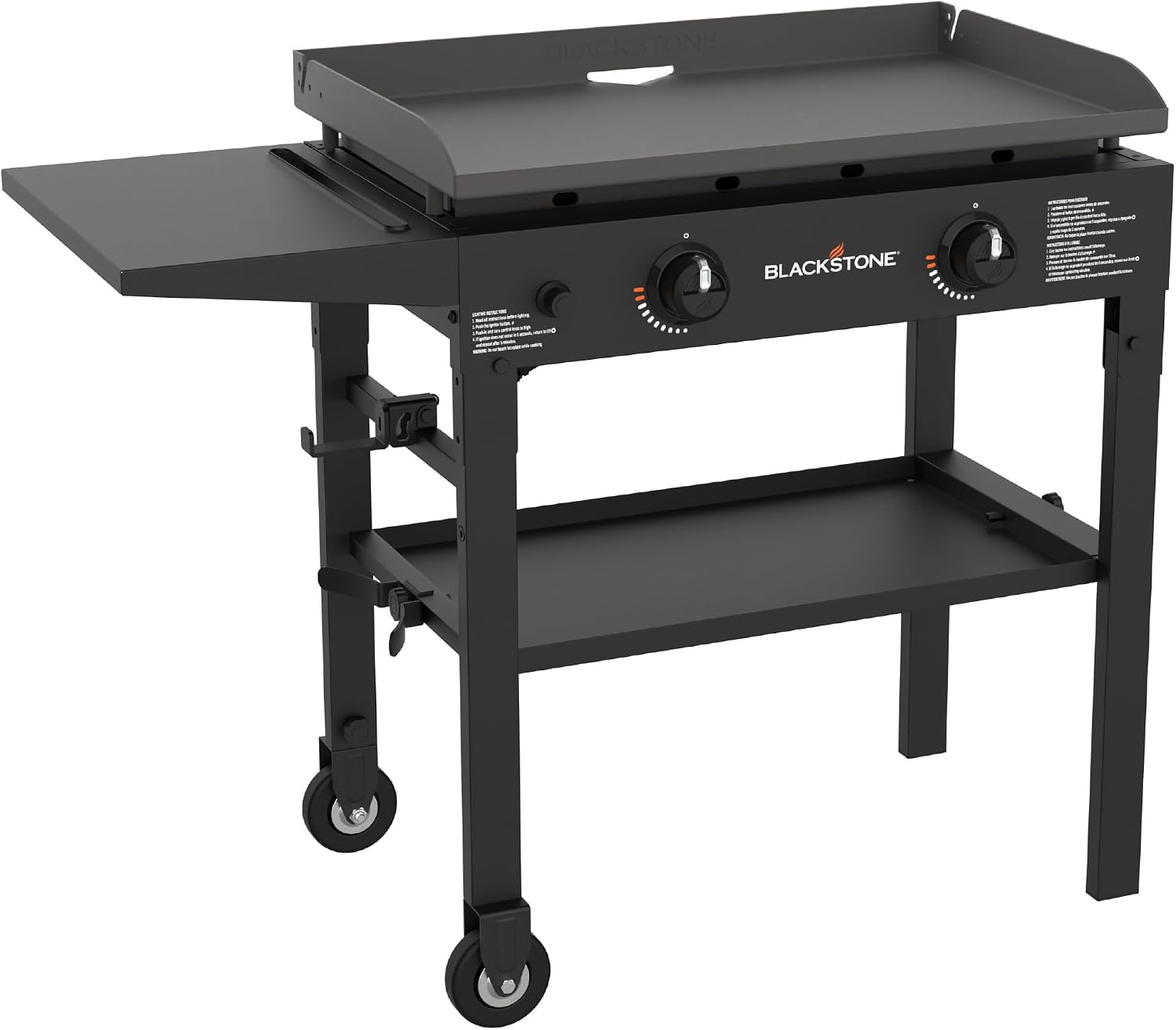
The full-size pick: Blackstone® 1517 Original 28" Omnivore Griddle, Black
 Visit on Amazon →
Twenty-eight inches is the size I tell most people to buy. Not thirty-six. The math is simple: you need enough surface for what you actually cook on a Tuesday night, and the extra width on a bigger unit is dead space you still have to season, scrape, and cover. Twenty-eight inches handles a full family breakfast and a smash burger session for six without turning your patio into a permanent landmark.
The Omnivore name is Blackstone's griddle top design, and the practical thing it buys you is even heat across the plate, which matters more than any burner number on a spec sheet. You want a surface that reads the same temperature at the left edge as it does in the middle. That is the whole game with flat tops, and it is why the burner layout matters more than the hype.
Check current Amazon price before you order, and budget for a cover in the same breath.
This is the one to buy if you are going to feed people. It is also the one that will punish laziness, because a wide plate takes longer to season evenly and shows every dry spot you leave behind.
Flaws but not dealbreakers: It is big, it is heavy, and it wants a cover. Steel rusts. Everything rusts if you neglect it, and this plate is no exception.
Anyone who cooks outside more than once a week and has a patio corner to give up will get their money's worth by the second month.
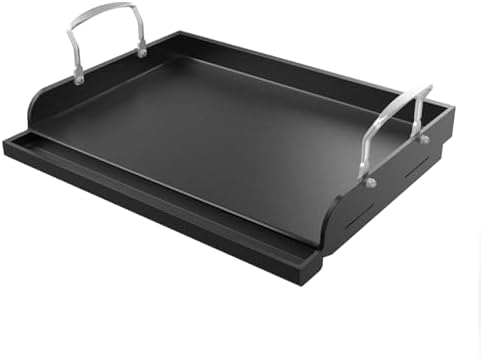
The drop-in pick: Cast Iron Griddle for Gas Grill Griddle 17 x 13 Inch Flat Top
 Visit on Amazon →
Cast iron seasons the same way a griddle plate does, with thin coats of oil and heat, and this 17 by 13 inch flat top drops over the grates of a gas grill you already own. That is the entire pitch. You are not buying a cart, a regulator, or a second propane tank. You are buying a surface.
The tradeoff is size and warm-up. Seventeen by thirteen is enough for four burgers, a two person breakfast, or a batch of onions and peppers for fajitas. It is not enough for a full diner service, and it never will be. Cast iron also wants a slow preheat rather than a blast, because dumping heat into a cold plate is how you encourage a warp.
For a small household, a rental patio, or somebody who wants to test whether flat top cooking fits their life before committing to a full unit, this is the cheap way in. Check current Amazon price and compare it against what a freestanding griddle would cost you to use twice a summer.
Flaws but not dealbreakers: It is heavy, and it stays hot long after you kill the burners, so plan where it lands when you pull it off. Set it on a plastic folding table and you will learn something about cast iron.
The seasoning routine, step by step
Seasoning is not a product you buy in a bottle. It is polymerized oil, which is a fancy way of saying you burned a very thin layer of fat onto the steel until it turned into a hard, dark, slick shell. Here is how to build that shell without wasting a bottle of oil and a Saturday.
Step one: strip the shipping oil. New plates come coated in a factory oil that is there to stop rust in the warehouse, not to cook on. Hot water, a little dish soap, a rag. Dry it immediately and completely. Do not let it air dry.
Step two: heat it dry. Burners on medium until a flick of water beads and skates across the surface instead of sitting there and evaporating. That drives off moisture and opens the pores of the steel.
Step three: kill the heat and wait for warm. Wipe on a thin coat of high smoke point oil. Flaxseed, canola, grapeseed. Thin is the entire game. If the surface still looks wet and shiny, you used too much, and too much oil turns into a sticky brown patch instead of seasoning. Wipe it again with a clean rag like you are trying to remove it.
Step four: heat until it smokes, then until it stops. Let it cool enough to touch with a rag, and repeat three to five times. Each pass darkens the plate a shade. You are not looking for black on day one. You are looking for a uniform amber to brown.
Step five: cook fatty food first. Bacon, smash burgers, sausage, onions. Fat is free seasoning. Save the acidic cooks for later.
Step six: scrape while hot, every single cook. Water on a hot plate, scraper, wipe with a rag, thin oil. This is a two minute habit that decides whether your griddle looks new in year three.
Step seven: cover it. Phoenix dust and monsoon humidity both find bare steel. A cover is cheaper than a new plate.
Step eight: never soak it, never leave it wet overnight, and never put cast iron anywhere near a dishwasher. The dishwasher is how cast iron dies.
The first cooks matter more than the last coat of oil
A fresh season is fragile for the first week. Preheat low and slow instead of slamming it on high, and give the plate five to ten minutes to even out before food touches it. Crowding the surface drops the temperature and steams instead of sears, which is also how you end up with gray burgers.
Keep a squeeze bottle of oil next to the griddle and add a thin stream before each batch. Not a puddle. A stream. If you are deglazing, use water, not vinegar or wine. Acid strips a young season. Simmering tomato sauce on a two week old plate is a great way to meet bare steel again.
When you are done, the shutdown order is always the same: scrape, wipe, oil, cover. Do it while the plate is still warm and it takes less time than washing a pan.
When the seasoning fails: the rescue routine
Rust spots, sticky patches, black flakes coming off on a spatula. None of that means the griddle is ruined. It means it was neglected, and neglect is fixable.
Scrape the loose material off while the plate is warm. Then scrub the affected area with steel wool and a little oil until you are back to bare metal in that spot. Wipe it clean, heat it dry, and start again at step three. Thin coats, real heat, repeat. Then cook a pound of bacon and let the fat do the rest.
Sticky patches are the most common failure and almost always mean too much oil, not too little. Flaking means the same thing on a bigger scale. The fix is counterintuitive: use less oil and more heat, not more oil.
One honest caveat, because I will not sell you a fairy tale. No griddle is rust proof. Not a coated one, not a seasoned one, not the expensive one. A griddle that rusts is a griddle that sat wet, and the seasoning habit is what prevents it.
The only accessories worth buying
A metal scraper. A squeeze bottle. A long thin spatula. An infrared thermometer so you actually know your surface temperature instead of guessing. A cover. That is the list. Everything else is optional.
What I would skip: bargain portable griddles with thin steel that arrives warped out of the box, because a warped cooking surface is a lifetime of uneven burgers. Nonstick coated griddles that lose their coating in a season. Griddle kits stuffed with gadgets you will touch once. Buy the scraper, buy the bottle, and spend the rest on bacon.
What this all costs over time
I am not going to pretend the math is complicated. A freestanding flat top is a one time purchase that gets cheaper every breakfast you cook on it, and a cast iron drop-in is the lowest cost way to find out whether you want one at all. Propane, oil, and a cover are the recurring line items. Everything else is technique, and technique is free.
Compare that against what you spend on breakfast sandwiches in a year, or what a single griddle you never cover costs you when the plate rusts and you replace it. The seasoning routine is the difference between a griddle that lasts a decade and a griddle that lasts two summers.
Do the routine once and the griddle does the rest
A flat top is the most versatile cooking surface you can put in a yard. It will cook eggs, smash burgers, hibachi, pancakes, fajitas, and a full breakfast for a crowd, and it will do it on the same plate with the same scraper. It just wants two minutes at the end of every cook.
Heat it, scrape it, oil it thin, cover it. Do that and you will still be cooking on the same steel in year five, and the eggs will still slide. That is the whole secret, and there is no product that replaces it.