Most people buy a countertop electric griddle, cook three good breakfasts on it, then slide it into a cabinet with a greasy film still on the plate. By spring that film is a sticky brown varnish and the coating is lifting at the corners. Electric griddle seasoning and cleaning is the entire game with these units, and once you build the habit it costs you about four minutes per cook.
I spent thirteen years on the line and eight of them on a four-foot flat top at a diner that served 400 breakfasts a morning. The rules on a 20-inch countertop plate are the same rules I used on the commercial griddle: control the heat, keep the oil thin, scrape while the surface is still warm, and never let the grease channel fill up.
The one thing that changes is the surface. A commercial flat top is bare steel, and you season it. A countertop electric griddle like the Dash Deluxe ships with a removable nonstick plate, and you do not season a nonstick coating. You protect it. That distinction is where nearly everyone goes wrong, and it is why their plate looks like a used frying pan by month three.
Why you should trust me
I am Dom. Thirteen years in kitchens, eight of them working a flat top in Phoenix at a diner that ran 400 breakfasts before 10 a.m. I run a food trailer now and a backyard griddle that gets used three times a week minimum. I have cooked everything on a flat top from smash burgers to hibachi for thirty people.
I test griddles the way a short-order cook does: 100 smash burgers, a full breakfast service, and the seasoning test, which is how long a surface goes before it rusts or the coating lifts if you slack off on care. I do not make "won't rust" claims, because everything rusts if you neglect it, and I say so out loud. I keep a scraper and a squeeze bottle in my truck at all times, and I use both more than any gadget in my drawer.
What I look for, and how I test it
When a griddle lands in front of me, four questions decide whether it stays in the trailer or goes to the curb:
- Does the heat distribute evenly across the cooking surface, or is it hot in the middle and dead at the edges?
- Does the grease management actually work, meaning can you get the tray out without a fight?
- Will the surface still be intact after 60 days of normal use?
- Would I cook a full breakfast service on it without wanting to throw it off the roof?
Those questions apply whether you are buying a $2,000 patio unit or a countertop plate for an apartment kitchen. What changes is the answer to question three, because coated plates and bare steel fail in completely different ways.
Two terms worth knowing before you read further. A burner zone is the independent heat area under the steel. More zones means more control, which means better cooks. A grease trap is the cup or channel that catches fat, and a good one is removable. A bad one is a science experiment by Sunday.
One more thing: I do not trust the dial. A dial set to 350 can be 290 at the corners of the plate and 400 in the middle. If you are serious about temperature, buy a surface thermometer and check the plate, not the knob.
The surface you need before you start
You can run this routine on any griddle, but the routine gets a lot easier if the plate comes off. A plate you can carry to the sink and wash properly will outlast a plate you wipe down with a rag while it is still hot. Look for a removable cooking surface and a drip tray you can pull out with one hand.
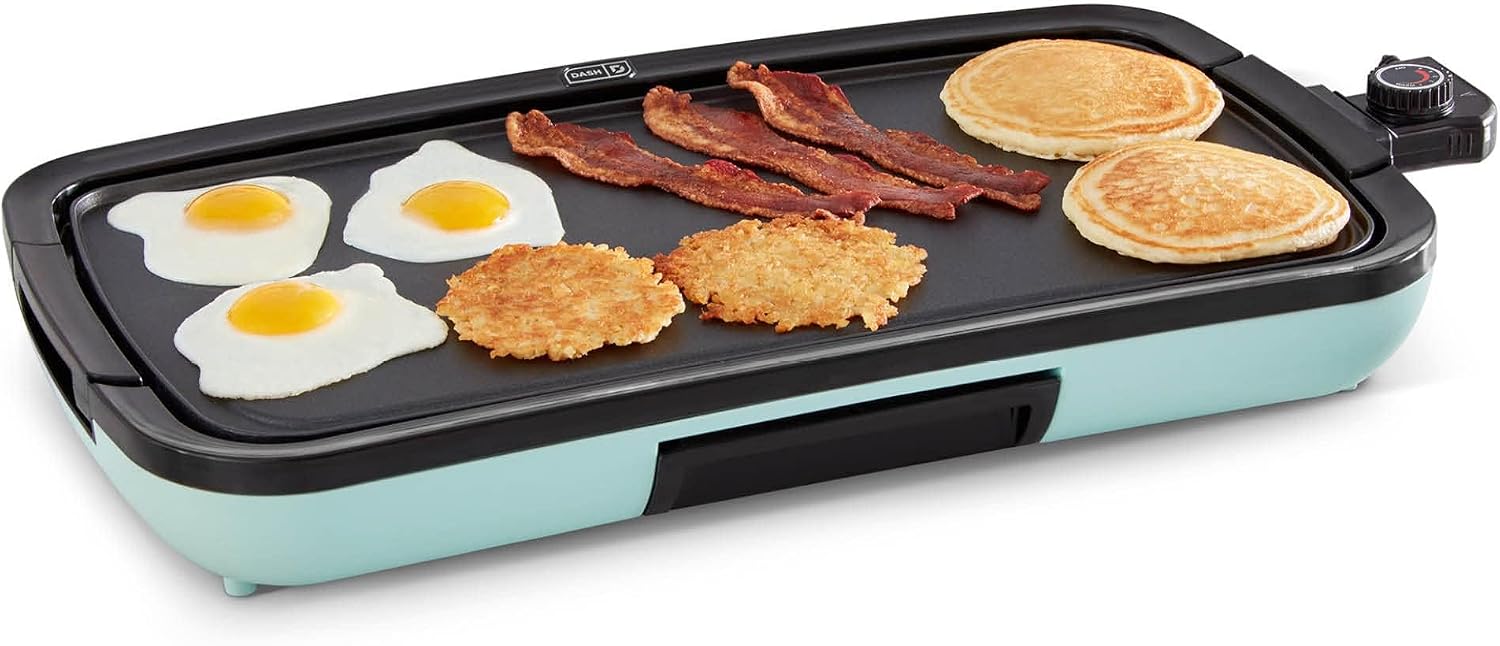
Our pick: Dash Deluxe Everyday Electric Griddle, Removable Nonstick Plate, Aqua
 Visit on Amazon →
The removable plate is the reason this is the pick for a countertop setup. When the plate lifts off, you can wash it in the sink with warm water and a soft sponge instead of wiping a hot surface and calling it clean. That single design choice is the difference between a griddle that lasts several seasons and one that smells like old bacon grease every time it heats up.
The nonstick plate also means you cook eggs and pancakes with a sheen of oil, not a puddle. Less oil means less smoke, and on a countertop unit under a range hood, smoke management is half the battle.
Flaws but not dealbreakers: A nonstick plate is a wear item. You will not re-season it back to life the way you can a bare steel flat top, so treat the coating like the fragile thing it is. Never crank the dial to maximum to preheat faster, never touch it with a metal spatula, and never scrub it with anything abrasive. Also, the aqua color is a color. It has nothing to do with how the thing cooks.
This is the right call for an apartment, a small kitchen, a couple, or a small family that wants a full breakfast off one surface without dragging a 36-inch patio unit out of the garage.
The tools you need before you start
A griddle without a scraper is a hobby. The most important accessory you will ever buy for a flat top of any size is the metal tool that cleans the surface while it is still hot, and the second most important is something to catch the fat you push off the plate.
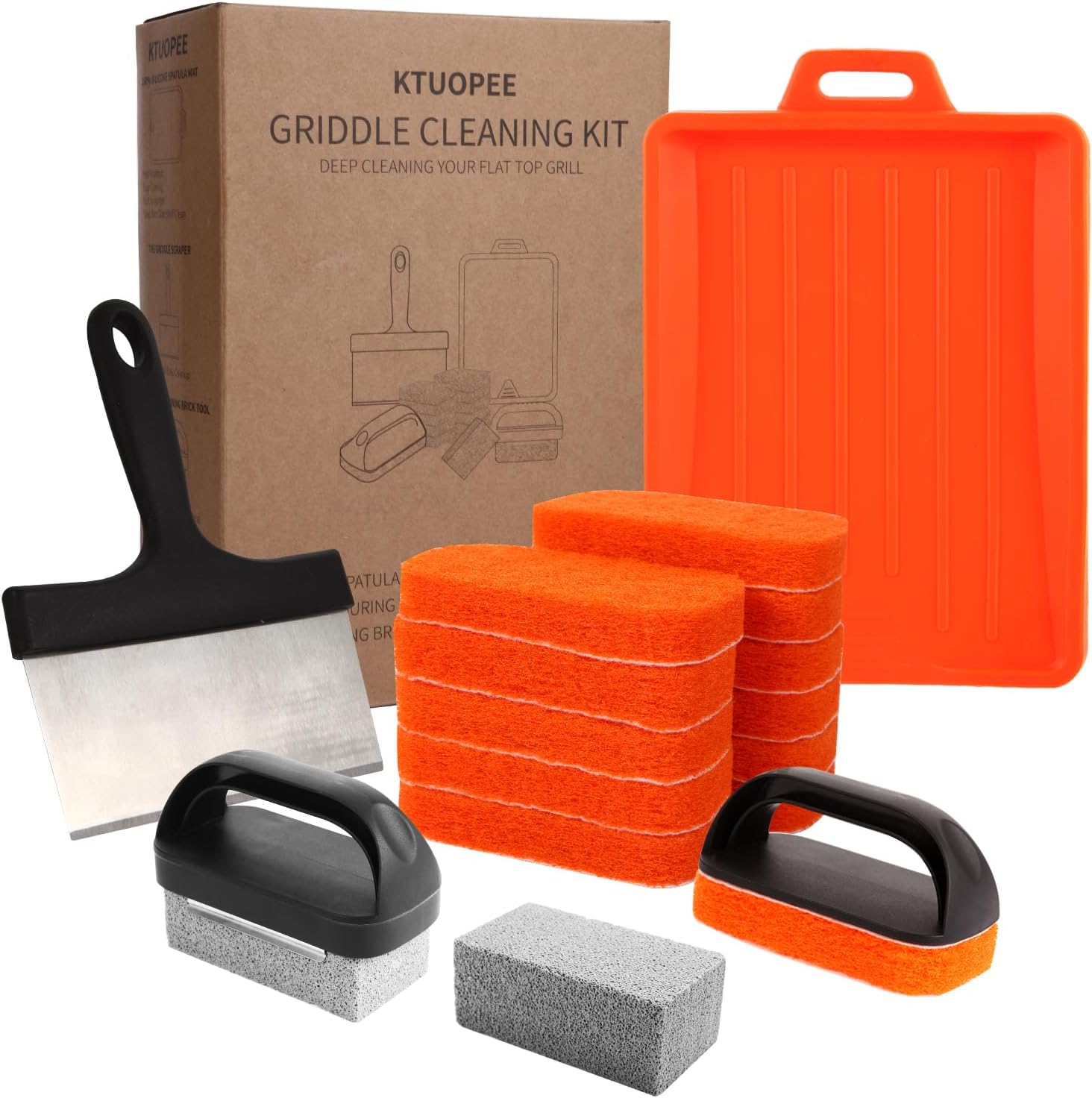
The kit that does the work: Upgraded Griddle Cleaning Kit for 18 Pieces Flat Top Grill Accessories Cleaner Tool Set with Scraper, Heat-Resistant Silicone Spatula Mat with Hanger, Grill Brick, Scouring Pads
 Visit on Amazon →
The scraper is the piece that earns its keep. Flat top cleaning happens while the surface is warm, and a scraper moves warm fat in two passes where a paper towel smears it around for five minutes. The silicone spatula mat with the hanger is the second piece I actually use, because it gives a hot tool somewhere to sit that is not your countertop or your floor.
The scouring pads are for the drip tray and the grease channel, which is where the real mess lives. That channel is the part everyone forgets, and it is the part that decides whether the griddle smells clean or smells like a diner dumpster when it heats up.
Flaws but not dealbreakers: The grill brick in this kit is for bare steel flat tops only. Do not take a grill brick to a coated electric plate. It is abrasive by design, and on a nonstick surface it is a one-way ticket to bare metal. Use the soft pads and the silicone spatula on a coated plate and save the brick for a commercial-style steel surface.
Second flaw: a kit this size always contains two or three pieces you will never touch. That is fine. You will use the scraper, the pads, and the mat constantly, and the rest can live in a drawer until you need it.
Anyone with a flat top of any kind, bare steel or coated, gets value here, because the tools are the part of griddle cooking that people buy last and need first.
The actual routine: season, cook, clean
Now the part you came for. This works on a countertop electric griddle, an indoor griddle, or a bare steel patio flat top. The surface changes the details, not the order of operations.
Step one: Know your surface. Bare steel gets seasoned. Nonstick gets protected. If you own a coated plate, skip the oil-bake rituals you read about online. Baking oil onto nonstick just cooks a sticky film onto the coating that you will fight for a month. If you own bare steel, season it with thin coats of a high smoke point oil, heat it until it just starts to smoke, let it cool, and repeat. Thin coats beat thick ones every single time. A thick coat turns into a gummy layer that flakes into your food.
Step two: Preheat with the lid off and nothing on the plate. Five minutes on medium beats two minutes on high, and it is gentler on a coating. Use the water test. Flick a few drops of water onto the surface. When they skate and sizzle instead of sitting there and evaporating slowly, you are ready to cook.
Step three: Oil thin. A teaspoon of oil spread with a paper towel or a silicone spatula is plenty. You want a sheen, not a puddle. A puddle means smoke, and smoke on a countertop means your smoke detector is about to have opinions about your breakfast.
Step four: Cook in zones. A countertop electric griddle is one big thermostat, so you do not get true independent burner zones. Create them anyway. Use the middle of the plate for searing and the edges for holding. Push finished food to the cool end. That is how you cook a full breakfast on one surface: potatoes in the middle first, eggs at the edge, pancakes in the middle after the potatoes come off.
Step five: Scrape while it is warm. This is the step people skip, and it is the step that matters most. When you are done cooking, while the plate is still warm but not screaming hot and not cold, push the residue into the grease channel with your scraper. Warm fat moves. Cold fat becomes cement, and you will be chipping at it with a pad next weekend.
Step six: Empty the grease trap every single time. Pour the drip tray into a can, not the sink. A bad grease management system ruins every cook, and on a countertop unit the tray is small enough that one pound of bacon will fill it. If the tray is a pain to remove, you will stop removing it, and then the whole griddle starts to smell.
Step seven: Wash the plate if it comes off. Warm water, a soft sponge, a drop of dish soap. No steel wool, no abrasive powder, no dishwasher unless the maker says otherwise. Rinse it, then dry it completely with a towel before it goes anywhere near the base.
Step eight: Dry and cool before storage. Leave the plate off the base until both are at room temperature. Stacking a warm plate on a warm base traps moisture in the gap, and trapped moisture is what makes a coating lift at the edges and what puts rust speckles on bare steel.
Once a month, pull the plate and look at the edges. If you see a speck of rust on bare steel, scrub it, dry it, oil it, and heat it. If you see the coating lifting on a nonstick plate, stop using metal tools on it and start washing it more gently. Catching either problem early is a two-minute fix. Catching it late is a new griddle.
The competition and why it lost
This guide is about the countertop routine, so the big patio flat tops are not the subject here, but they come up in every email I answer, so here is the short version.
The Blackstone 36-inch is the benchmark for a reason. The burner layout is proven and the accessory ecosystem is unbeatable. Camp Chef's flat top is the best for temperature control because the independent burners are genuinely different zones, not marketing copy. Weber's griddle is the best built of the group, and the construction quality shows up in year three when everything else is wobbling. Royal Gourmet is the best budget option, with thinner steel that cooks fine if you season it properly.
If you are in an apartment and want a bigger indoor surface than a countertop plate, Cuisinart's indoor griddle is the pick because the smoke is manageable and it actually gets hot. And skip the cheap portable griddles with warped cooking surfaces. A warped griddle is a lifetime of uneven burgers, and no amount of seasoning fixes steel that was never flat.
None of those change the routine above. Seasoning, heat control, and grease management work the same way on a four-foot commercial griddle and a countertop plate. That is the whole point.
What this all costs
Check current Amazon price on the griddle and on the cleaning kit, and do the math on cost per cook instead of sticker price. A countertop griddle is a one-time buy. The cleaning kit is a one-time buy. After that your recurring costs are oil, replacement pads, and the four minutes a day you spend scraping and drying.
Compare that to what you spend on takeout breakfast in a single week, and the griddle pays for itself fast, even before you count the fact that you stop throwing away units every other year because the coating failed.
The expensive version of this hobby is buying a new griddle every season because you never learned the routine. The cheap version is buying one plate, one kit, and treating both like tools instead of appliances. The difference is not money. It is the four minutes.
That is the job. Your griddle was built to take it.