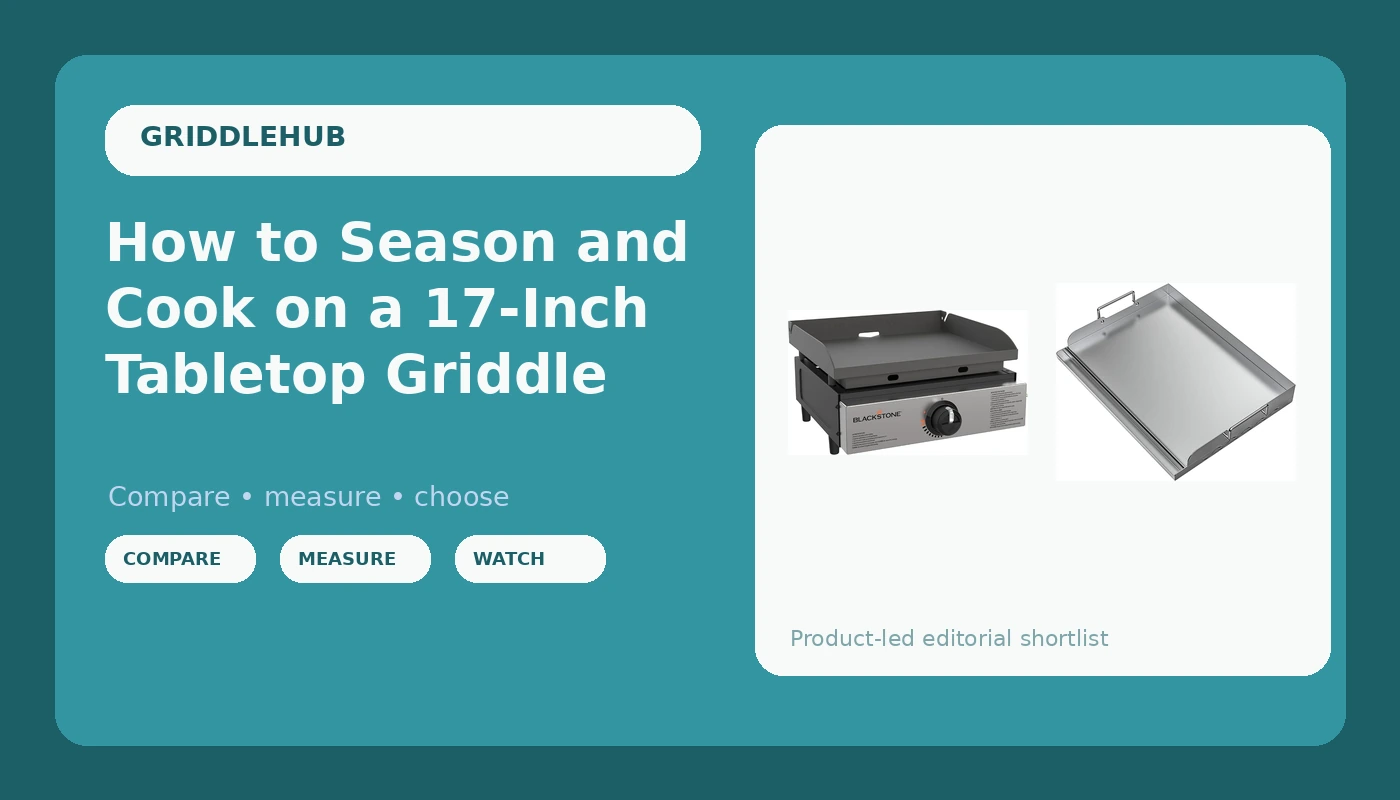
Tabletop griddle seasoning is a habit, not an event. That is the first thing I tell anybody who buys a 17-inch flat top, because the internet has convinced a generation of cooks that one afternoon with a bottle of flaxseed oil turns a steel plate into a permanent nonstick surface. It does not. What it does is start a process you have to keep feeding, and a griddle that rusts is a griddle that got neglected, not a griddle that was bad.
So this is the whole job, start to finish: picking the right 17-inch surface for how you actually cook, breaking it in, running your first real cook on it, and cleaning it in a way that means you are not scraping rust off it three weeks from now.
You have two paths to a 17-inch flat top. You buy a dedicated tabletop griddle, or you drop a steel plate on the grill you already own and turn that into a flat top. Both work. They season differently and they cook differently, and I will be straight with you about which one fits which cook.
Why you should trust me
I spent 13 years on the line, eight of them working the flat top at a diner that pushed 400 breakfasts out the window before 10 a.m. Now I run a food trailer and a backyard griddle that gets fired three times a week minimum, and I have cooked everything on a flat top from smash burgers to hibachi for 30 people.
The way I judge a griddle is the way a short order cook judges one. Does the heat spread across the steel or does it pool in the middle? Does the grease trap actually work, or am I fighting a lake of bacon fat at minute four? And the long test, the one nobody talks about: how long before the surface starts showing rust if you slack off for a week?
I do not do "will not rust" claims. Everything rusts if you neglect it. I say so every time.
What I look for before I recommend a 17-inch flat top
Four things, in this order.
Flatness. This is non-negotiable. A warped griddle is a lifetime of uneven burgers, and it is the single most common defect on cheap portables. Lay a straightedge or your scraper across the surface cold, then again after ten minutes of heat. If it rocks or you can slide a business card under the middle, send it back. Do not season a warped plate and hope.
Burner layout, not BTU count. BTU count is a lie without burner layout. Four burners of nothing beats two burners of hype. On a 17-inch tabletop you are basically working one zone, so what matters is whether that one zone is even, and whether the steel is thick enough to hold heat when a cold patty hits it.
Grease management. The grease trap decides whether you cook or fight. A bad trap ruins every cook. Look for a cup or channel that comes off without tools and does not dump fat back onto the cooking surface when you tilt the unit.
Seasoning retention. A surface that sheds its layer every time you cook something acidic is a surface you will be re-seasoning forever. Thicker steel holds a seasoning better. That is just how it works.
Two ways to get a 17-inch flat top
Pick based on what is already in your yard. If you own nothing that makes fire, the dedicated unit is the cleaner answer. If you already own a gas grill, the plate is the cheaper way in, and it is a genuinely good way to cook.
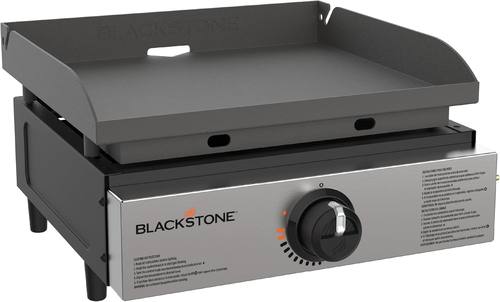
Our pick for a dedicated rig: Blackstone 1971 Original 17" Omnivore Tabletop Griddle, Black
 Visit on Amazon →
This is the one I point people to when they want a real flat top and not a toy. Blackstone built the category, and the 17-inch tabletop is the version that lives on a tailgate table, a camp picnic table, or a small patio. The name on the box is the same name on the 36-inch units, and the thing that matters there is the same thing that matters here: a proven layout, and an accessory ecosystem where the scraper, the spatula, and the squeeze bottle all exist and all fit.
Practical answer on size: 17 inches feeds two to four people comfortably, and it feeds a crowd in batches. I ran a full breakfast service off a surface this size for years. You learn to cook in waves, hash browns first, then bacon, then eggs, and you hold the finished food warm. It is not a limitation, it is a rhythm.
Flaws but not dealbreakers: A tabletop unit is one cooking zone. If you want a sear station on one side and a keep-warm side on the other, this is not that griddle, and no 17-inch tabletop is. It also wants a level surface and some shelter from the wind. Set it up on a slope and your grease runs the wrong way.
Who it is for: Anyone who wants a griddle that lives on a shelf in the garage and comes out on Saturday morning. If you are feeding six every weekend, buy bigger. You do not need 36 inches for a Tuesday night, but you do need it for a party.
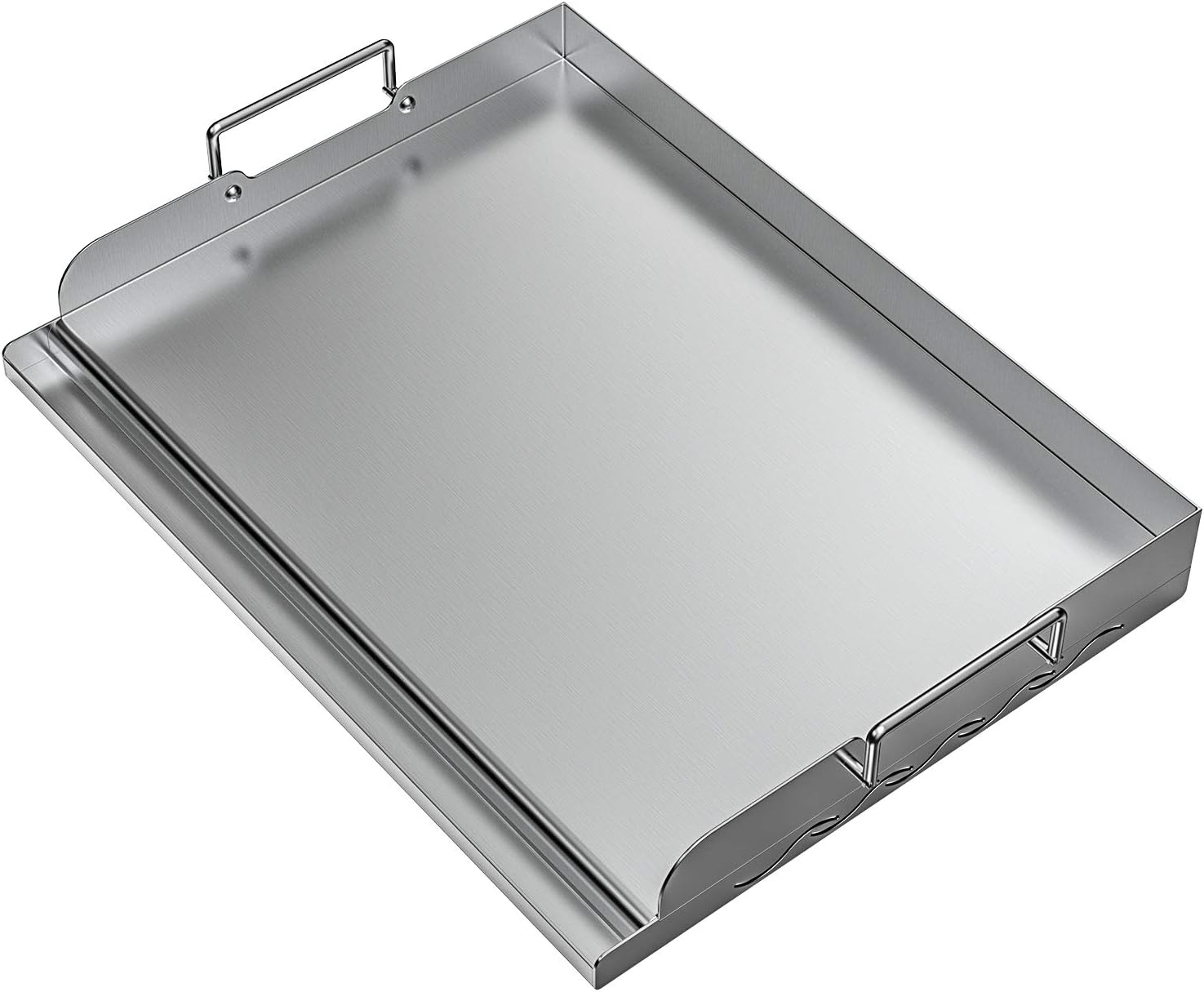
Best if you already own a grill: Skyflame Stainless Steel Griddle Flat Top Plate 17" x 13"
 Visit on Amazon →
Here is the honest version of this product: it is a stainless steel plate that sits on your existing grill grates and gives you a flat cooking surface. It does not season the way a carbon steel griddle seasons, and anyone who tells you it will build a black patina is selling you something. Stainless is not porous the way cold rolled steel is. The polymerized oil layer that makes a griddle nonstick does not lock into it, so you clean it back to bare metal and you cook on it with oil.
That is not a flaw. It is a different tool. Stainless gives you a surface that cannot rust through, that shrugs off acidic food like tomato and citrus and vinegar-based marinades, and that you can scrub hard without wiping out a layer you spent a month building. For searing, for smash burgers, for hibachi rice and vegetables, for bacon, it does the job well.
The catch is heat. Your plate is only as even as the burners underneath it, and grill burners have hotspots. Give it a longer preheat than you think it needs, ten to fifteen minutes with the lid closed, and let the steel even out before the first patty goes down. Lean proteins will stick if you rush it. Fat is your friend here.
Flaws but not dealbreakers: It needs a level landing and a clear drip path. Fat runs off the plate and onto your grill, so your grill's own grease management has to be up to the volume. Also check the fit against your grill's dimensions before you buy. A 17 by 13 plate on a small two-burner grill can cover more than you expect.
Who it is for: Grill owners who want a flat top without buying a second cooker. If you already have a gas grill and counter space is tight, this is the smart buy.
The actual seasoning workflow
This is for the carbon steel surface, so it applies to the dedicated tabletop griddle. If you bought the stainless plate, skip to the next section.
Step one: wash it. New carbon steel ships with a factory oil that is there to stop rust in the warehouse, not to cook on. Hot water, a drop of dish soap, a sponge. It will come off gray and ugly. That is correct.
Step two: dry it completely, then heat it. Towel dry, then put it on the heat on medium for five minutes. Every trace of water has to be gone before oil goes on, or you are seasoning around a water spot that will rust from underneath.
Step three: thin coats, not pools. A high smoke point oil on a paper towel, held with tongs. Wipe it across the whole surface and then wipe it again like you are trying to remove it. The mistake everybody makes is pouring oil on. You want a film measured in molecules, not a puddle. Puddles turn into sticky gum, and sticky gum is worse than bare steel.
Step four: heat until it just smokes, then let it cool. Take it to the smoke point, hold it there a minute or two, kill the heat, let it come down. Then do it again. Three or four passes gets you a brown, slick surface. Ten passes in one afternoon does not make it better, it makes it uneven.
Step five: cook on fat first. Your first cook should be bacon, sausage, onions, or smash burgers. Something with fat in it. Do not break in a new griddle with a lean piece of fish and a spray of oil. Fat is what builds the layer.
Step six: scrape while it is hot. After the cook, while the surface is still warm, push the crud off with a scraper into the grease trap, wipe with a towel, and lay down one more thin coat of oil. That last coat is the whole habit. It takes 30 seconds.
For the stainless plate, the routine is shorter. Preheat gradually and evenly, oil the food rather than the plate, cook, then scrub it back to bare metal with hot water while it is still warm and dry it thoroughly. No seasoning passes, no patina to protect. Just clean steel.
The first cook, and what to keep off the surface
A 17-inch surface is a short order station. Here is how I would run the first breakfast on it.
Hash browns or diced potatoes first, because they take the longest and they lay down fat. Push them to the cool edge when they are close. Then bacon, laid flat, not crowded. Move it up top to drain. Then eggs, in the bacon fat, low and slow. Toast on the edge if you have room. Total time is about 20 minutes once the surface is hot, and the whole cook is one continuous motion if you keep your scraper in your left hand.
Three things to keep off a freshly seasoned griddle for the first month: vinegar and citrus-heavy marinades, sugary glazes, and anything you would describe as lean and wet. Acid strips a young seasoning. Sugar burns into a black ring you will be scraping for weeks. And a wet, lean protein will stick to a layer that is not fully built yet. Give it a month of fatty cooks and then cook whatever you want.
Cleanup, rust, and the 60-day habit
A griddle that rusts is a griddle that was neglected. That is the whole story. It is not the steel's fault and it is not the manufacturer's fault.
The routine: scrape hot, wipe warm, oil thin, cover if it lives outside. In Phoenix I can leave a griddle on the patio for months because the air is dry. If you live somewhere with real humidity, a cover is not optional, and neither is the oil coat after every single cook. Skip it for a week in August in the wrong climate and you will find orange spots.
If you do find rust, it is not the end. Scrape it off, scrub it down to bare metal, wash it, dry it, and start the seasoning passes again. I have brought back griddles people were ready to throw out.
What I left out and why
The 36-inch class griddles are the benchmark for a reason, but they are not what this article is about. If you are feeding a crowd every weekend, that is a different guide and a different footprint. Same with the indoor electric griddles that apartment cooks ask me about, and the cast iron griddle pans that live on a stovetop. Good tools, wrong article.
I also left out the two-burner camp stoves and the accessory bundles. Half the kits on the market are a spatula, a scraper, and two squeeze bottles sold at a markup. Buy the scraper. Buy a good long spatula. Everything else you can find in your kitchen.
What this all costs
Both paths here are in the same general range, and the plate is the lower-cost way in if you already own a grill, because you are not paying for a burner and a body. Check current Amazon price on both before you decide, since that number moves.
The math that actually matters is cost per cook. A griddle used three times a week pays for itself faster than any other cooker in the yard, because it covers breakfast, lunch, and dinner on the same steel. Twenty minutes of seasoning work up front and 30 seconds of oil after every cook is the entire maintenance bill.
That is the job. Heat it, oil it thin, scrape it hot, oil it again. Do that and the surface gets better every month instead of worse.