Most 22-inch griddles let their owners down in the first week, and it is almost never the burner's fault. It is the setup. A tabletop griddle setup done right is three things: a level surface, steel that has been washed and seasoned, and a cook who understands that two burners mean two heat zones, not one big hot rectangle.
I spent 13 years on the line, eight of them working a four-foot commercial flat top that ran from open to close. These days I run a food trailer and a 22-inch tabletop griddle in the backyard, three or four nights a week. The tabletop is not a compromise. For most households it is the right size, and the food that comes off it is the same food that came off the big steel.
Here is how to set one up, break it in, and cook on it without fighting it.
Why you should trust me
I have cooked a breakfast service that fed 400 people before 11 a.m., and I have cooked hibachi for 30 on a surface the size of a laptop. Everything I know about heat, grease, and seasoning came from repetition, not from a spec sheet.
My standard for any griddle is the same every time: 100 smash burgers, one full breakfast service, and a 60-day seasoning check where I watch how quickly the steel starts to rust when I get lazy about oiling it. That is the test. A griddle that passes it gets used. A griddle that fails it goes back.
I also keep a scraper and a squeeze bottle in my truck at all times, which tells you where my priorities sit. Tools do not make the cook, but the right two tools make the cook faster.
What I check before I trust a griddle
Five things, in order. Steel thickness, because thin steel warps and a warped surface means uneven burgers for as long as you own it. Burner layout, because a BTU number on a box tells you nothing about whether heat spreads across the whole plate or pools in one hot stripe. Grease management, because a trap you cannot clean turns every cook into a fight. A cover, because a griddle that stays dry between cooks holds its seasoning longer. And flatness out of the box, which I check with a straightedge and a cup of water before I ever light a burner.
Heat zones matter more than most people think. Two independent burners give you a searing side and a holding side. That is the whole game on a small surface. You need somewhere to put food that is done, or almost done, while the rest of the order finishes.
The gear you need before the first cook
You do not need a kit with a branded spatula and a carrying bag. You need a surface, a scraper, a squeeze bottle of oil, and a plan. Here are the two surfaces worth looking at for a patio or a camp setup, and what each one is actually for.
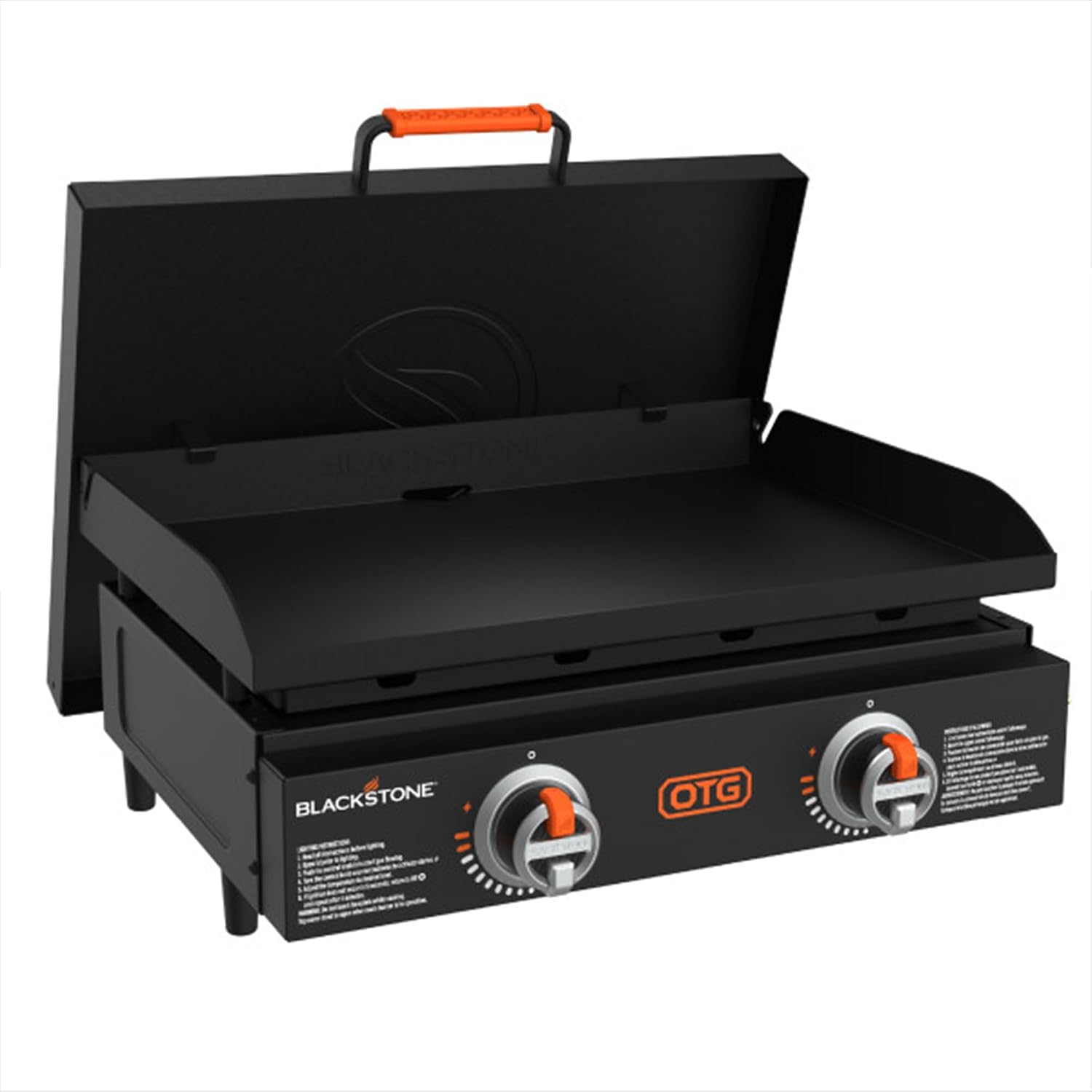
The tabletop pick: Blackstone OTG Tabletop Griddle with Hard Cover, Dual Heat Zones, 22 Inch
 Visit on Amazon →
This is the shape I would buy for a patio, a tailgate, or a small deck. The 22-inch plate is small enough to live on a shelf and big enough to hold four smash burgers with room for onions beside them. Dual heat zones are the part that matters to me. Two independent burners mean you can run one side hard for the sear and keep the other side low for eggs, peppers, or holding finished food. That is a real cooking advantage, not a spec sheet line.
The hard cover is the feature people skip past and then regret. A griddle left open collects dust, pollen, and rain, and every one of those things attacks the seasoning. A cover turns cleanup into a thirty-second job and makes the difference between steel that stays black and steel that starts spotting.
Worth pricing out a metal scraper and a squeeze bottle at the same time, because those two tools are what turn the plate into a workstation.
Flaws but not dealbreakers: A 22-inch plate is a batch cooker. If you routinely feed eight people at once, you will be cooking in shifts.
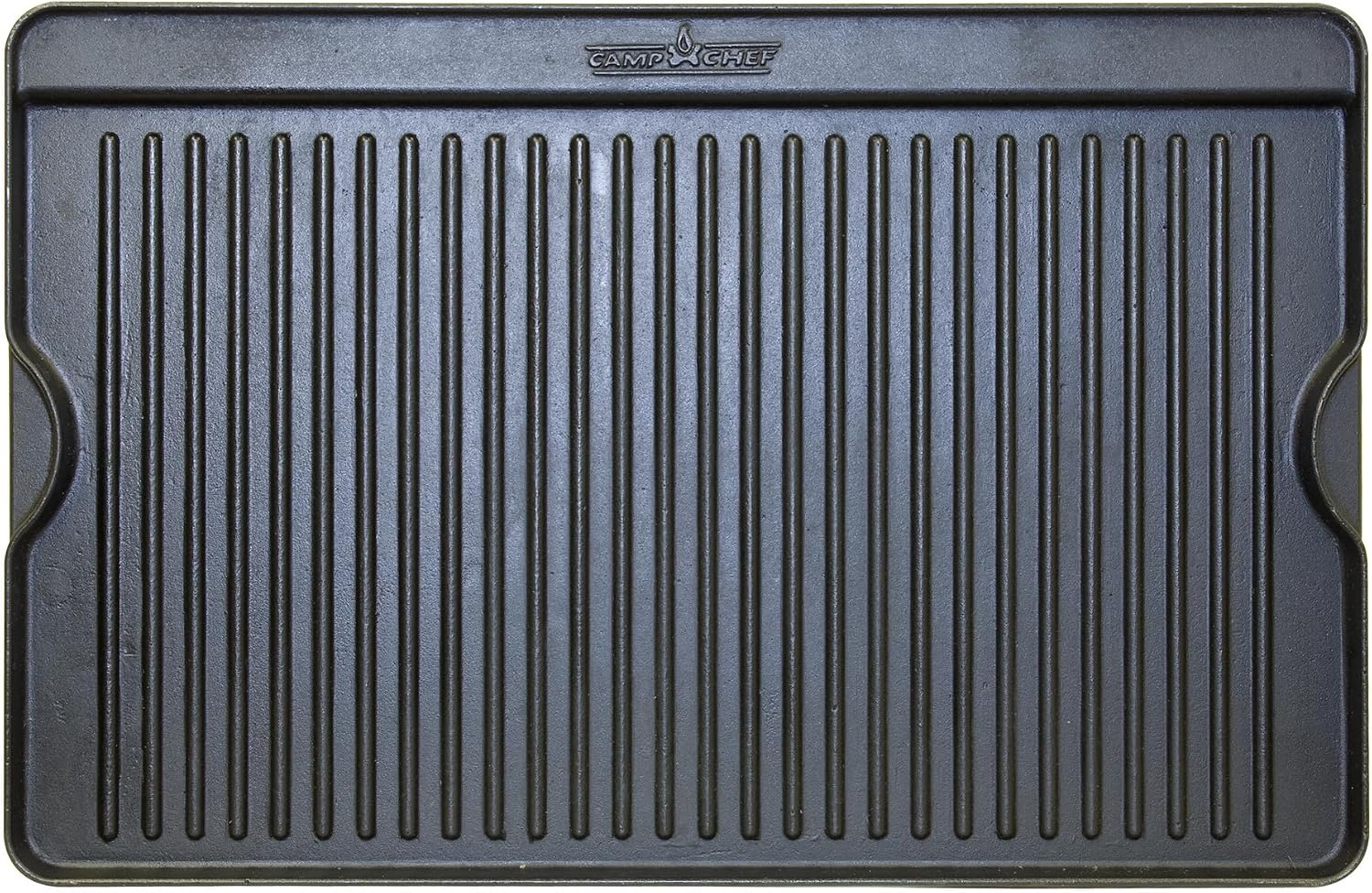
The camp stove alternative: Camp Chef Cast Iron Griddle - 16 x 24, Non-Stick Grill/Griddle Sides
 Visit on Amazon →
If you already own a two-burner camp stove or a grill with a wide firebox, this is the lower entry point into flat top cooking. Cast iron holds heat differently than rolled steel. It takes longer to come up, and once it is hot it stays hot when a pound of cold ground beef lands on it. That thermal mass is exactly what you want for searing, and exactly what you do not want if you are impatient.
The 16 by 24 footprint gives you a grill side and a griddle side, so one piece covers smash burgers and chicken thighs on the same cook. Cast iron also takes seasoning beautifully. Whatever finish it arrives with, the layer you build on top of it is what actually releases the food.
Flaws but not dealbreakers: Cast iron is heavy, and it will not fit every camp stove or grill. Measure your grate before you order.
The setup and first cook, step by step
Step one: Inspect the surface. Before anything else, put a straightedge across the plate and look for daylight underneath. Then pour a thin layer of water across it and watch where it pools. Water that gathers in the middle or runs to one corner tells you the plate is not flat. Send it back. A warped griddle is a lifetime of uneven burgers, and no amount of technique fixes it.
Step two: Wash off the shipping oil. Whatever is on the steel when it arrives is there to stop rust in a warehouse, not to cook on. Scrub it off with hot water and a little dish soap, then dry it completely and put it over heat for a few minutes to drive off the last moisture.
Step three: Level the unit and map your zones. Set the griddle on a solid, level surface and check the level in both directions. Then light both burners and let the plate come up to temperature with nothing on it. If you have an infrared thermometer, shoot the surface at several points to see where the hot spots sit. If you do not, flick water across the plate and watch how the droplets behave. This is how you learn the layout before you learn it the hard way with a burnt pancake.
Step four: Season it in thin coats. Heat the plate until a drop of water beads and skitters. Add a teaspoon of a high smoke point oil and spread it with a folded paper towel held in tongs. Let it smoke, then stop. Repeat three to five times. Thin coats, not a puddle. A thick coat turns gummy and flakes. This is the single most important step in the whole tabletop griddle setup, and it is the one most people rush.
Step five: Prove the surface with an onion. The classic first cook is a sliced onion, not a burger. Onions tell you where the heat is, they smell like a diner, and they leave a nice layer behind. Cook them low and slow on the cooler zone and watch how the plate behaves. If food sticks, your seasoning is thin or your heat is wrong, and an onion is a cheap way to find out.
Step six: Learn the two-zone habit. Once the plate is seasoned, run every cook with one side hot and one side moderate. Sear on the hot side, then move food to the moderate side to finish or hold. On a 22-inch plate this is not a luxury, it is the difference between serving four plates at once and serving one plate four times.
Step seven: Start with the Tuesday night menu. Do not open with a holiday breakfast. Start with what you actually eat on a weeknight: smash burgers, sliced onions, a couple of eggs, peppers for fajitas. Get comfortable with the size of the plate before you try to run eight orders on it.
Step eight: Manage the grease. Scrape the plate down while it is still hot, pushing the fat toward the trap. Empty the trap before it cools, every single time. Grease that sits overnight turns into a job. Grease that leaves while it is warm is a thirty-second wipe. This is the part of griddle ownership that decides whether you cook on the thing or avoid it.
Step nine: Cool, oil, cover. When the plate is cool enough to touch but still warm, wipe a thin film of oil across it and put the cover on. That film is what stops rust. The cover is what keeps the film from washing off in the rain.
When 22 inches is the right size and when it is not
Twenty-two inches feeds four people comfortably and six if you cook in two batches. It handles a family breakfast, a pile of smash burgers for a cookout, and a weeknight dinner without dragging out a second appliance. If your normal cook is for two, this size is more than enough, and you will use it more often than a bigger unit because it sets up in two minutes.
Go bigger if you regularly feed eight or more, if you want four distinct heat zones, or if you want a cart with side shelves and a larger grease system. A 36-inch cart griddle is a different animal: more control, more space, and a permanent footprint on your patio.
Skip the cheapest portable units no matter how good the price looks. Thin steel and a warped plate are the two things you cannot fix with technique, and a griddle that rocks under your spatula will make you hate cooking on it.
Keeping the seasoning alive
Seasoning is a habit, not a one-time event. Every cook ends the same way: scrape while hot, wipe the grease, thin oil film, cover. Every few weeks, do a full re-season on a clean plate to fill in the spots that wear thin, usually the middle where the spatula lives.
Everything rusts if you neglect it. A cast iron plate left wet on a humid night will spot by morning, and a steel plate will do the same if the oil film is too thin. Rust is not a defect, it is a message. Scrub it off with steel wool, wash, dry, heat, and start building the layers again. I will never tell you a griddle will not rust, because that would be a lie, and the owners who believe it are the ones buying a replacement in year two.
What this all costs
The surface is the main expense, and the rest of the kit is small: a metal scraper, a squeeze bottle, a pair of tongs, a roll of paper towels, and a bottle of high smoke point oil. Add a cover if the unit does not come with one, and an infrared thermometer if you want to know your zones instead of guessing at them.
Check current Amazon price on both surfaces before you decide. A cast iron plate over a stove you already own is the lowest entry point. A self-contained tabletop unit with its own burners and a hard cover costs more up front and saves you the cost of a stove you might not have.
The math that matters is not the sticker. It is how many times you cook. A griddle that gets used three nights a week earns its keep inside a year against takeout, and it does it while making better food. That is the whole argument.
The bottom line
Set it up level, wash off the shipping oil, season it in thin coats, and learn your two zones before you try to feed a crowd. Do those four things and a 22-inch tabletop will out-cook a much larger griddle that was never broken in properly. That is the job. Light it and get the scraper moving.