I have cooked on a flat top for a living since I was twenty-two. Eight of my thirteen line years were spent behind a four-foot commercial griddle at a diner that pushed 400 breakfasts before eleven in the morning, and these days the same style of surface runs on my food trailer and in my backyard at least three nights a week.
Flat top griddle cooking is not hard. It is unforgiving, which is a different thing. The surface tells you the truth about everything you did wrong within thirty seconds of the first burger hitting the steel: a cold corner, the wrong oil, too much fat pooling under the patty, a scraper you never bought. Fix the setup before the first cook and the cooking takes care of itself.
This is the guide I text to friends standing in a hardware store parking lot. Two surfaces worth considering, the tools that earn their space, and the order of operations for a full breakfast service at home.
Why you should trust me
Thirteen years on the line, eight of them on a flat top. I have worked a griddle through a Mother's Day rush and through a Tuesday night with two customers, and I learned more from the Tuesday.
My rule costs me free products, and I keep it anyway: no surface gets a recommendation from me until it has cooked 100 smash burgers and a full breakfast service. Then comes the seasoning test, the one that actually predicts whether you will still like the thing in year three. Season it properly, cook on it hard for 60 days, then see how long the steel takes to flash rust when you slack off on maintenance. Most of them rust. I say so.
I also keep a surface thermometer within arm's reach at all times. If a griddle write-up does not include a surface temperature, it is a press release, not a review.
How I picked and how I tested
The two surfaces below are not the only flat tops in the world. They are the two that make sense for this job, which is feeding a household from a surface that fits a normal kitchen or a normal patio.
Four things decided it.
Heat across the whole surface. A griddle that runs 450 degrees in the middle and 280 at the corners cooks one burger at a time. I check the center, the four corners, and the front edge with a surface thermometer.
Grease management. Fat has to leave the cooking surface and land somewhere you can actually clean. A trap that needs a spoon and a prayer ruins more cooks than thin steel ever will.
Seasoning behavior. I want a surface that takes three thin coats of oil and holds them. If the seasoning lifts on the first scrape, the steel or the coating is wrong.
Footprint. A 22-inch surface is not a compromise for a home cook. It is roughly six burgers or eight eggs at once, which is more than most Tuesday nights require.
The cast iron plate and the electric countertop unit below cleared all four. Everything else I looked at failed at least one.
Pick your surface before you cook anything
The first decision is not brand. It is how you want to apply heat.
A cast iron flat top sits on a burner or a grill grate and pulls heat from whatever is under it. You get one zone unless your stove lets you run burners at different levels, and you get the best sear of any home option, because cast iron holds heat and dumps it into the food.
An electric countertop griddle brings its own heat source. You plug it in, you get a thermostat, and you can run it on a patio table, in a garage, or in a rental kitchen with a weak stove. The trade is that you are limited by the cord and the element layout.
Both routes work. Pick based on where you will actually cook.
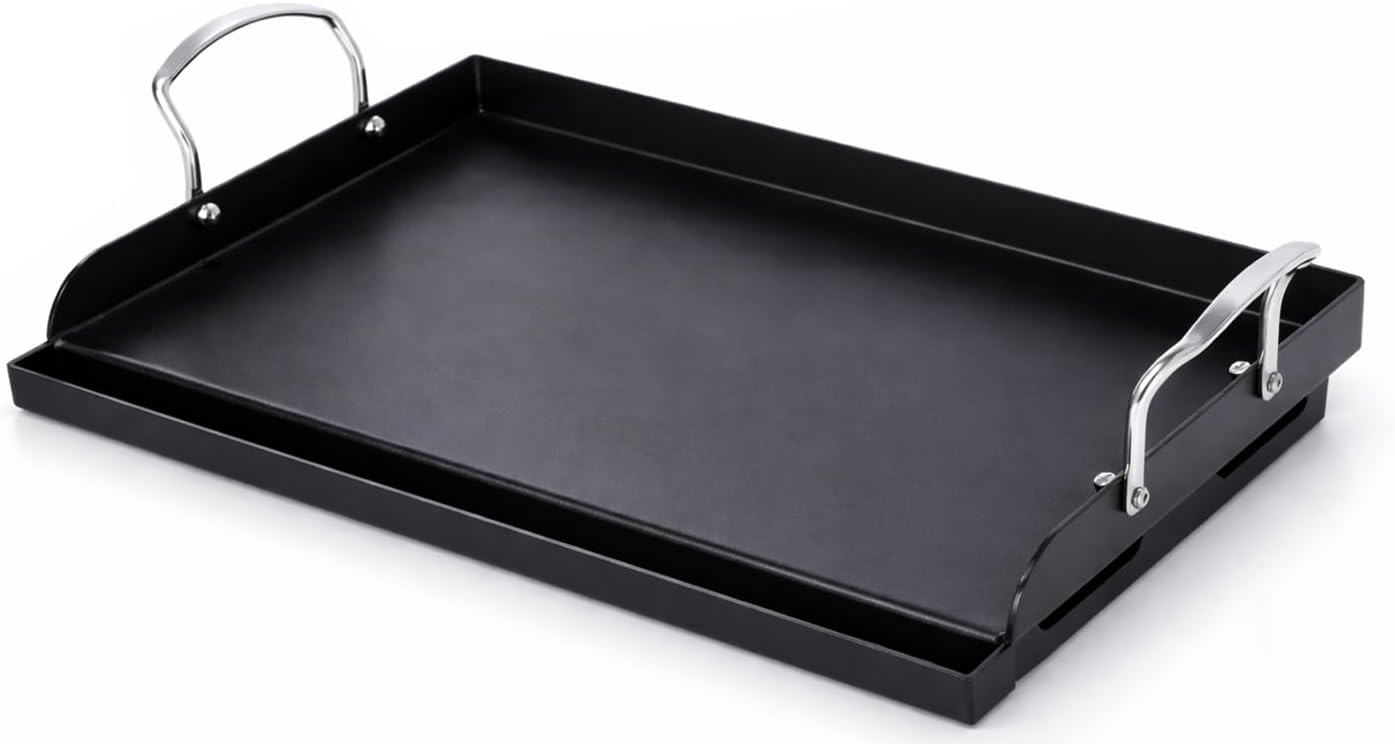
The stovetop route: Utheer Cast Iron Griddle, Pre-Seasoned, Nonstick, 17 x 13 in Flat Top
 Visit on Amazon →
Check current Amazon price, and this is the surface I point people to when they want a flat top without buying another appliance.
The spec that matters is the 17 by 13 inch cooking area. That is four smash burgers with room to move them, or a full package of bacon, or six pancakes at a time. It fits across a two-burner span on a gas stove or over the grates of a standard gas grill, which means it doubles as the flat top your grill has been missing.
It arrives pre-seasoned, which saves a step but does not excuse you from the habit. Factory seasoning is a starting point, not a finished surface. Three thin coats of a high smoke point oil before the first cook are what make the plate behave.
Cast iron takes longer to heat than steel and holds that heat once it is there. That is why it sears well, and it is also why you preheat it for ten minutes instead of three.
Flaws but not dealbreakers: Cast iron is heavy, and it is not a surface you leave in the rain. If you cook outside, it comes back inside with you. Wipe it dry while warm, oil it, and store it where humidity cannot find it.
Anyone with a gas stove, a gas grill, or a campfire ring who wants the best sear available at home should start here.
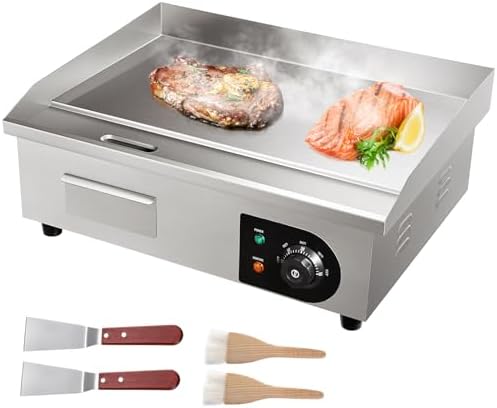
The dedicated countertop route: VEVOR Commercial Electric Griddle, 22", Countertop Flat Top Griddle
 Visit on Amazon →
Check current Amazon price. This is the route for anyone who wants a flat top that does not depend on the stove.
Twenty-two inches of countertop surface is the number to notice. That is a genuine breakfast: six eggs, a pile of hash browns, and a row of sausage links at once, with a lane left over for toast. It runs off a standard outlet and it works on a patio table, which is the whole point. Your kitchen stove stops being the bottleneck, and you stop carrying a screaming hot pan of bacon across the yard.
The commercial label matters less than the format. What you get is a self-contained surface with its own thermostat, so you work one consistent heat zone across most of the plate instead of the hot ring and cold ring you fight on a stovetop.
Flaws but not dealbreakers: An electric countertop griddle needs an outlet and a place to live. It is not a thing you pull out of a cabinet for one pancake. It also needs the same oil-and-heat care as cast iron, because a neglected electric plate rusts exactly like a neglected skillet.
Anyone without a strong stove, anyone in an apartment with a weak hood, and anyone who wants to cook outside without a propane tank should look here first.
The tools that actually matter
Four tools. That is the whole kit, and you can ignore every boxed bundle that promises more.
A metal scraper. The single most important thing you will buy for a flat top. It cleans the surface while it is hot, it flips food, and it moves grease toward the trap. Get a stiff one with a straight edge.
A squeeze bottle. Oil control is the difference between a sear and a poach. A squeeze bottle lays a thin film exactly where the food is going instead of pouring a puddle across the plate.
A surface thermometer. Infrared or probe. You cannot manage heat you cannot measure, and the dial on an electric griddle reads the element, not the steel.
A stiff brush or a grill stone. For the corners the scraper cannot reach. Corners are where carbon builds up, and carbon is what makes a surface taste like last night's fish.
Skip the twenty-piece kit. Buy these four.
The actual flat top workflow
This works on any seasoned surface, iron or steel, stovetop or countertop.
Step one: season before the first cook. Heat the surface until a drop of water skitters across it, wipe a thin coat of a high smoke point oil over everything, and let it smoke off. Repeat three times. Thin coats, not a puddle. A thick coat turns gummy and lifts on the first scrape.
Step two: preheat longer than you think. Ten minutes for cast iron, five to seven for an electric plate. Check the surface with the thermometer. You want roughly 350 degrees for eggs and pancakes, 400 to 450 for burgers and searing. If the corners read 100 degrees colder than the center, cook in the center and rotate.
Step three: lay the oil thin. Squeeze a teaspoon onto the surface and spread it with the scraper or a paper towel held in tongs. If the oil beads and smokes hard, the surface is too hot. If it sits flat and does nothing, it is not hot enough.
Step four: cook in lanes. Set food down in a grid and do not crowd it. Steam is the enemy of a sear, and a crowded plate steams. Six burgers on a 22 inch plate is comfortable. Ten is a braise.
Step five: run breakfast in the right order. Hash browns and sausage first, because they take longest and they season the surface. Then eggs, in the coolest lane. Then pancakes last, because batter wants steady low heat and it does not want the taste of sausage grease. If your griddle has zones, this is what they are for.
Step six: push the grease, do not chase it. Every few minutes, scrape fat toward the trap and dump it. Fat that sits on the surface burns, and burnt fat is what gives a griddle burger that acrid taste people blame on the meat.
Step seven: clean while it is hot. When the food is off, scrape the whole surface down, push everything into the trap, and wipe with a damp towel held in tongs. Steam does most of the work. Do not dunk a hot plate in water and do not use soap on a seasoned surface.
Step eight: re-oil before you walk away. Wipe a thin film across the plate while it is still warm. This is the step everyone skips, and it is the reason griddles rust.
That is a full service. Thirty seconds a burger, three minutes a batch of pancakes, and a surface that comes back clean.
Where flat top cooking goes wrong
Three failures cause almost every bad griddle meal I have seen.
A cold corner. Cook on a surface with a weak zone and skip the rotation, and you get one side of the plate burnt and one side gray. Check with the thermometer, then rotate the food through the hot lane.
Too much oil. A griddle is not a frying pan. Oil is for contact, not depth. A thin film gives you the sear. A quarter inch of fat gives you a poached burger with a crust on one side.
Grease left in the trap. Fat cools, thickens, and turns into something you need a putty knife to remove. Empty the trap while the fat is still liquid, every time.
The one thing that is not a failure is a surface that darkens. A well-used flat top goes from gray to bronze to black. That is seasoning building, and it is exactly what you want.
The competition and why it lost
Not every griddle format belongs in this guide.
A full-size propane flat top cart with a 36 inch plate is a fantastic machine for a backyard that feeds twenty people. It also needs a tank, a permanent spot, a cover, and a hose. Feed four people on a weeknight and you are heating four feet of steel to cook six burgers.
An indoor electric griddle with a nonstick coating is convenient, and it is a different product category. Coatings wear, and when they wear you replace the appliance. A seasoned steel or iron surface gets better with age instead of worse.
A cast iron griddle pan with a handle is a great pan and a poor flat top. The raised edges and the handle shrink the usable surface, and you cannot run a scraper across it the way a flat top wants.
A griddle insert that drops into a gas grill is a reasonable middle path, and it is worth it only if you already own a grill you love. If you do not, the cast iron plate or the countertop unit above gets you cooking sooner.
Each of these is the right answer for somebody. For a household that wants a real flat top without a trailer, they are not.
What this all costs
The cast iron plate and the electric countertop unit both run on equipment you probably already own: a stove, a grill, or an outlet. Check current Amazon price on each before you decide, because the gap between them moves with sales.
The tools are the cheap part and they last. A scraper, a squeeze bottle, a thermometer, and a brush are a one-time purchase that will outlive the griddle.
Consumables are oil and either propane or electricity. A thin film of oil per cook is pennies. An electric plate pulls a steady load for the twenty minutes it runs, which is roughly what a toaster oven costs for the same stretch.
Then there is the honest math on time. A cast iron plate wants ten minutes of preheat and a wipe down after. An electric countertop unit wants five to seven minutes and a scrape. Neither is a ten-second appliance, and neither is meant to be.
What you get for that time is the thing that kept me on the flat top for eight years: one surface, one scraper, and every meal from breakfast to hibachi coming off the same steel.
Season it, heat it properly, and empty the trap while the fat is still hot. That is the entire job.