Most gas grills are bad at breakfast. You can cook a steak over grates, but try running hash browns, eggs, and a pile of onions on the same surface and you get flare-ups, food falling through the gaps, and a grease fire waiting to happen. A flat top griddle insert fixes all of it in one move. It drops a solid plate over your burners and turns a backyard grill into a short-order line.
I spent thirteen years on a four-foot commercial flat top, eight of them working a diner that served four hundred breakfasts before ten in the morning. My home setup is smaller and simpler, but the rules are identical. A flat top griddle insert lives or dies on three things: whether the plate sits flat, how evenly heat spreads across it, and whether you keep the seasoning up. Get those right and you can cook smash burgers, hibachi, cheesesteaks, and a full Sunday breakfast on the same surface without thinking about it.
Here is the whole process, from measuring your grill to the first flip.
What a flat top griddle insert changes about your gas grill
Grates are a compromise. They give you grill marks, they let fat drip away, and they leave most of your food touching nothing but hot air. A solid plate does the opposite. Every square inch of the food sits on hot steel, which is why a smash burger gets that lacy crust in ninety seconds and why a batch of pancakes comes out evenly browned instead of striped.
The second thing it changes is the grease problem. On a grate, fat drips into the fire and burns, which is where flare-ups come from. On a plate, fat pools and runs to a low corner, a channel, or a trough. That is the whole game. If the plate traps fat in the middle with nowhere to go, you will spend every cook pushing grease around with a scraper instead of cooking. Look at how the plate handles runoff before you look at anything else.
The third change is control. On a gas grill with independent burners, a flat top insert gives you real zones: a hot end for searing, a middle for cooking through, and a cool corner for eggs, cheese, and resting. That is what a diner line is, and it is the reason a short-order cook can run twelve orders at once on one surface.
What to check before you buy
Measure the firebox, not the lid. Grill dimensions in the marketing copy describe the outside of the lid. What matters is the opening where your grates sit, side to side and front to back, plus how much clearance you have under the closed lid. A plate that is a half inch too wide will not sit down, and one that is too small leaves a gap where food falls.
Decide whether it replaces the grates or sits on them. Some inserts are designed to drop into the firebox on the ledge where the grates normally rest. Others are built to sit on top of the grates. Both work. The first gives you better heat transfer and more room under the lid. The second is easier to lift off when you want to grill instead of griddle.
Think about steel thickness. Thick steel holds heat and recovers fast when you throw a pound of cold ground beef on it. Thin steel drops temperature and takes its time coming back, which is how you end up with gray burgers. Heavy is better, with one caveat: you have to be able to lift it.
Check the grease path against your grill's drip tray. Your grill already has a place where fat goes. The insert should send fat there, not dam it up on top.
Ignore anything that promises it will never rust. Everything rusts if you neglect it. Steel, cast iron, coated, uncoated, all of it. The question is not whether the surface can rust, it is whether you are going to take ninety seconds to oil it after every cook.
How to fit a griddle insert to your grill
Step one: Empty the firebox. Pull the grates and, if you have them, the heat deflectors or flavorizer bars. You want a clear look at the opening and the ledges.
Step two: Dry fit it cold. Set the plate in place before you light anything. Press down on all four corners. If it rocks, find out why: a bent grate, a ledge that is not level, or a plate that is twisted. A plate that rocks will never heat evenly.
Step three: Check the lid. Close the lid slowly with the plate in place. You want clearance. If the plate touches the lid or the thermometer probe, take it out and rethink the fit.
Step four: Burn off the shipping oil. Every new plate comes with a film of machine oil or a light factory coating. Heat the grill to medium high for fifteen to twenty minutes with the lid open, let it cool enough to handle, then wipe it down with a rag and hot water.
Step five: Season it before the first cook. More on that below. Do not skip it just because the box says pre-seasoned.
The two pieces you actually need
You can spend a fortune on flat top gear. You need two things: a plate that fits your grill, and a small set of tools that lets you move food and clean the surface.
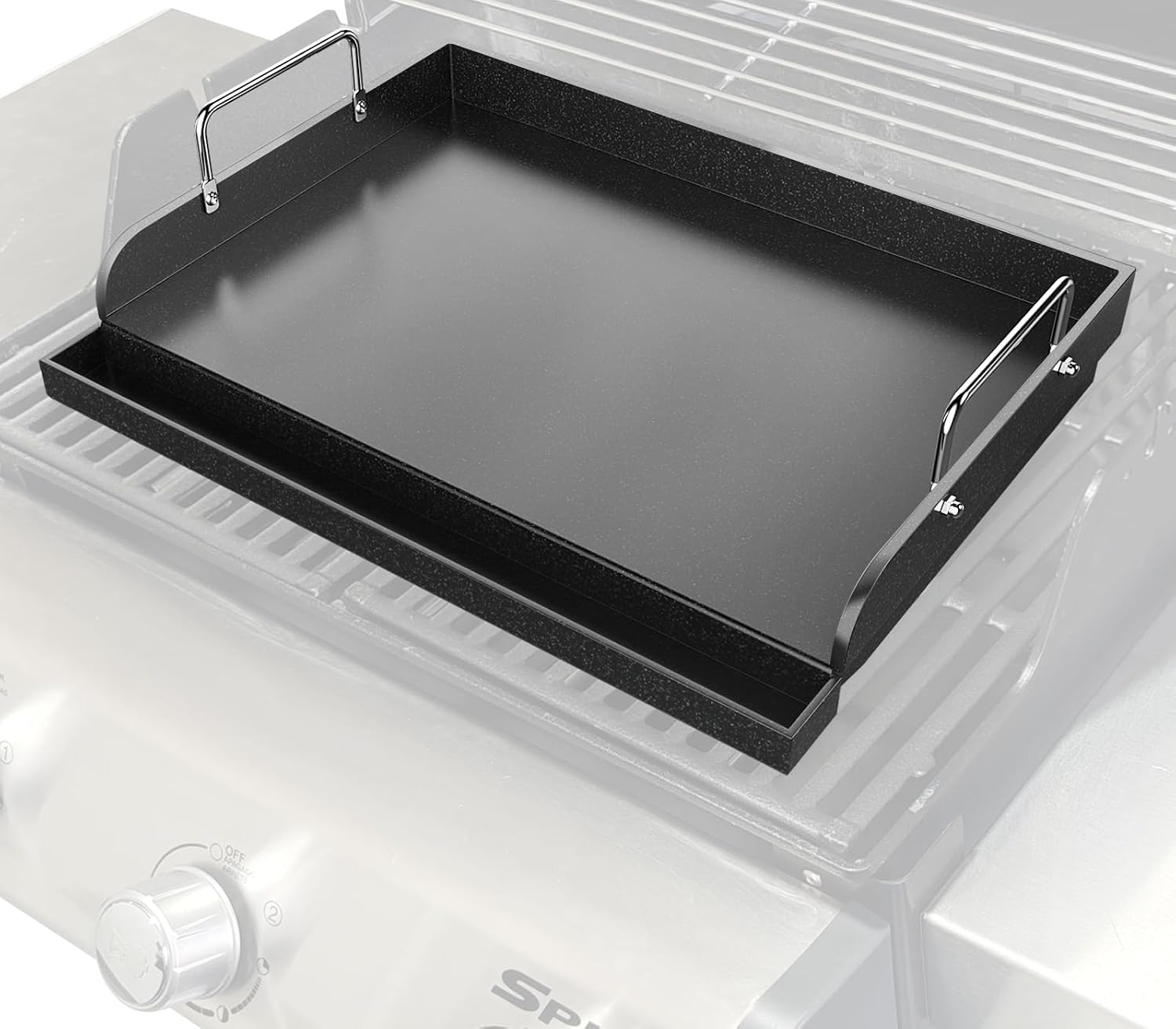
The surface: Pre-seasoned Cast Iron Griddle for Gas Grill, Nanoceramic Nonstick Flat Top Griddle Insert
 Visit on Amazon →
This is a 17 by 13 inch cast iron plate with a nanoceramic nonstick finish, sized for the common Weber, Nexgrill, and Charbroil footprints. The pre-seasoned part is real, and it means you can cook the day it lands, but treat it as a starting coat rather than a finished surface. Two thin oil coats on your own grill will make it noticeably more forgiving.
Cast iron is the right material for this job because of thermal mass. It takes a few minutes longer to come up to temperature than thin rolled steel, and once it is there it stays there when you slide four patties onto it. That stability is what you want for burgers, pancakes, and a pile of onions. It is also heavy, so if your grill grates are flimsy, plan on setting it on the firebox ledge instead of on top of them.
The nonstick layer is a bonus, not a license. Use a light hand with metal early on, keep the heat in the medium range rather than wide open, and the surface will keep its release. Check current Amazon price.
Flaws but not dealbreakers: Cast iron is heavy and it needs to come out of the weather. If you leave it on the grill through a rainy week, you will be scrubbing rust. Bring it inside or cover the grill.
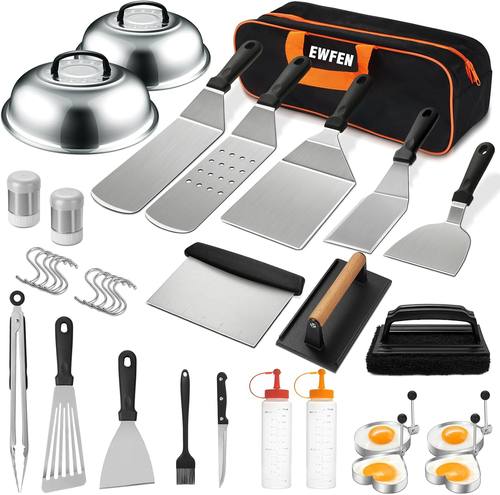
The toolkit: EWFEN 35PCS Griddle Accessories Kit, Flat Top Grill Accessories Set
 Visit on Amazon →
Thirty-five pieces sounds like a lot, and it is. Half of them you will use every single cook, and half will live in a drawer. That is fine, because the half you use is the half that matters.
The scraper is the most important tool in the box. It is what cleans the plate while it is still hot, and it is what chops a pile of onions into a pile of hash browns. The enlarged spatulas are the second. A wide, thin edge slides under a smash burger without tearing it and lifts a whole griddle full of fried rice in one move. The basting cover is the third. Drop it over a burger with a slice of cheese and you get a proper melt in thirty seconds instead of a cold slice on a hot patty. Check current Amazon price.
Flaws but not dealbreakers: Kit tools are kit tools. The handles are not restaurant grade, and if you are on the flat top four hours a day you will wear them out. For a backyard cook who fires up three times a week, they will last years.
How to season a flat top griddle insert
Seasoning is polymerized oil: thin layers of fat baked onto the steel until they bond into a hard, slick surface. It is a habit, not an event, and it is the difference between a plate that releases eggs and a plate that holds onto them.
Use the right oil. Something with a high smoke point. Canola, grapeseed, vegetable shortening, or flaxseed if you like the ritual. Olive oil is a finishing oil, not a seasoning oil.
Keep the coats thin. Wipe oil on with a rag or paper towel, then wipe most of it back off like you made a mistake. A thick coat turns gummy and flakes. Thin coats stack.
Heat until it stops smoking, then let it cool. Medium heat, ten to fifteen minutes, until the shine dulls and the smoking stops. Then let it come down. Repeat two or three times. That is your base layer.
Reapply after every cook. Ninety seconds. A dime sized drop of oil, spread with a rag while the plate is still warm. That single habit is what keeps a griddle nonstick for years.
The first cook, in order
Start with fat. Bacon, sausage, or a thin layer of oil. It lays down a base layer of seasoning and it tells you where your hot spots are.
Then onions or potatoes, because they want the middle of the surface and they do not care if the temperature dips. Then proteins. Then eggs, cheese, and anything delicate in the coolest corner you have.
Two rules that matter more than any recipe. Do not crowd the plate. Every piece of food you add drops the surface temperature, and a crowded griddle steams instead of sears. And keep the scraper in your hand. Push the food, clear the surface, and move on. That rhythm is the entire job.
Cleaning and daily care
Scrape while it is hot. Push the grease and the crusty bits to the grease channel or the low corner and out. If something is stuck, splash a little water on it and scrape again. The steam lifts it.
Wipe it down, then oil it. That is it. No soap on a fresh seasoning, no soaking, no dishwasher, no leaving it to dry in the sink overnight.
If it rains and you forget it outside, you will find rust. Scrape it off, wash the plate, dry it hard, and re-season. It is not ruined. It is just neglected, and neglect is fixable.
Mistakes that kill a griddle insert
- Leaving it wet or out in the weather
- Cooking everything on high heat because hotter is better
- Glopping oil on and calling it seasoned
- Letting it cool down dirty, so the food bakes on
- Overloading the surface and wondering why nothing browned
- Buying a plate that does not actually fit your grill
What it costs
The plate and the toolkit together are a small fraction of what a standalone flat top griddle costs, and they turn the grill you already own into a second cooking surface. Check current Amazon price on both and do the math against a dedicated unit. If you already own a three or four burner gas grill, the insert is the cheaper path to a flat top by a wide margin, and it stores in the garage when you are not using it.
The short version
Measure your firebox, buy a plate that sits flat and sends grease somewhere useful, season it thin and often, and keep a scraper in your hand. That is the whole method. Do it and your gas grill stops being a steak machine and starts being the most versatile surface you own.
That is the job. Hot surface, thin layer of oil, and go.