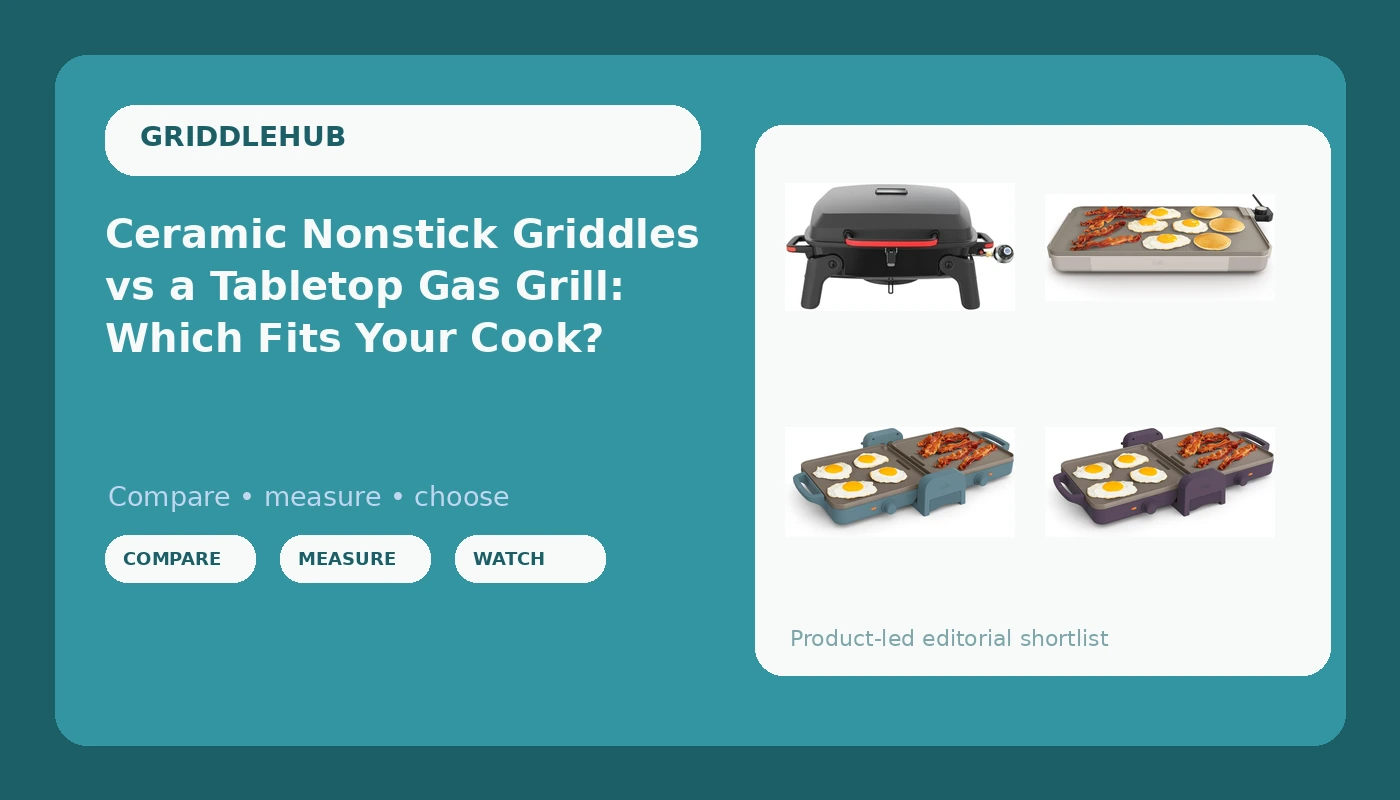
Choosing between a plug-in electric griddle and a small gas grill is less about brand loyalty and more about where you cook, what you cook, and what you are willing to clean afterward. The four listings here sit on both sides of that line: one single-burner tabletop gas grill with foldable legs, and three electric ceramic nonstick griddle options, two of which are the same fold and store unit in different colorways. If you have been circling a ceramic nonstick griddle purchase and cannot decide between the countertop electric route and the gas route, the differences that actually matter are fuel, surface size, storage footprint, and how the cooking surface gets maintained week after week.
Related: Flat Top Grease Management: Traps, Cups, and Channels →
Quick answer
These four products split into two families, and the split is the decision. The Megamaster is a gas grill: one burner, foldable legs, and a warming rack, which makes it a portable outdoor cooking option rather than a flat top. The three bella units are plug-in electric griddles with ceramic coatings the listings describe as non-toxic: a larger 12 x 22 model in Oatmilk, and a 10 x 20 fold and store model offered in Surf and in Plum. Pick the electric route when your cooking happens on a counter and you want a flat surface. Pick the gas route when you need to cook away from an outlet. Between the two 10 x 20 units, the difference is the colorway, not the cooking surface.
Four useful options
| Model | Best fit | What stands out |
|---|---|---|
| Megamaster Tabletop 1 Burner Gas Grill, Foldable Legs with Warming Rack | Cooking away from an outlet | Single burner, foldable legs, warming rack |
| bella 12 x 22 Electric Ceramic Nonstick, Nontoxic Griddle, Oatmilk | Feeding several people from one counter | Larger 12 x 22 surface, ceramic coating described as non-toxic |
| bella 10"x20" Fold and Store Griddle, Non-Toxic, Ceramic Coating, Surf | Small kitchens and tight storage | 10 x 20 surface with a fold and store design |
| bella 10"x20" Fold and Store Griddle, Non-Toxic, Ceramic Coating, Plum | The same surface in a different color | Identical size and design to the Surf version |
The tabletop gas option: Megamaster Tabletop 1 Burner Gas Grill, Foldable Legs with Warming Rack
Be honest with yourself about what this one is. It is a grill, not a flat top. If you want to smash burgers on a continuous steel surface, a grill with a grate does a different job, and no amount of technique turns one into the other. What a single-burner tabletop gas unit gives you is independence from an outlet and a footprint small enough to live in a closet between cooks. The trade-off is heat control: one burner means one heat zone, so you manage doneness by moving food around the grate rather than by dialing separate zones up and down. Gas also means fuel management, which means a propane supply you have to plan for before the cook, not during it.
The larger electric surface: bella 12 x 22 Electric Ceramic Nonstick, Nontoxic Griddle, Oatmilk
Surface size is the whole argument for this one. Two extra inches of width and two of depth change how many pancakes, burger patties, or eggs you can run at once without crowding, and crowding is what steams food instead of searing it. The cost of that surface is counter space and storage space, plus a longer preheat and a bigger cleaning job at the end. Before you commit, measure the counter you plan to use and the cabinet or closet it will live in. A griddle that only fits on the stove top because it has nowhere else to go is a griddle that stops getting used.
The fold and store pick: bella 10"x20" Fold and Store Griddle, Non-Toxic, Ceramic Coating, Surf
The fold and store design is the reason to look at this one over the larger model. If your storage is a cabinet above the fridge or a shelf in a shared kitchen, the ability to collapse the unit matters more than two inches of cooking surface you would only fill on holidays. A 10 x 20 surface still handles a family breakfast, a batch of quesadillas, or four burger patties at a time. What you give up is margin: when you cook for a crowd, you cook in more batches, and batching means the first food waits while the last food cooks.
The same griddle in Plum: bella 10"x20" Fold and Store Griddle, Non-Toxic, Ceramic Coating, Plum
There is no performance argument to make between the Surf and the Plum version, and anyone who tells you otherwise is selling something. Same size, same coating description, same fold and store approach. Choose on the color you want sitting on your counter and on what is available when you buy. That sounds trivial until you remember that the griddle you like looking at is the griddle you leave out, and the griddle you leave out is the one that gets cooked on three times a week instead of three times a year.
Prices and availability may change. Product images, names, and retailer links are matched to verified listings. No current price, rating, stock status, or measured result is stated here without current evidence.
Gas or electric: what actually changes in the kitchen
The first decision is not size or color, it is where the heat comes from, and that decision cascades into everything else. A tabletop gas grill needs an outdoor space, ventilation, and a propane supply. It gives you the ability to cook anywhere you can carry it, and it gives you a grate rather than a flat surface, which is a different cooking technique with different results. An electric griddle needs a wall outlet, a counter with room for it, and a place to store it. It gives you a continuous flat surface, no fuel to buy or store, and no open flame, which is often the deciding factor for apartment dwellers, renters, and anyone cooking on a balcony with rules about grills.
The second thing that changes is heat control. Electric griddles heat through the plate, and how evenly that plate heats is a function of the element layout and the metal above it. Gas gives you an instant, visible flame, and a single-burner unit gives you exactly one zone to work with. If you have cooked on a multi-burner flat top, a single zone will feel like a constraint until you learn to use the cooler edges of the surface for resting and holding. There is no free upgrade here: fewer zones means simpler, not better, and simpler is sometimes exactly what a small patio or a Tuesday night dinner needs.
Ceramic coatings versus seasoned steel, and how to treat each
Ceramic nonstick griddles and seasoned steel flat tops get cleaned and maintained in opposite ways, and mixing up the two is how people ruin a surface in the first month. Seasoned steel wants thin coats of oil, high heat, and a metal scraper while the surface is still hot. A ceramic coating wants a gentler hand: no metal tools dragging across it, no abrasive pads, no sudden temperature shocks from a cold rinse on a hot plate. The listings here describe the coatings as non-toxic and nonstick, which tells you the surface is designed to release food rather than to be built up with polymerized oil over time.
The practical consequence is that you cannot season your way out of a worn ceramic coating the way you can re-season a steel griddle. That is not a knock on ceramic, it is a maintenance schedule difference. Treat the coating as the wear item, keep your tools non-metal, wash it after it cools, and store it so nothing rests on the surface. And apply the same rule to the gas grill that applies to everything: no surface is immune to neglect. Steel rusts, grates rust, and coatings degrade. The variable is not the product, it is whether you clean and dry it after the cook.
- Measure the counter you will actually cook on and the space where the unit will be stored when it is not in use.
- Decide the fuel question first: an outlet nearby means electric is viable, and no outlet means gas or nothing.
- Match the surface size to the number of people you cook for most nights, not the number you cook for twice a year.
- Check how the unit folds, collapses, or comes apart, and confirm you can do that alone without rearranging the kitchen.
- Plan the cleaning routine before the first cook, including which tools are safe on the surface you chose.
Practical guidance before you buy
- Measure twice. Width and depth on the counter matter, but so does the height clearance under cabinets and the door swing on the cabinet where it will live.
- Confirm your outlet situation. A plug-in griddle needs a reachable outlet, and the cord length in the listing details is worth reading before you commit.
- Buy a scraper and a thin spatula sized to your surface. A tool that is too small for the plate makes every cook slower.
- Keep metal tools off ceramic coatings. Silicone, nylon, wood, and plastic are the safe set for a nonstick surface.
- Store nothing on the cooking surface. Stacking pans on a griddle is how coatings get scratched and how grates get bent.
- If you go the gas route, sort out your propane supply before the first cook, not the morning you plan to feed people.
Which option should you choose?
Choose the Megamaster Tabletop 1 Burner Gas Grill, Foldable Legs with Warming Rack when you cook outdoors, want gas heat, and need foldable legs and a warming rack in a unit you can carry and store. Choose the bella 12 x 22 Electric Ceramic Nonstick, Nontoxic Griddle, Oatmilk when you want the largest cooking surface of the electric options and you have the counter and cabinet space to match. Choose the bella 10"x20" Fold and Store Griddle, Non-Toxic, Ceramic Coating, Surf when storage is the constraint and a 10 x 20 surface covers what you actually cook. Choose the bella 10"x20" Fold and Store Griddle, Non-Toxic, Ceramic Coating, Plum when you want that same fold and store unit and prefer the Plum finish.
One caveat worth repeating: nothing here is a claim about measured performance, durability over years, or how a specific unit behaves in your kitchen. Those answers live in the current listing details and in how consistently you clean and store the surface you buy.
The bottom line
The gas versus electric question answers itself once you know where you cook. No outlet and an outdoor space points to the single-burner tabletop gas grill. A counter and a cabinet point to one of the electric ceramic nonstick griddles, and then the decision narrows to surface size against storage: 12 x 22 for more room at once, 10 x 20 fold and store for a smaller footprint, with the Surf and Plum versions being the same griddle in two finishes. Buy the size you will use on a normal weeknight, keep your tools off the coating, and clean it while it is still warm. That routine matters more than any spec on the box.