A flat top griddle is the most versatile cooking surface a backyard can hold, and the case for it is simple. It does a full breakfast service, a pile of smash burgers, and a batch of hibachi vegetables without you swapping a single tool. The problem is that shopping for one gets noisy fast. Listings lead with square inches, burner counts, and big BTU numbers, and none of that tells you whether the surface will still cook evenly after a season or whether the grease will end up on your patio. What actually decides whether a flat top griddle earns its space is the surface itself, the zones under it, the grease management, and the two or three tools you keep next to it. Below is what I check first, plus four pieces of gear that cover the common backyard setups.
Related: How to Season a Flat Top Griddle and Keep It Nonstick →
Quick answer
There is no single flat top griddle that suits every backyard, so the honest answer is a split one. Match the cooking surface to the number of people you actually feed and the space you actually have, then put part of the budget into the tools that make that surface work. A three-burner propane flat top with a hinged lid and wind guards covers most small and medium patios. A four-burner grill and griddle combo suits cooks who want a grate and a flat top on one cart. A smash burger kit bundles the press, spatula, shaker, and patty papers. A cleaning block keeps carbon from building up between cooks. None of these is the right pick for everyone, and none of them stays nonstick if the seasoning gets neglected.
Four useful options
| Model | Best fit | What stands out |
|---|---|---|
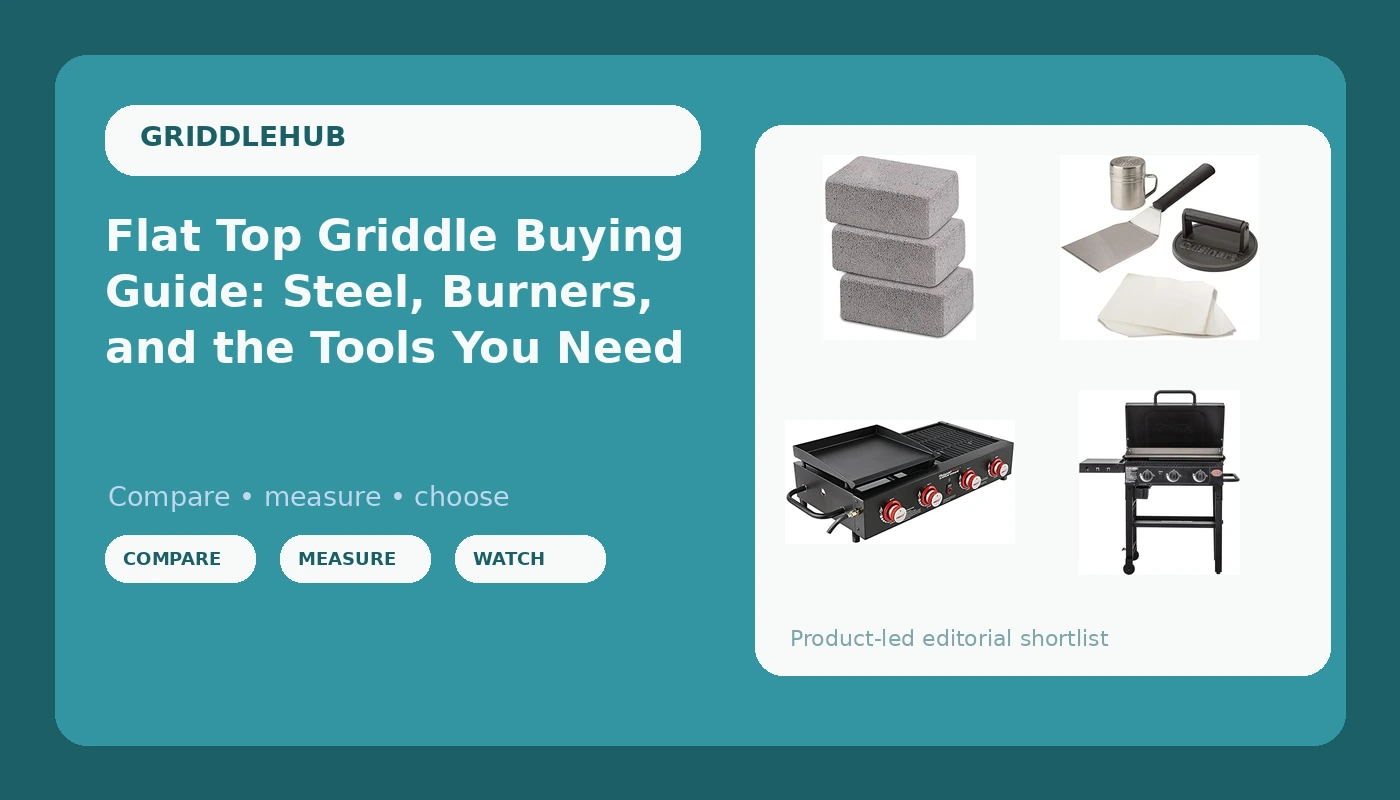
| Char-Griller Flat Iron 3-Burner Propane Gas Flat-Top Griddle | Small and medium backyards, tailgates | Three burners, 520 square inches of cooking surface, hinged lid, and wind guards |
| Royal Gourmet GD4002T 4-Burner Tailgater Grill and Griddle Combo | Cooks who want a grate and a flat top in one cart | Four burners with both a grill side and a griddle side in a single tailgater frame |
| Cuisinart Smash Burger Kit | Anyone building a smash burger routine | Burger press, spatula, shaker, and patty papers in one purchase |
| Grill Stone Cleaning Brick Cleaner Block, 3Pack | Keeping a seasoned surface clean | Three abrasive cleaning blocks intended for griddle and stove surfaces |
The compact propane flat top: Char-Griller Flat Iron 3-Burner
Three burners is the number I keep coming back to for a household rig. You get a hot zone for searing, a middle zone for onions and peppers, and a cooler zone for holding finished food or toasting buns. The Flat Iron puts 520 square inches of steel griddle top under those three burners, which is enough for four to six smash burgers at a time or a family breakfast without cooking in relays. The hinged lid matters more than people expect: it traps heat for melting cheese and steaming a pile of onions, and it keeps the surface covered between cooks. The wind guards are the quiet feature. On a breezy evening, an exposed flat top loses heat across the whole surface and you spend the night chasing the burners. The trade-off is size. This is not a four-foot commercial griddle, so a party of twenty means cooking in batches, and the steel still needs the same seasoning habit as any other propane flat top.
The grill and griddle combo: Royal Gourmet GD4002T
A combo unit solves a specific problem. You want to sear a steak over a grate and finish the sides on a flat top, and you do not want two carts in the yard. The GD4002T puts four burners and both surfaces into one tailgater frame, which is the format that makes sense if your cooking happens in a driveway, a parking lot, or a campsite as often as it happens at home. The honest trade-off is that you are splitting the real estate. Each surface ends up smaller than a dedicated unit at the same overall footprint, and the two surfaces want different care. A grate does not need seasoning the way a flat top does, so you will be maintaining one part of the cart more carefully than the other. If you cook almost everything on a flat top and only occasionally want a grate, a dedicated griddle is the simpler machine. If you genuinely cook both ways, the combo earns its space.
The smash burger kit: Cuisinart Smash Burger Kit
Technique matters more than the gear here, but the gear removes the friction. A smash burger is a two to three ounce ball of ground beef dropped on a hot, lightly oiled surface, pressed flat once with real pressure, and then left alone until the edges go lacy and brown. Give it about thirty seconds, scrape under it, and flip. The press in this kit spreads that pressure evenly across the whole patty, which is the difference between beef that sears on contact and beef that steams in its own puddle. The spatula is the tool you actually use for the scrape and the flip. The shaker is for the salt and pepper you hit the patty with right after the press, and the patty papers keep portioned balls from fusing together in the fridge. If you already own a stiff spatula and a flat-bottomed press, you can skip the kit. If you are starting from nothing, buying the set beats assembling the pieces one at a time.
The cleaning block: Grill Stone Cleaning Brick Cleaner Block
A cleaning block is the least glamorous item on this list and the one that decides how long your seasoning survives. Carbon builds up on a flat top no matter how well you scrape, and a thin layer of burned-on residue is what makes food stick and taste like yesterday. These blocks are abrasive, so they take that layer off. Used with some restraint, they are a maintenance tool. Used hard after every single cook, they will take the seasoning down with the carbon, and you will be back to rebuilding a bare surface from scratch. The three-pack format matters more than it sounds, because a block wears down and gets greasy, and having a fresh one on hand is the difference between cleaning the griddle and putting it off until tomorrow. Keep it in the same drawer as the scraper.
Prices and availability may change. Product images, names, and retailer links are matched to verified listings. No current price, rating, stock status, or measured result is stated here without current evidence.
How burner zones change what you can cook
Burner count gets marketed as a number, but the number that matters is how many independent zones you can run at once. A griddle with three burners is not just a bigger two-burner unit. It is three separate heat areas, and that is what lets you run a breakfast service: bacon on the left, eggs in the middle at a lower setting, toast on the right. Two burners gives you two zones, which is enough for burgers and a pile of onions but tight for a full breakfast. Four burners gives you the most control and the most surface, at the cost of a bigger footprint and more propane burned per session.
Layout matters as much as count. Burners that run front to back create vertical zones, so you can keep a hot strip along the back and a cooler strip along the front. Burners that run left to right create horizontal bands. Both approaches work. What does not work is a large surface with a single wide burner underneath it, because you get one hot spot in the middle and cool steel at the edges, and no BTU rating on the box fixes a layout problem. Before you buy, look at the burner arrangement and ask yourself which zones you could realistically run on a Tuesday night.
What to check before you buy
- Count the people you feed on a normal week, not the biggest party you have ever thrown. A 520 square inch surface handles a family breakfast or four to six burgers at once; a crowd means cooking in batches.
- Look at the burner layout instead of the total BTU figure. Independent zones you can set differently are worth more than one large burner with a big number attached.
- Check the grease management. A removable cup or channel you can actually get a hand into is the difference between cooking and scrubbing.
- Confirm the lid and wind protection situation for your yard. A hinged lid helps with melting and holding, and wind guards keep a breezy patio from stealing your heat.
- Budget for the tools in the same purchase. A scraper, a stiff spatula, and a cleaning block are not optional accessories, they are part of the machine.
Practical guidance for the first month
- Season before you cook anything, then season again after every session for the first few weeks. Thin coats of oil, heat until the surface darkens, repeat.
- Scrape while the surface is still warm. Residue comes off easily when it is hot and turns into a chisel job once it cools.
- Use the cleaning block for buildup, not for every cook. Heavy abrasive use strips seasoning along with carbon.
- Keep water off the steel between cooks. A flat top that rusts was a flat top that sat wet, not a flat top that was badly made.
- Store the scraper and the block with the griddle instead of in the kitchen. Tools that live next to the surface actually get used.
Which option should you choose?
Choose the Char-Griller Flat Iron 3-Burner Propane Gas Flat-Top Griddle when you want a dedicated propane flat top for a small or medium backyard and you value the hinged lid and wind guards more than raw surface area. Choose the Royal Gourmet GD4002T 4-Burner Tailgater Grill and Griddle Combo when you genuinely cook both ways and want a grate and a flat top on one cart you can take to a tailgate. Choose the Cuisinart Smash Burger Kit when your goal is a repeatable smash burger routine and you would rather buy the press, spatula, shaker, and papers as one set. Choose the Grill Stone Cleaning Brick Cleaner Block when you already own a griddle and want the maintenance tool that keeps carbon from taking over the surface.
If more than one of those describes you, buy the griddle first and the tools second. The surface decides what you can cook; the tools decide how long it keeps cooking well.
The bottom line
A flat top griddle rewards the cook who thinks about zones, grease, and seasoning before thinking about square inches. Pick the surface that matches your normal week, whether that is a three-burner propane unit with a lid and wind guards, a four-burner combo that covers both a grate and a flat top, or a smaller setup with a smash burger kit parked next to it. Then treat the steel like what it is: a surface that stays nonstick because you keep feeding it oil and scraping it clean, not because a listing promised it would. Buy the size you will actually use, keep the cleaning block within arm's reach, and the griddle will outlast the novelty of every other outdoor cooking purchase you have made.