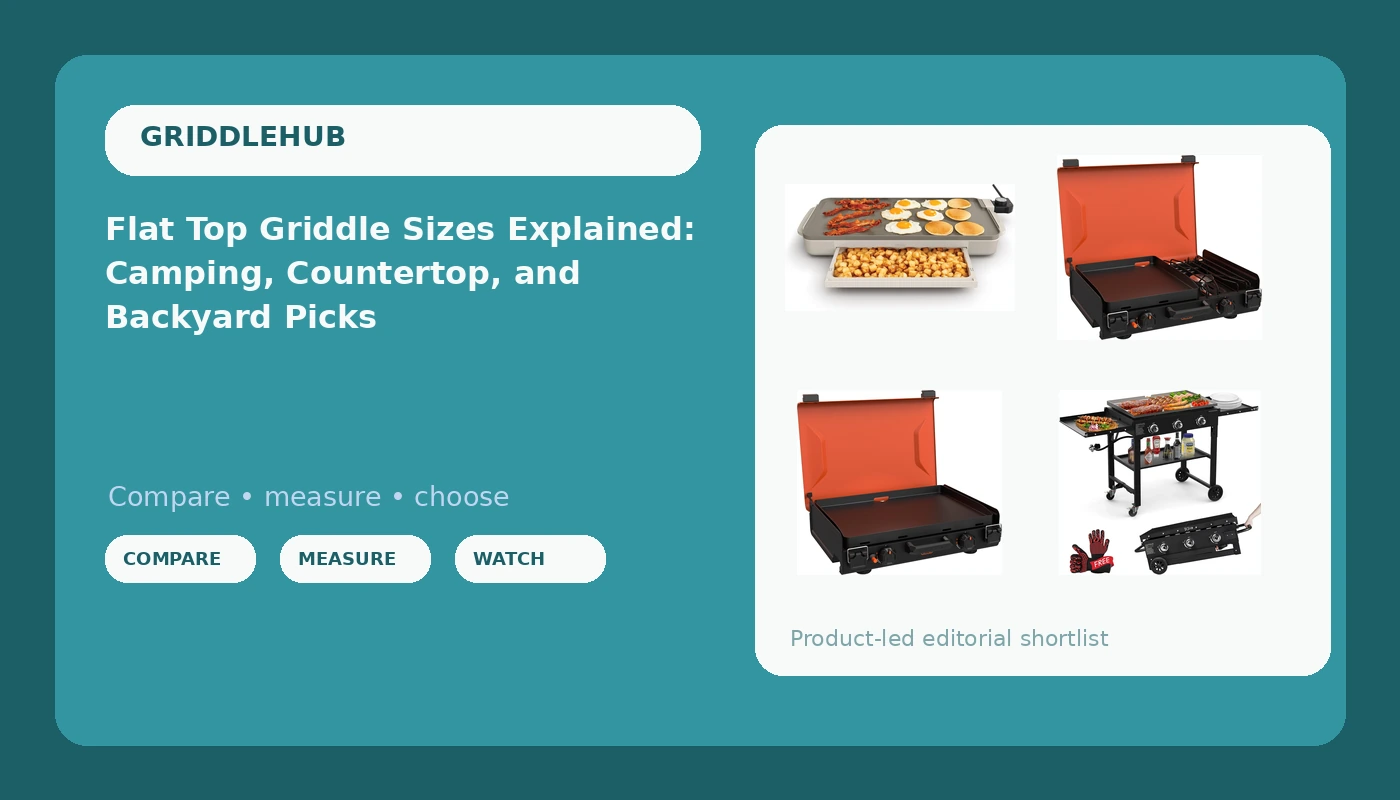
A flat top griddle is the most versatile cooking surface you can own, and the reason most people end up disappointed with one has nothing to do with the brand name on the lid. It is the size and the burner layout. Buy a compact camping griddle to feed a family of five and you will be cooking in shifts, standing there with a scraper while everyone else eats. Buy a three burner propane flat top for two people and you will spend more time managing a half cold surface than actually cooking on it. The four griddles in this guide sit at different points on that spectrum: a folding three burner propane unit for the backyard, an electric countertop griddle for indoor cooking, and two camping griddles in different footprints. What follows is how to tell which one fits the way you actually cook on a Tuesday night, not the way you cook once a summer.
Related: How to Season a Flat Top Griddle So It Stays Nonstick →
Quick answer
Match the cooking surface to the number of people you feed and to the heat source you already have. A three burner propane flat top is the right shape for backyard cooking for a group. A countertop ceramic griddle is the right shape for indoor cooking in an apartment or a small kitchen where propane is not an option. A camping griddle is the right shape for a tailgate, a two burner stove, or a picnic table. Inside the camping category, the 20 by 14 inch model buys you more cooking area, and the 12 by 14 inch model trades some of that area for a dedicated side burner. None of the four is a universal answer, and that is exactly the point.
Four useful options
| Model | Best fit | What stands out |
|---|---|---|
| BESTFIRE Foldable Flat Top Grill, Outdoor Griddle-3 Burner Propane Griddle | Backyard cooking for a group | Three propane burners under one surface, with a body that folds for storage |
| bella 10"x20" Ceramic Griddle with Warming Tray, 1500W Non-Toxic, Oatmilk | Indoor countertop cooking | A 1500W electric ceramic surface with a warming tray, in an Oatmilk finish |
| ® 2364 12" x 14" Camping Griddle with Side Burner | Small camping and tailgate setups | A compact 12 by 14 inch cooking area plus a dedicated side burner |
| ® 2363 20" x 14" Camping Griddle | Camping and cooking for a group | A larger 20 by 14 inch cooking area in a portable camping format |
Backyard propane pick: BESTFIRE Foldable Flat Top Grill, Outdoor Griddle-3 Burner Propane Griddle
The trade-off with any propane flat top is that the fuel, the wind, and the outdoor space all become part of the cook. Three burners give you the ability to run one zone hot for searing and another lower for keeping things warm, which is the whole reason a flat top works for a crowd. But more burners also mean more surface to preheat, more steel to season evenly, and a bigger footprint when it is set up. If you cook for two most nights and only host a few times a year, this is more machine than your routine needs. If your weekends are a full breakfast and a round of smash burgers for eight, it is the format that keeps you cooking instead of waiting.
Countertop pick: bella 10"x20" Ceramic Griddle with Warming Tray, 1500W Non-Toxic, Oatmilk
The thing to understand about a ceramic coated surface is that it does not follow the rules of seasoned steel. You are not building a polymerized oil layer, so you do not scrape it with a metal tool, you do not attack it with a stiff brush, and you do not leave it to bake at high heat to "set" anything. You cook on it, you wipe it while it is warm, and you protect the coating. The upside is convenience and a surface that works indoors without a tank. The downside is that any electric griddle produces smoke and grease vapor, so ventilation matters more than the spec sheet suggests. This is the pick for an apartment, a dorm, a small kitchen, or a rainy day when the backyard unit is under a cover.
Compact camping pick: ® 2364 12" x 14" Camping Griddle with Side Burner
Here is the honest trade-off on this one: 12 by 14 inches is a batch cooking surface, not a service line. You can do smash burgers, you can do a round of eggs and potatoes, and you can do a couple of steaks, but you will be working in rounds. What you get in exchange is the side burner, which is the feature that makes a small camping griddle feel like a real camp kitchen instead of a novelty. Coffee going on one side, bacon on the other, and no juggling. If you camp with two or three people and you value having two cooking vessels running at once over having a wide surface, this is the layout that makes sense.
Larger camping pick: ® 2363 20" x 14" Camping Griddle
Choosing between the two camping griddles comes down to one question: do you want more cooking area, or do you want a second burner? The 20 by 14 inch surface gives you room to spread food out so it sears instead of steaming, and room to hold a section warm while you finish the rest. The smaller unit with the side burner gives you a second vessel but less flat top. Both are portable, both need the same seasoning habit, and neither one is going to replace a full size backyard griddle for a big party. Pick the one whose limitation you can live with, because every griddle has one.
Prices and availability may change. Product images, names, and retailer links are matched to verified listings. No current price, rating, stock status, or measured result is stated here without current evidence.
Burner layout matters more than the heat number on the box
Every griddle listing leads with a big heat number, and that number tells you far less than the layout underneath the steel. A single burner running across a wide surface creates a hot center and cool edges, which is why so much griddle food comes out uneven. Multiple burners let you build zones: a hot side for searing, a medium side for eggs, and a low side for holding. That zoning is what a diner flat top does all day, and it is the reason a cook can run a full breakfast service without plating cold food.
Steel thickness and surface material decide how those zones behave. Thin steel reacts fast, which sounds good until you realize it also loses heat the second cold food lands on it and recovers unevenly. Thicker steel holds temperature better but takes longer to preheat. Ceramic coated electric surfaces behave differently again, since the heat comes from a heating element under the coating rather than an open flame, and the coating itself changes what tools you can use. None of this is visible in a marketing photo, so look at the burner count and the layout diagram before you look at the headline number.
There is also no honest way to judge heat without measuring it. A surface thermometer costs very little and tells you what your griddle is actually doing at the left, center, and right of the surface. If you never measure, you are guessing, and guessing is how you end up with burgers that are charred on one end and pink in the middle.
How to size a griddle to the way you actually cook
Sizing is the decision that matters most, and most people get it wrong in the same direction: they buy for the biggest cook of the year instead of the average weeknight. Work through these five steps in order.
- Count the people you feed on a normal weeknight, not the number of guests at your biggest party. That count sets your minimum surface area, and everything above it is a convenience you pay for in storage space and preheat time.
- Measure the space you actually have, including lid clearance, side shelf swing, and room for the grease cup to slide out. A griddle that technically fits but cannot drain is a griddle you will not use.
- Choose the fuel before the model. Propane means outdoors, a tank, and wind management. Electric means an outlet, indoor ventilation, and a coating that needs gentler handling.
- Inspect the grease management system. A removable cup or a defined channel is a system. A shallow lip that lets fat run toward the burner is a problem waiting for your first pound of bacon.
- Budget for the accessories that actually matter: a sturdy scraper, a good spatula, squeeze bottles for oil and water, and a cover. Those four items do more for your cooking than any upgrade to the griddle itself.
Seasoning and grease habits that decide year three
The griddle that is still cooking well in year three is not the one with the best spec sheet. It is the one that got maintained. These habits matter more than any feature you can buy.
- Season in thin coats. Multiple thin layers of oil, heated until they darken, build a durable surface. One thick pour turns into a sticky mess you have to strip.
- Scrape while the surface is hot. The scraper is the most important accessory you own, and it works best before the grease sets up.
- Empty the grease trap before it is full. A neglected trap is a science experiment, and it is the single most common reason a griddle gets retired early.
- Keep a light oil film on the surface between cooks, and cover the unit. Steel rusts when it is neglected. There is no coating that changes that, only habits that prevent it.
- Do not treat a ceramic coated surface like seasoned steel. No metal scraper, no abrasive pad, no high heat bake to set a seasoning layer. Wipe it warm and protect the coating.
Which option should you choose?
Choose the BESTFIRE Foldable Flat Top Grill, Outdoor Griddle-3 Burner Propane Griddle when you cook outdoors for groups and want three burners, multiple heat zones, and a body that folds down between cooks. Choose the bella 10"x20" Ceramic Griddle with Warming Tray, 1500W Non-Toxic, Oatmilk when you cook indoors, want a plug in electric surface with a warming tray, and can manage the smoke with good ventilation. Choose the ® 2364 12" x 14" Camping Griddle with Side Burner when you want a compact camping surface and value running a second pot alongside the griddle more than you value extra flat top area. Choose the ® 2363 20" x 14" Camping Griddle when you camp or tailgate with a group and need the widest cooking surface you can carry.
One caveat worth stating plainly: the descriptions above come from the listings, not from measured performance in your yard. Wind, altitude, fuel pressure, and how well you preheat will change how any propane griddle behaves, and every steel surface will rust if you neglect it. Buy for the size and layout you will use weekly, then treat the maintenance as part of the purchase.
The bottom line
The flat top griddle decision is not about which unit is objectively superior. It is about which surface area and which heat source match your actual cooking. A three burner propane flat top earns its space when you feed a crowd outdoors. A countertop ceramic griddle earns its space when you cook indoors and want convenience over seasoning rituals. The two camping griddles split the portable category between more surface area and a side burner, and you should pick based on which of those two you would miss more. Get the size right, keep the surface seasoned and the grease trap empty, and the griddle becomes the surface you reach for three times a week.