Most people who go looking for a flat top griddle for gas grill cooking are one plate away from the food they want. You already own the fire, the lid, the side shelf, and the fuel. What you do not own yet is a slab of steel sitting where the grates sit, holding heat, holding fat, and giving you a surface you can scrape clean in eight seconds.
I spent eight of my thirteen line years on a four foot commercial flat top, working a diner that served 400 breakfasts a morning. Now I run a food trailer in Phoenix and a backyard griddle that gets used three times a week minimum. When a neighbor asks whether he should buy a stand-alone griddle or drop a plate on the grill he already owns, I give the same answer every time: start with the plate. You find out in a week whether flat top cooking fits how you actually eat, and if it does, you will know exactly what you want when you buy the big one later.
This guide covers the two plate styles that make sense for most backyard cooks: a plate that sits on the grates of a gas or charcoal grill, and a carbon steel half size drop-in that turns a Ninja grill into a flat top on one side. I will cover how to choose between them, how to season carbon steel so it stops sticking, and the exact setup I run before a breakfast service.
One warning before we start. A plate that sits on your grates does not come with the grease management of a stand-alone griddle. There is no trap, no channel, and no removable cup. You move fat with a scraper and a foil pan. That is a hassle for about two cooks, and then it is just part of the rhythm of the surface.
Why you should trust me
Thirteen years on the line, eight of them on a flat top. I have cooked breakfast for 400 people before ten in the morning and hibachi for 30 in a backyard. A griddle is the most versatile cooking surface in existence, and I will argue that with anyone holding a charcoal chimney.
When I write about a surface, it gets three things: 100 smash burgers, a full breakfast service, and a 60 day seasoning test where I clean it the way a normal person cleans it and watch for rust. I keep a scraper and a squeeze bottle in my truck at all times, which tells you most of what you need to know about my tool philosophy. A burger flipper and a scraper are the whole kit. Everything else in the drawer is optional.
I also have two biases worth stating up front. BTU count is marketing until you know the burner layout underneath it. And seasoning is a habit, not a one time event. You will not read a single won't-rust claim in this article, because a griddle that rusts is a griddle that was neglected, not a griddle that was bad.
How I picked and how I tested
Every cooking surface that shows up here goes through the same three part test.
The burger test is 100 smash burgers, four ounces each, pressed flat on a surface I have preheated and read with a thermometer. I am watching for hot spots, which show up as one patty browning faster than the one six inches away. Four burners of nothing beats two burners of hype, and a plate with a cold corner tells you that in the first ten patties.
The breakfast test is eggs, pancakes, hash browns, and a pound of bacon in sequence, because breakfast is where a surface tells the truth. Eggs find every hot spot and every low spot. If the whites run to one corner and set there, I write it down.
The seasoning test runs 60 days. Cook, clean, oil, repeat, and check the polymer layer for patchiness and rust. Cheap steel is getting better every year, but the neglect test is still the one that separates a plate you keep from a plate you give away.
Plates get a different version of the test than stand-alones. You are not testing burner layout, because your grill already has one. You are testing whether the plate pulls heat evenly out of the burners, whether it rocks or warps when it comes up to temperature, whether it holds a real searing surface (I read it with a surface thermometer, not my hand), and whether it fits the grill you actually own.
Two caveats apply to both plates below. Fit matters more than any spec sheet, so measure your grill before you order. And carbon steel is carbon steel: it will rust if you leave it wet and uncovered, no matter what the box promises.
Two plates, two very different jobs
Both of these turn a grill you already own into a flat top, but they solve different problems. One is a full cooking surface for a gas or charcoal grill. The other is a half size drop-in for a Ninja grill, which means you keep half your grates and half your old way of cooking.
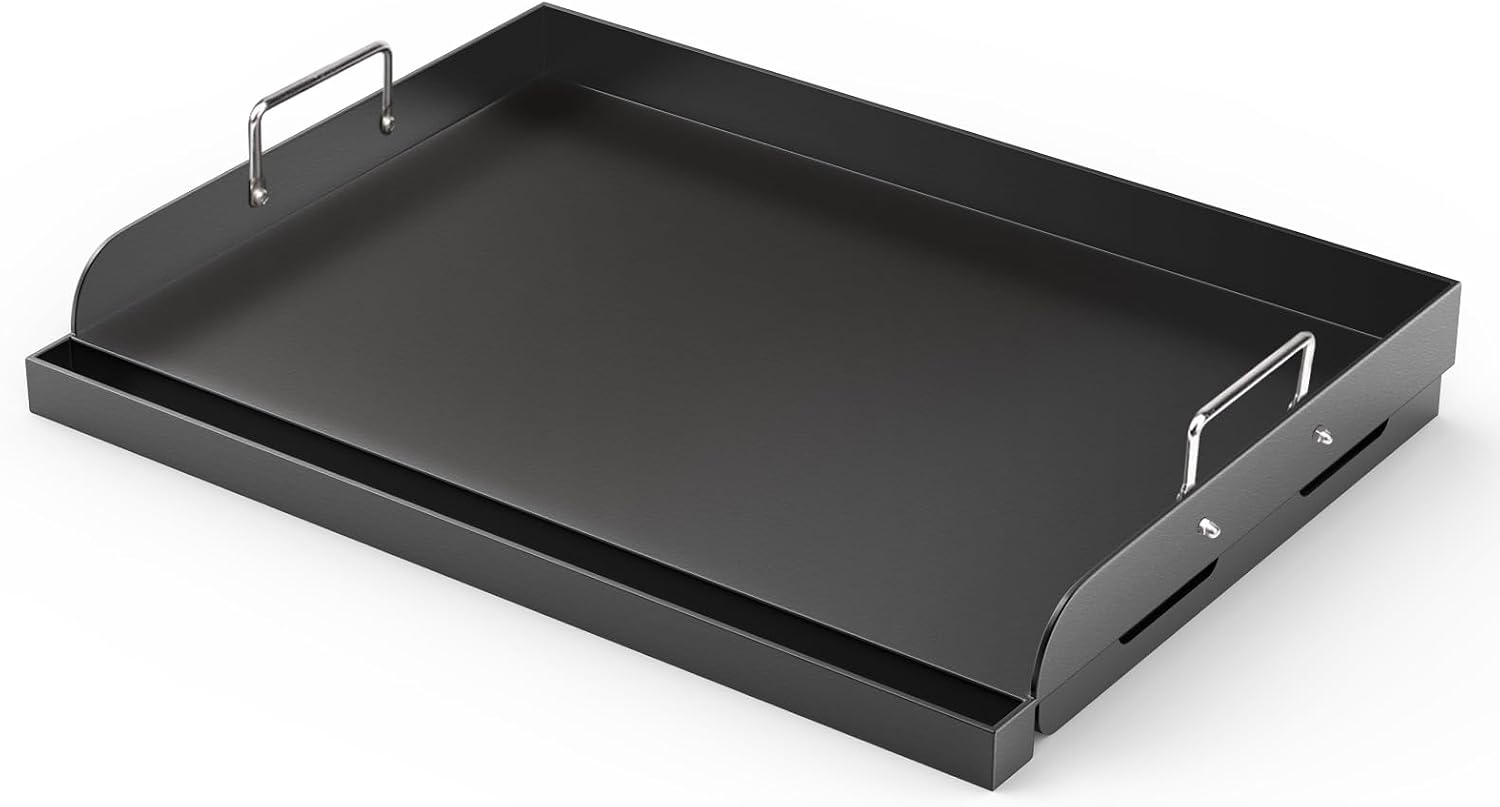
The full surface option: Griddle for Gas Grill, 17" x13" Flat Top Griddle for Charcoal/Gas
 Visit on Amazon →
This is the plate I recommend to anyone with a gas grill, and it is the plate I would drop into a charcoal kettle without thinking twice. The 17 by 13 inch surface is enough for four smash burgers with room to work a flipper, or six eggs and a pile of hash browns, or a pack of bacon in two batches. It sits on the grates, so installation is: set it down, preheat ten to fifteen minutes, cook. Check current Amazon price.
Two habits make it work. First, measure your grill's interior before you order, because a plate that overhangs by an inch is a plate you will not use. Second, cook with the lid open unless you are deliberately steaming something. Close the lid on a plate and you have built a low oven, and a low oven turns a sear into a gray braise.
On charcoal, the plate gets better. Bank the coals to one side and you have a hot zone and a warm zone on the same surface, which is the whole point of a flat top. Sear on the hot half, move the eggs to the warm half, and you are cooking like a short order line instead of running back and forth to the grill.
Flaws but not dealbreakers: There is no grease trap. Fat runs to the low edge and you push it into a foil pan or the drip tray. The plate also gets hot everywhere, edges included, so keep a folded towel and your scraper within reach.
Anyone with a two or three burner gas grill, or a charcoal kettle, who wants a real searing surface without buying a second appliance should start here.
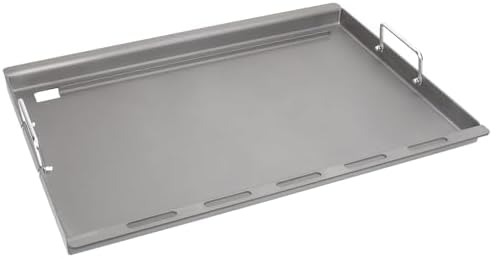
The drop-in option: Carbon Steel Half Size Griddle for Ninja Grill Replacment Parts
 Visit on Amazon →
This is the half size drop-in, and it is the move for anyone who wants flat top cooking without giving up the grates on the other half of the grill. It is carbon steel, it replaces one grate section on a Ninja grill, and it seasons like a carbon steel skillet: thin coats, heat, patience. Check current Amazon price.
Because it is a replacement part, fit is the entire game. Match the plate to your specific Ninja model before you order, and dry fit it cold with the lid closed so you know nothing fouls when the hood comes down. Half size also means half the output. You are cooking four burgers at a time, not twelve, and a breakfast for eight becomes two rounds instead of one. For a Tuesday night that is perfect. For a party it is a lesson in patience.
Carbon steel is the most honest material on a grill. It takes seasoning better than anything else and it punishes neglect faster than anything else. A well seasoned half size plate will out-cook a coated surface in year three, because there is no coating to lose. There is just your oil, your heat, and your scraping arm.
Flaws but not dealbreakers: The factory oil has to come off before the first cook, and the half size footprint means batching. Neither is a dealbreaker, but both surprise people.
Ninja grill owners who want a flat top on one side and a grate on the other will get the most out of this plate.
Setup, seasoning, and your first cook
Now the part you came for. This order works on any carbon steel plate, whether it sits on grates or drops into a Ninja.
Step one: Measure and dry fit. Set the plate on the grill cold. Close the lid. Make sure the plate sits flat, does not rock, and does not block the lid from closing. If it rocks now, it will rock worse when it is hot.
Step two: Strip the factory oil. The plate ships with a machining oil that is not seasoning and will not become seasoning. Hot water, a drop of dish soap, and a green scrub pad. Rinse it, then put it on the grill and heat it dry for five minutes to drive the moisture out. Do not let it air dry on the counter.
Step three: The first seasoning. High smoke point oil. Canola, grapeseed, or peanut all work. Put a thin coat on with a rag held in tongs, heat the plate until the oil just starts to smoke, hold it there for about ten minutes, then kill the heat and let it cool. Repeat three or four times. Thin coats, always. If the surface comes out sticky, you used too much oil, and the fix is more heat, not more oil.
Step four: Preheat and read the surface. Give the plate ten to fifteen minutes to come up. I read it with a surface thermometer. Smash burgers want 400 to 450. Hash browns want around 375. Eggs and pancakes want 350. Above 450 you are burning oil and smoking out the neighborhood. Below 325 you are steaming, and steamed food is the reason people think they hate cooking on a flat top.
Step five: Build your grease plan before the first burger goes down. Foil pan at the low edge of the plate, scraper in hand, squeeze bottle of oil within reach. A bad grease setup ruins every cook, and on a plate you are the grease setup.
Step six: Cook, and cook hot. Hot surface, thin layer of oil, loose ball of beef, press it flat with a stiff spatula and hold it for a beat, then let it crust. Scrape under it and flip. The first burger on a new plate is always the worst one. That is normal, and it is why I season with cheap food before I invite anyone over.
Step seven: Clean it while it is hot. Scrape the surface down, splash a little water on it, scrape again, wipe it with a rag, and lay down one thin coat of oil. Two minutes. If you wait until the plate is cold, you are chiseling instead of cleaning.
Step eight: Store it covered. Rust is a moisture problem, not a brand problem. Oil it after every cook, cover it, and if it sits for a week, look at it before you light the grill.
The competition and why it lost
A stand-alone griddle is the obvious alternative, and the Blackstone 36 inch remains the benchmark. The burner layout is proven and the accessory ecosystem is unbeatable. It is also a second appliance with its own fuel, its own cart, its own cover, and its own square footage. Buy it if you are feeding a crowd most weekends. If you cook for four on a Tuesday, the plate wins on footprint alone.
Cast iron griddle pans and insert plates are the second alternative. They hold heat and they sear hard, but they are small and they are heavy, and a small surface means you are cooking in shifts.
Indoor electric griddles are the third route, and Cuisinart's indoor griddle is my pick for an apartment, but this is an outdoor guide and the smoke is the whole story.
Then there are coated and nonstick plates. A surface that loses its coating in a season is not a cooking surface, it is a consumable. Carbon steel, seasoned and scraped, gets better every month you own it, and that is the only upgrade path I trust.
What this all costs
I do not print prices, because listings move. Both plates in this guide are on Amazon, so check current Amazon price on each one and compare it to what a stand-alone griddle runs. The plate route exists precisely because you already paid for the fire, the lid, and the fuel. You are not buying a cart, a cover, or a second regulator.
The honest math is that a plate costs a fraction of a stand-alone and the stand-alone costs you space you may not have. What you pay instead is attention: oil, propane, and the two minutes of scraping you owe the surface after every cook. Do that every time, and the cost per breakfast drops to almost nothing while the plate outlives the grill it sits on.
That is the job. Get the plate, season it right, and cook breakfast for eight on Sunday morning with the lid open. Your grill was built to do this. The plate just makes it honest.