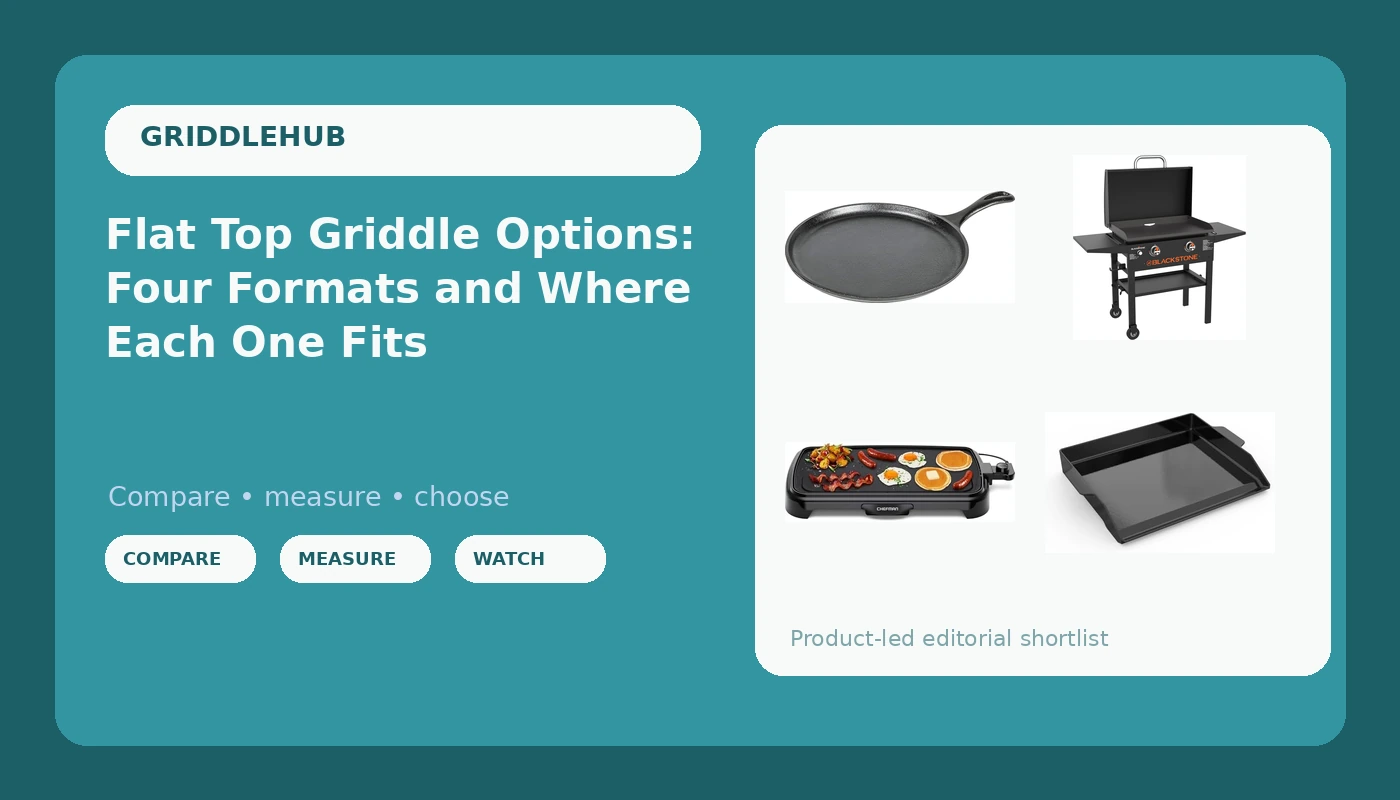
A flat top griddle is one cooking surface sold in four completely different packages, and that is where most buyers lose their way. The same two words cover a 10.5 inch round piece of cast iron that sits on your stove, a 28 inch freestanding unit with its own hood and propane regulator, a countertop electric model you plug into a wall outlet, and a rectangular insert that drops into the grill already sitting on your patio. All of them sear, all of them make smash burgers, and all of them handle grease in a different way. Sorting through flat top griddle options is less about which surface cooks better and more about where you cook, how many people you feed on a normal night, and whether you want to maintain a seasoned surface or wipe down a coated one. This explainer covers the four formats in the product records below, what each one is built for, and the questions that settle the decision before you spend anything.
Related: How to Season a Flat Top Griddle and Keep It Nonstick →
Quick answer
Match the format to where the griddle lives. A round cast iron griddle is the smallest commitment and works on a stovetop, on a grill grate, or over a campfire. A freestanding propane griddle is the format for higher volume outdoor cooking, because it brings its own frame, cooking surface, and hood. A countertop electric griddle is the plug in choice for indoor cooking where an open flame is not practical. A cast iron insert converts a grill you already own into a flat top without adding a second appliance. Once the location is settled, compare cooking surface size, how the heat is controlled, and how the grease gets out.
Four useful options
| Model | Best fit | What stands out |
|---|---|---|
| Blackstone 1883 Original 28" Omnivore Griddle with Hood, Black | Backyard cooking for a family or a small crowd | Freestanding propane griddle with an included hood and a 28 inch cooking surface |
| Chefman XL Electric Griddle with Removable Temperature Control, Immersible Flat Top Grill, Burger, Eggs, Pancake Griddle, Nonstick Extra Large Cooking Surface, Slide Out Drip Tray, 10 x 20 Inch | Indoor countertop cooking in an apartment or small kitchen | Removable temperature control, slide out drip tray, and a 10 x 20 inch nonstick surface |
| onlyfire Universal Enamelled Cast Iron Griddle Insert, 18.6" x 14" | Turning an existing grill into a flat top | Enamelled cast iron insert sized at 18.6 by 14 inches for universal grill fit |
| Lodge Round Seasoned Cast Iron Griddle, PFAS-Free, 10.5 Inches | Stovetop, grill grate, or campfire cooking for one or two people | Round pre-seasoned cast iron described as PFAS-free, 10.5 inches across |
The freestanding workhorse: Blackstone 1883 Original 28" Omnivore Griddle with Hood, Black
This is the format most people picture when they say griddle. It stands outside, runs on a propane tank, and gives you the largest single cooking area of the four options here, which matters when you are cooking a full breakfast for a group instead of two eggs. The hood is the detail worth noticing, because a covered surface keeps debris off the steel and gives you a place to trap heat for melting cheese over a pile of burgers. The trade offs are the ones that come with any freestanding unit: you need outdoor space, a fuel source, and a place to store it. The other thing to weigh is grease management. Fat has to go somewhere, and on a large surface it goes there in volume, so look closely at how the trap or channel is designed and how easy it is to pull out and clean.
The countertop electric: Chefman XL Electric Griddle with Removable Temperature Control, Immersible Flat Top Grill, Burger, Eggs, Pancake Griddle, Nonstick Extra Large Cooking Surface, Slide Out Drip Tray, 10 x 20 Inch
This is the option for anyone who cannot run propane indoors. It sits on a counter, plugs into a standard outlet, and the removable control means the cooking base can be separated from the electronics for cleaning, which is the part that usually fails on cheaper electric griddles. The slide out drip tray handles runoff without you tilting the whole unit. The practical limits are worth stating plainly: a nonstick coating is not the same material as seasoned steel, so metal spatulas and scrapers are the wrong tools here, and you should expect to replace a coated surface long before a cast iron one wears out. Indoor cooking also means indoor smoke and grease vapor, so ventilation matters more than the griddle itself on burger night.
The grill conversion insert: onlyfire Universal Enamelled Cast Iron Griddle Insert, 18.6" x 14"
If a grill is already on your patio, this is the least expensive path to a flat top in terms of storage space, because it does not add an appliance, it changes the one you have. Cast iron holds heat well, and the enamel coating means you are not building a seasoning layer from scratch or fighting rust the way you would on bare steel. Two things to check before ordering. First, measure your grill opening and the clearance above the burners, because a universal fit still has to physically fit. Second, understand what enamel likes and does not like. It tolerates heat and food, but it can chip if you bang it with a metal edge or scrape it hard, so a plastic or wooden tool is the right call here.
The cast iron starter: Lodge Round Seasoned Cast Iron Griddle, PFAS-Free, 10.5 Inches
This is the low commitment entry point and the one that travels. It works on a gas burner, an electric element, an induction top, a grill grate, or a campfire, which is more placement flexibility than any of the other three options offer. Cast iron takes a while to heat and then holds that heat, so it sears well once it is up to temperature, but it is also slower to cool down when you want to drop the heat. The honest caveats: 10.5 inches cooks for one or two people, not a crowd, and cast iron will rust if you leave it wet or skip the oil. Seasoning is a habit, not a one time event, and this is the format where that habit matters most.
Prices and availability may change. Product images, names, and retailer links are matched to verified listings. No current price, rating, stock status, or measured result is stated here without current evidence.
What actually decides how a griddle cooks
Four things separate a surface that cooks evenly from one that fights you, and none of them is the marketing sticker on the box.
The first is mass and thickness. A heavy cooking surface absorbs heat and releases it steadily, which is what gives you a consistent sear across the whole surface instead of a hot ring in the middle and cold corners. Thin material reacts fast to burner changes but also drops temperature the moment cold food lands on it. Cast iron sits at the heavy end. Coated electric surfaces sit at the light end.
The second is how the heat is delivered. On a stovetop you are working with one burner, so you get one zone. On a freestanding propane unit, the surface is typically divided into zones you can run at different temperatures, which is what lets you hold finished food on one side while searing on the other. That layout matters more than any single number printed on a spec sheet, because four well placed burners and two well placed burners produce very different cooking experiences.
The third is grease management. Fat renders out of burgers and bacon and has to leave the surface. A griddle with a shallow channel and a small trap forces you to stop cooking and deal with it mid service. A griddle with a wide channel and a removable cup lets you keep going and clean up later.
The fourth is the surface itself. Bare steel and cast iron rely on polymerized oil, the seasoning layer, to release food. Coated surfaces rely on a factory applied layer. Both work. They just demand different tools, different cleaning, and different expectations about how long they last.
How to narrow the choice in five steps
- Decide where it cooks. Outdoors with propane, indoors on a counter, or on a grill you already own. This single answer eliminates half the options immediately.
- Count the people you feed on a normal weeknight, not at a party. A 10.5 inch round surface handles one or two. A 28 inch freestanding surface handles a family and then some.
- Look at how heat is controlled. One burner is one zone. Multiple zones give you the ability to sear and hold at the same time, which is the difference between cooking a full breakfast and cooking it in shifts.
- Inspect the grease path. Find where the fat goes, how big the trap is, and whether you can remove it without tools. This is the most commonly overlooked detail on any griddle.
- Plan the maintenance before you buy. Seasoned steel and cast iron need oil and heat. Enamel and nonstick need gentler tools. Pick the maintenance routine you will actually keep up with, because the surface you neglect is the surface that fails.
Before you buy, check these five things
- Measure the space, not just the cooking surface. A 28 inch unit needs clearance around it for the hood, the tank, and you.
- Confirm the footprint of an insert against your actual grill opening and the clearance above the burners before ordering.
- Buy the scraper and a squeeze bottle for oil at the same time as the griddle. They are the two tools that make a flat top work.
- Match your utensils to the surface. Metal is fine on bare steel and cast iron. It is the wrong choice for enamel and nonstick.
- Decide where the griddle lives when it is not in use. Storage is what pushes people toward smaller formats or toward an insert that stores inside the grill.
Which option should you choose?
Choose the Blackstone 1883 Original 28" Omnivore Griddle with Hood, Black when you cook outdoors for a group and want a freestanding surface with its own hood. Choose the Chefman XL Electric Griddle with Removable Temperature Control when you cook indoors and want a plug in surface with a removable control and a slide out drip tray. Choose the onlyfire Universal Enamelled Cast Iron Griddle Insert when a grill is already on your patio and you want a flat top without buying a second appliance. Choose the Lodge Round Seasoned Cast Iron Griddle when you cook for one or two people and want a small, durable surface that works on a stove, a grill grate, or a fire.
None of these formats is universally better than the others, and the listings describe features rather than measured performance. Confirm dimensions, fuel type, and surface material against your own setup before you commit, and treat any claim about even heating or easy cleanup as something to verify in the first few cooks rather than something to take on faith.
The bottom line
The griddle question is really a placement question. Decide where the surface will live and how many people it has to feed, and the format picks itself. Outdoors with volume points to a freestanding propane unit with a hood. Indoors with a wall outlet points to an electric countertop model with a removable control. An existing grill points to a cast iron insert that costs you storage space instead of counter space. A small kitchen or a camping kit points to a round piece of cast iron that will outlast everything else in the drawer. Whatever you choose, budget for a scraper, a bottle of oil, and the five minutes of cleanup after every cook, because that routine is what keeps any flat top working.